Resin flooring contractors Rochdale distribution and manufacturing operators rely on for floors that survive long aisle runs. Supporting facilities across Kingsway Business Park, Sandbrook Park, Smallbridge and the wider M62 corridor.
Working for national manufacturers, logistics operators and public sector estates since 1999.
As resin flooring contractors Rochdale operators call on regularly, we answer a traffic question rather than a substrate one. The town is strung along the M62 between Junctions 20 and 21, with the A627(M) running south towards Oldham, and its commercial weight sits in large business parks and distribution estates.
Those floors take continuous, high-cycle loading that shows as measurable wear within a few years rather than a few decades. Sustained forklift and pallet traffic over long distances, repeated dock cycles, and heavy racking on floors that must stay flat enough for narrow-aisle operation.
A refurbishment layer survives in the older estates and canal-side premises, and we do plenty of it. But in Rochdale the headline is what runs across the floor, not what lies beneath it.
A major mixed-use park hosting manufacturing, logistics and large-format units.
Industrial and trade-focused units with regular forklift movement near the M62.
Light manufacturing, storage and engineering use north-east of the town centre.
Established industrial and trade premises linking the town to the motorway network.
Older industrial and converted stock in workshop, storage and manufacturing use.
Roadside trade counters, merchants and vehicle service units along the A58.
Long aisle runs, marshalling areas and concentrated impact at dock leveller edges.
Floor flatness and joint condition affecting truck performance as well as safety.
Oil, coolant and swarf exposure with localised heavy loading beneath plant.
Washdown areas, chilled zones and hygiene detailing within larger sheds.
The highest concentration of impact and chemical exposure per square metre.
Worn, dusting concrete needing assessment and repair before anything is coated.
Aisle length is what makes a Rochdale floor different. The same wheels cross the same joints thousands of times a week, and cumulative wear along set traffic lines takes out arrises long before the surface between them looks tired.
EN 13813 and BS 8204-6 give a defensible basis for heavy-duty flowables or screeds where aisle and dock traffic demands it.
In narrow-aisle work, flatness and joint condition affect truck performance and mast stability, not just floor life.
Large plates expose incorrect falls quickly, so setting-out and drainage are designed before installation begins.
High-cycle operations have very little natural downtime, so work is planned along the aisles rather than across the building, and the sequence is agreed against the operational plan before a system is chosen.
Floors are taken aisle by aisle or door by door with racking left loaded where possible, and rapid-cure options are used where a run has to be back under traffic quickly.
Maintenance is discussed at the same time. Cleaning regime compatibility and planned recoat intervals protect the asset, and treating that as a scheduled operational task is cheaper than replacing a lane later.
EN 13813 screed materials with BS 8204-6 for in-situ resin, matched to aisle and dock duty.
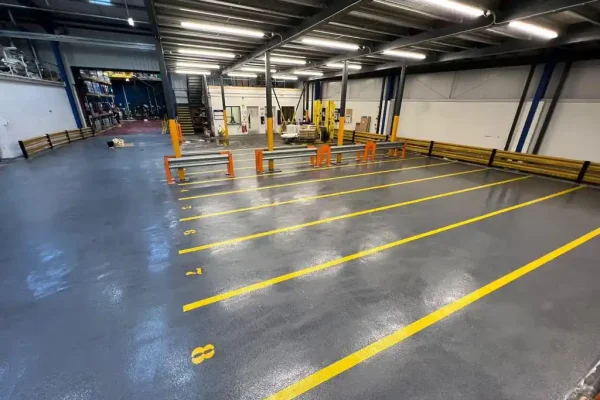
Demarcated forklift lanes, walkways and crossings as the control in high-cycle sheds.
BS 7976 pendulum values at dock aprons rather than applied uniformly throughout.
EN 13501-1 with the fl suffix across escape routes and large warehouse space.
FeRFA classifies resin flooring into eight types by build-up and thickness, and BS 8204-6 governs which one a floor actually needs, with EN 13813 covering screed materials. Polyaspartic and MMA sit outside that classification because they describe the resin chemistry rather than the build-up. In Rochdale the aisle and dock duty sets the type.
FeRFA Type 1. Two or more coats up to 150 microns, binding a dusting substrate and giving a cleanable surface. From £8 per square metre.
FeRFA Type 2. Dual component to 300 microns, solvent free, in gloss, matt or silk. Chemical resistance with a decorative finish.
FeRFA Type 3. Up to 1000 microns over prepared concrete and the system specified on most industrial jobs. Takes colour well for demarcation.
FeRFA Type 4. Multi-coat build at 1 to 3mm with aggregate broadcast between coats, for impact and constant wear.
FeRFA Type 5. Flow-applied at 2 to 3mm for a seamless finish where hygiene and cleaning matter more than impact resistance.
FeRFA Type 7. Three part filled system at 4 to 6mm thickness, giving a self-smoothing finish for heavy and very heavy duty areas.
FeRFA Types 7 and 8. Trowel-applied at 6 to 9mm to take thermal shock, steam cleaning and constant heavy forklift traffic.
Cures at temperatures down to −5°C and is ready in around two hours. Installed overnight or at a weekend it can remove the need to shutdown entirely.
Cures in hours, but the odour can taint food, fabrics and stock and the area must be cleared and ventilated. Better suited to new build and refurbishment projects.
Rates run from £8 per square metre for a floor seal to £45 for MMA, inclusive of preparation, labour and materials. Main aisles and dock zones sit at the upper end and are priced separately from the low-traffic areas around them.
| System | FeRFA | Thickness | Per m² |
|---|---|---|---|
| Floor Seal | Type 1 | Up to 150µm | From £8 |
| Epoxy and PU Coating | Type 2 | 150 – 300µm | £8 – £12 |
| High Build Coating | Type 3 | 300 – 1000µm | £8 – £12 |
| Multi-Layer Flooring | Type 4 | 1 – 3mm | £12 – £16 |
| Self-Smoothing | Type 5 | 2 – 4mm | £20 – £30 |
| Heavy Duty Flowable | Type 7 | 4 – 6mm | £25 – £35 |
| Heavy Duty PU Screed | Type 8 | 6 – 9mm | £30 – £40 |
| Polyaspartic | Chemistry | 300 – 500µm | £38 |
| MMA | Chemistry | 2 – 6mm | £45 |
Inclusive of preparation, labour and materials. Rates assume a sound, accessible substrate and are indicative until the floor has been surveyed. Polyaspartic and MMA sit outside the FeRFA type classification because they describe the resin chemistry rather than the build-up.
A three day shutdown at a plant turning over £2,000 an hour is £120,000 of lost output. On most sites that is several times the price of the floor.
Five contractors quoted one timber processing plant. All five proposed the same system and a three to four day closure. None of them costed the closure.
We proposed a faster-curing system installed across a weekend. A higher rate per square metre, and no shutdown at all. On the client’s own figures the avoided losses exceeded the price of the floor.
We install evenings, weekends and one bay at a time.
Whether a shutdown costs you thousands an hour or simply gets in the way, you do not always have to close your site for a resin flooring installation.
Arris rebuilding and flexible sealing along aisle runs and at dock leveller edges.
Setting out falls so washdown and vehicle-wash areas drain rather than stand in water.
Forklift lanes, walkways and crossings set out as a scheme and applied in resin, not paint.
High-cycle systems and joint repairs installed aisle by aisle around live operations.
Impact resistant build-ups at leveller edges, phased door by door around trailers.
Worn canal-side and town-fringe concrete assessed, repaired and sealed for current use.
We work across the borough regularly, from Kingsway Business Park and Sandbrook Park through to Smallbridge, the Queensway corridor, the canal-side units and the trade premises along Bury Road. We are Cheshire based, so a survey usually happens within days and there is no mobilisation charge for attending.

Because of aisle length. The same wheels cross the same joints thousands of times a week, and that cumulative loading takes out the arris long before the surface between joints looks worn. Repairing arrises along the main runs is far cheaper than replacing a lane.
In narrow-aisle operations it matters operationally, not just cosmetically. Flatness and joint condition affect how a truck tracks and how stable a mast is at height, so it is a performance question rather than a finish question, and it is worth specifying explicitly.
Almost always the falls. On a large floor plate an incorrect fall shows up immediately and is disruptive to work around, which is why setting-out and drainage are design decisions taken before installation rather than corrections attempted afterwards.
Cleaning regime compatibility and a planned recoat interval, discussed at specification rather than left until something fails. Treating floor maintenance as a scheduled operational task protects the asset and costs considerably less than replacing worn runs.
From £8 per square metre for a floor seal up to £45 for MMA, inclusive of preparation, labour and materials. Main aisles and dock zones sit at the upper end and are priced separately. The full table by system is on the cost page.
Heywood · Middleton · Oldham · Bury · Manchester · Ashton-under-Lyne · Bolton
Tell us the aisle layout, where the joints are going and which runs can be released. We attend, test the substrate, and put a written specification and a fixed price in front of you at no cost.