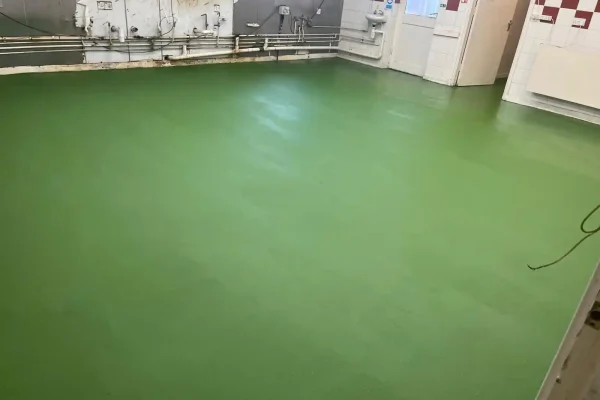
Resin flooring contractors Runcorn process and logistics operators rely on for chemically resistant floors and heavy-traffic durability. Supporting industrial, process and distribution facilities across Astmoor, Whitehouse, Manor Park, Preston Brook and the Weston Point corridor.
Working for national manufacturers, logistics operators and public sector estates since 1999.
As resin flooring contractors Runcorn operators call on regularly, we specify against two separate briefs in the same town. Runcorn sits on the Mersey and the Manchester Ship Canal with the M56 along its southern edge, connected onward by the Mersey Gateway and Silver Jubilee crossings.
What separates it from Ellesmere Port is the balance. Ellesmere Port is dominated by refining and bulk hydrocarbons. Runcorn carries broader chemical manufacturing across more separate sites, sitting alongside a genuinely large distribution sector on some of the biggest estates in the region.
So a floor here is either being specified for chemical exposure and containment, or for relentless wheeled traffic across a large plate. The mistake is letting one argument stand in for the other, because the systems that answer them are not the same.
One of the largest estates in the North West, mixing chemical, logistics and manufacturing across many building ages.
An extensive industrial area supporting manufacturing, processing and storage across a wide range of unit sizes.
Mixed industrial and warehousing units with high vehicle movement and direct access onto the M56 corridor.
Industrial and logistics operations requiring durable, compliant flooring across substantial floor plates.
The canal and dockside process and bulk handling area on the Mersey and the Manchester Ship Canal.
Distribution and storage premises sitting at the canal and motorway interface south of the town.
Chemically resistant systems with containment detailing and correct falls to drainage.
Spill-tolerant, impermeable surfaces detailed to maintain containment at every upstand.
Impact resistance with tolerance of the oils, coolants and solvents in daily use.
Abrasion resistance and durable joints at Whitehouse, Manor Park and across Astmoor.
Seamless, reagent-resistant finishes for quality control and research-adjacent areas.
Impact and slip resistance at the yard interface where grit and water are tracked in.
A system chosen for solvent resistance will not necessarily survive a fleet of reach trucks, and a floor built for abrasion may fail on first contact with a process spill. Runcorn sites frequently contain both, sometimes in adjoining bays.
Acids, alkalis, solvents and process chemicals drive the choice, stated against your actual exposure profile rather than in general terms.
Where HGVs, forklifts and racking loads govern, the decision is abrasion class and joint detailing rather than chemical resistance.
Buildings are specified zone by zone. Averaging the two requirements produces a floor that satisfies neither of them properly.
On a Runcorn process site the constraint is rarely the floor. It is the permit, the isolation and the handback, and those are agreed before mobilisation rather than negotiated on arrival.
Applicator competence is scrutinised as part of that process. ISOPA and ALIPA diisocyanate training records are directly relevant where polyurethane systems are specified, and every operative handling them holds current REACH certification.
On the distribution side the constraint is different but no less real. Work is sequenced aisle by aisle, into shift changeovers or weekend windows, with rapid-cure systems where a bay has to be back under racking quickly.
Secondary containment at 110% of capacity makes the floor part of the site environmental control system.
ISOPA and ALIPA diisocyanate training, directly relevant where competence forms part of permit-to-work.
BS 7976 pendulum values for production zones, transfer areas and goods-in bays where spill risk is real.
Under HSE L24, separating people, vehicles and hazardous zones across complex multi-building sites.
FeRFA classifies resin flooring into eight types by build-up and thickness, and BS 8204-6 governs which one a floor actually needs. Polyaspartic and MMA sit outside that classification because they describe the resin chemistry rather than the build-up. On a Runcorn site the same building often needs two different answers, which is why we specify by zone.
FeRFA Type 1. Two or more coats up to 150 microns, binding a dusting substrate and giving a cleanable surface. From £8 per square metre.
FeRFA Type 2. Dual component to 300 microns, solvent free, in gloss, matt or silk. Chemical resistance with a decorative finish.
FeRFA Type 3. Up to 1000 microns over prepared concrete and the system specified on most industrial jobs. Takes colour well for demarcation.
FeRFA Type 4. Multi-coat build at 1 to 3mm with aggregate broadcast between coats, for impact and constant wear.
FeRFA Type 5. Flow-applied at 2 to 3mm for a seamless finish where hygiene and cleaning matter more than impact resistance.
FeRFA Type 7. Three part filled system at 4 to 6mm thickness, giving a self-smoothing finish for heavy and very heavy duty areas.
FeRFA Types 7 and 8. Trowel-applied at 6 to 9mm to take thermal shock, steam cleaning and constant heavy forklift traffic.
Cures at temperatures down to −5°C and is ready in around two hours. Installed overnight or at a weekend it can remove the need to shutdown entirely.
Cures in hours, but the odour can taint food, fabrics and stock and the area must be cleared and ventilated. Better suited to new build and refurbishment projects.
Rates run from £8 per square metre for a floor seal to £45 for MMA, inclusive of preparation, labour and materials. Process and containment areas sit at the upper end, distribution floors usually lower, which is why zoning saves money.
| System | FeRFA | Thickness | Per m² |
|---|---|---|---|
| Floor Seal | Type 1 | Up to 150µm | From £8 |
| Epoxy and PU Coating | Type 2 | 150 – 300µm | £8 – £12 |
| High Build Coating | Type 3 | 300 – 1000µm | £8 – £12 |
| Multi-Layer Flooring | Type 4 | 1 – 3mm | £12 – £16 |
| Self-Smoothing | Type 5 | 2 – 4mm | £20 – £30 |
| Heavy Duty Flowable | Type 7 | 4 – 6mm | £25 – £35 |
| Heavy Duty PU Screed | Type 8 | 6 – 9mm | £30 – £40 |
| Polyaspartic | Chemistry | 300 – 500µm | £38 |
| MMA | Chemistry | 2 – 6mm | £45 |
Inclusive of preparation, labour and materials. Rates assume a sound, accessible substrate and are indicative until the floor has been surveyed. Polyaspartic and MMA sit outside the FeRFA type classification because they describe the resin chemistry rather than the build-up.
A three day shutdown at a plant turning over £2,000 an hour is £120,000 of lost output. On most sites that is several times the price of the floor.
Five contractors quoted one timber processing plant. All five proposed the same system and a three to four day closure. None of them costed the closure.
We proposed a faster-curing system installed across a weekend. A higher rate per square metre, and no shutdown at all. On the client’s own figures the avoided losses exceeded the price of the floor.
We install evenings, weekends and one bay at a time.
Whether a shutdown costs you thousands an hour or simply gets in the way, you do not always have to close your site for a resin flooring installation.
Crack stitching, arris rebuilding and flexible joint sealing across the older Astmoor units.
Traffic routes, walkways and hazard zoning applied in resin rather than in tape or paint.
Damp proof membrane where a substrate fails moisture testing, supplied as a standalone package.
Chemically resistant build-ups detailed to bunds and transfer bays, phased around permit-to-work.
Abrasion resistant floors and joint repairs, sequenced aisle by aisle without closing the building.
Impact tolerant systems specified against the oils, coolants and solvents actually in use.
We work across the town regularly, from Astmoor and Whitehouse through to Manor Park, Preston Brook and the Weston Point corridor. We are Cheshire based rather than Runcorn based, so a survey usually happens within days and there is no mobilisation charge for attending.
Two, almost always. A system chosen for solvent resistance will not necessarily survive a fleet of reach trucks, and an abrasion-led floor may fail on first contact with a process spill. We specify zone by zone, because averaging the two requirements produces a floor that satisfies neither.

Yes, and it is a large part of what we do here. Permit-to-work integration, isolation and handback are agreed before mobilisation, and work is sequenced into shutdown windows or taken area by area rather than requiring the site to stop.
Yes. Every operative handling polyurethane systems holds current REACH certification, and ISOPA and ALIPA training records are available at survey. On Runcorn sites that competence is frequently scrutinised as part of permit-to-work, so we expect to evidence it.
The floor becomes part of the site environmental control system, so upstands, joints and penetrations are detailed to hold what the bund is there to hold. Oil storage and permitting rules require secondary containment at 110 per cent of capacity, and the detailing is what delivers it.
From £8 per square metre for a floor seal up to £45 for MMA, inclusive of preparation, labour and materials. Process and containment areas sit at the upper end and distribution floors usually lower. The full table by system is on the cost page.
Widnes · Warrington · Ellesmere Port · Northwich · Chester · Frodsham · Helsby
Tell us which areas are process and which are traffic, what they are exposed to and when they can be released. We attend, test the substrate, and put a written specification and a fixed price in front of you at no cost.