Industrial resin flooring contractors working across the North West, Yorkshire, the Midlands and North East Wales. Heavy-duty floors specified against the traffic, temperature and chemicals your site actually runs, and programmed around production rather than through it.
A commercial floor has to look right. An industrial floor has to survive counterbalance forklifts, pallet drops, steam cleaning, thermal cycling and whatever is being decanted onto it, then keep doing so for fifteen to twenty years.
That changes the specification entirely. Thickness follows point loading rather than appearance. Chemical resistance is selected against your COSHH register, not claimed in general. Slip resistance is specified against the contamination actually present, wet or dry.
Where most quotes go wrong is not the product. It is specifying one duty band too light for the traffic, then preparing the substrate too little to hold it.
FeRFA classifies resin flooring into eight types by build-up and thickness. Which one suits your site depends as much on the installation window as on the traffic, because cure time decides whether production has to stop.

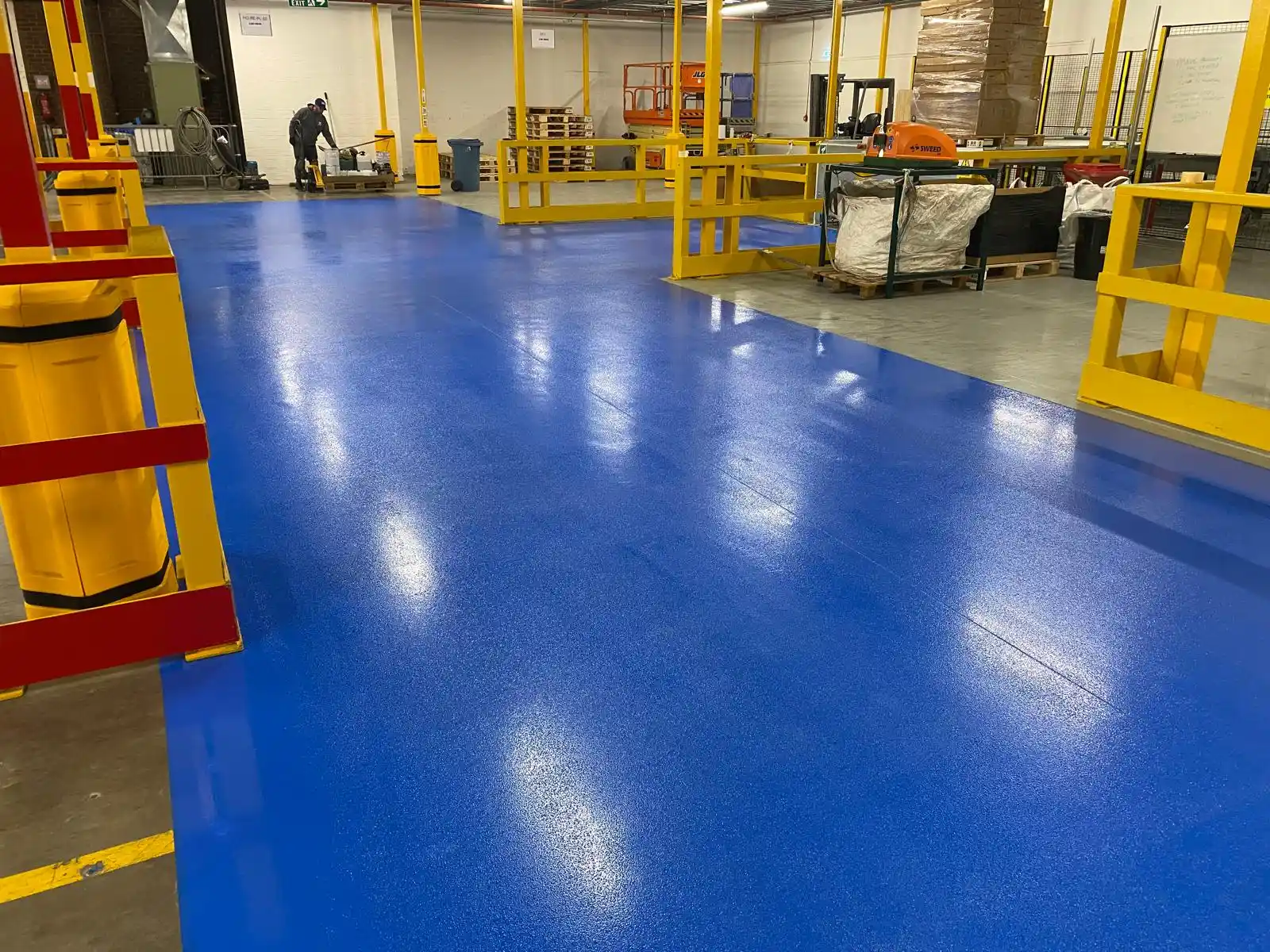
FeRFA Type 1. Two or more coats up to 150 microns, binding a dusting slab and giving a cleanable surface. From £8 per square metre.
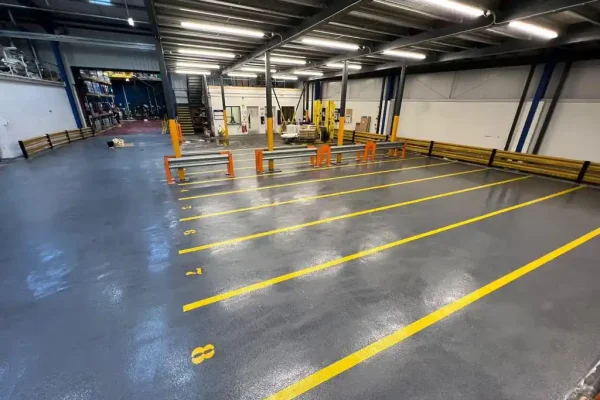
FeRFA Type 2. Dual component to 300 microns, solvent free, in gloss, matt or silk. Chemical resistance with a decorative finish.
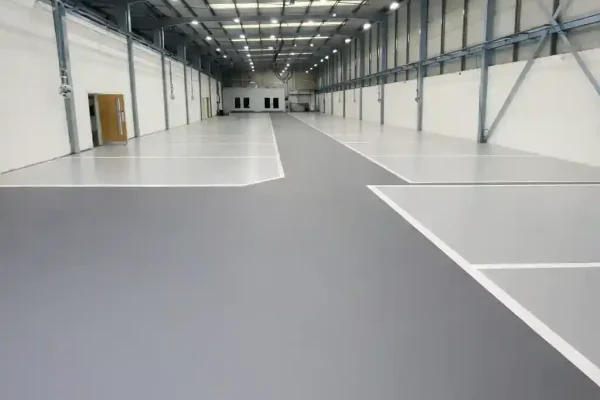
FeRFA Type 3, and the system specified on most industrial jobs. Thin layers cure quickly, cost less than a screed, and take colour well for demarcation.
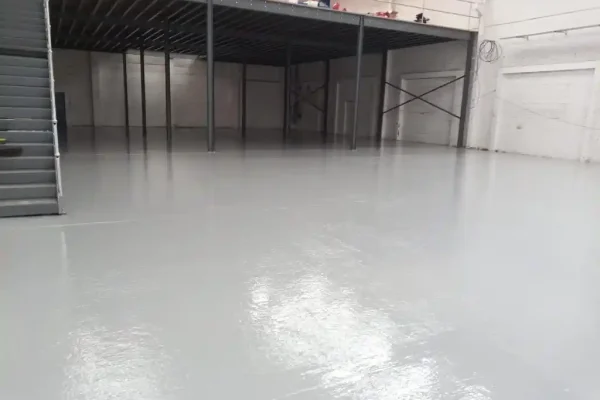
FeRFA Type 4. Multi-coat build at 1 to 3mm with aggregate broadcast between coats, for impact and constant wear.
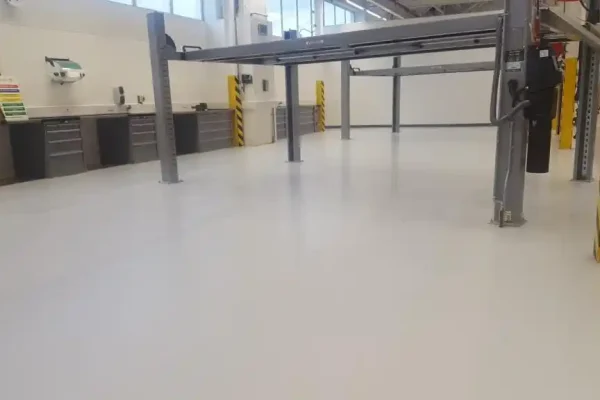
FeRFA Type 5. Flow-applied at 2 to 4mm for a seamless, easily cleaned surface, specified where hygiene matters more than heavy impact resistance.
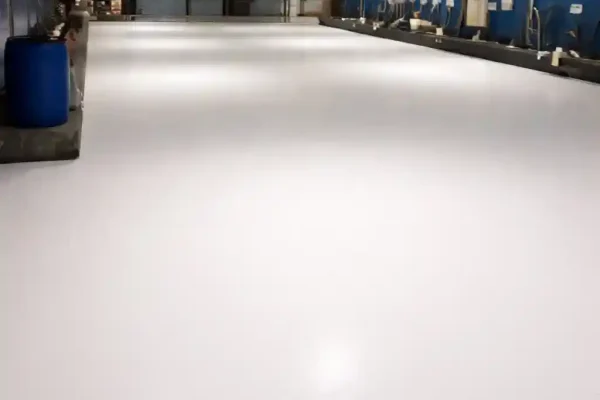
FeRFA Type 7. Three part filled system at 4 to 6mm thickness giving a self-smoothing finish for heavy and very heavy duty areas.

FeRFA Types 7 and 8. Trowel-applied at 6 to 9mm to take thermal shock, steam cleaning and the constant counterbalance traffic of a working plant.

Cures down to minus five degrees and is ready in around two hours. Installed overnight or at a weekend it removes the shutdown from the programme.

Cures in hours, but the odour taints stock and the area has to be cleared and ventilated, which limits it to new build and refurbishment work.
On an industrial site the shutdown is often the larger cost. A three day closure at a plant turning over £2,000 an hour is £120,000 of lost output, which on most jobs is several times the price of the floor.
Evenings, weekends, shutdown windows and one bay at a time. Where the programme allows, a faster-curing system can remove the shutdown entirely, even though it costs more per square metre.
Five contractors quoted one timber processing plant. All five proposed the same system and a three to four day closure. None of them costed the closure.
The cost page carries a calculator that puts material cost and lost production side by side, so you can compare the quotes you already hold on total cost rather than rate alone.
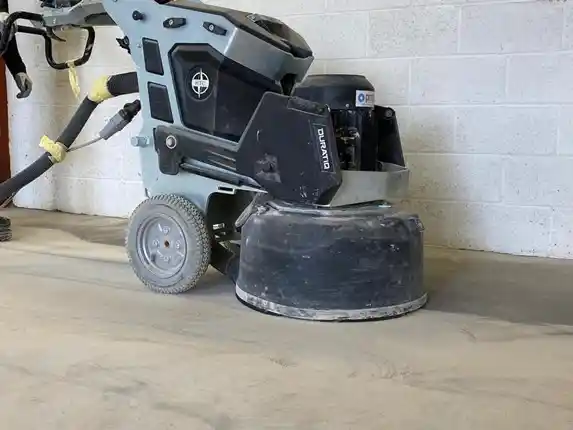
Industrial substrates are rarely clean. Twenty years of oil, sugar, coolant or laitance sit on the surface, and older bays often carry a failed coating that was applied over the top of the last one.
Preparation on an industrial floor means diamond grinding or shot blasting back to sound concrete, moisture testing to confirm it is dry enough to coat, crack and joint repair, and moisture suppression where the readings demand it.
FeRFA guidance is explicit on this point: a resin floor follows the profile of the substrate beneath it. Preparation is not the part of the quote to compare on price.
Every operative handling polyurethane products holds current REACH diisocyanate training, documented on completion and renewed on the five-year cycle.
Method statements, COSHH assessments and risk documentation issued before mobilisation rather than chased up once the work has started.
Specified to hold up under BRCGS and pharmaceutical inspection, with sealed junctions and coving detailed where the audit requires them.
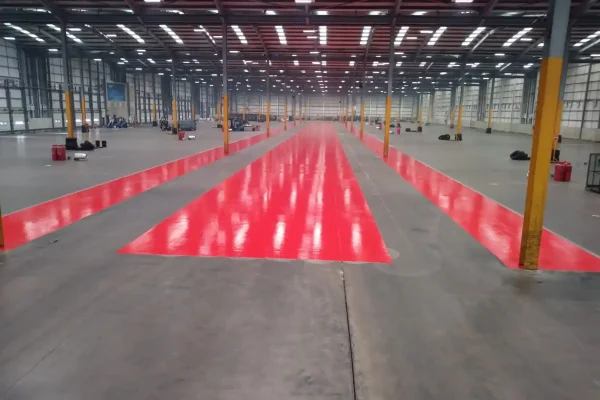
Heavy-duty screeds and demarcation across logistics facilities, sequenced into planned shutdown and holiday windows.
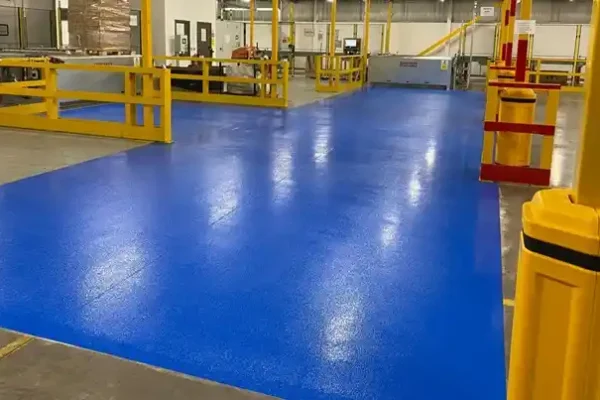
Chemically resistant floors phased bay by bay around live production so that lines keep running throughout.
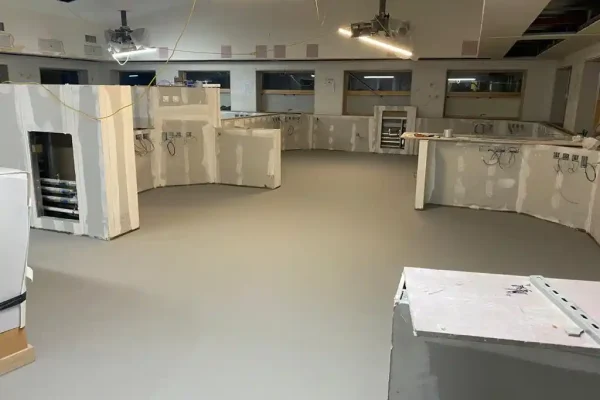
Hygienic and cleanroom-grade finishes for food, pharmaceutical and healthcare sites working to external audit.
Some sites need one element rather than a full installation. These are quoted and programmed as standalone works.
Surface-applied damp proof membranes over concrete that is still releasing moisture, installed as a preparation package for main contractors rather than as part of a complete flooring solution.
Vehicle and pedestrian segregation, bay marking, walkways, hatching and 5S layouts, applied in resin rather than tape so they survive forklift traffic and washdown. Set out with your HSE and workflow requirements.
Crack stitching, expansion and saw-cut joint repair, spalled bay edges and localised patch repairs to failed resin. Carried out bay by bay so the rest of the floor keeps working while we do it.
On most industrial sites, yes. Work is phased bay by bay, or programmed into evenings, weekends and shutdown windows. Where the schedule is tight, a faster-curing system can remove the closure altogether. The constraint is cure time rather than application time, which is why the programme is agreed at survey rather than assumed.
Fifteen to twenty years and beyond with maintenance. The determining factors are substrate condition, preparation quality and whether the system was matched to the traffic. A floor specified one duty band too light will not reach those figures whatever the product.
That is what the FeRFA type is for. Types 7 and 8 polyurethane screeds at 6 to 9mm are specified for constant counterbalance traffic and point loading. Thinner coatings will not hold under that duty, which is the most common reason an industrial floor fails early.
It depends on the specific chemicals, their concentration, temperature and contact time. Chemical resistance is a property of the individual system rather than of resin flooring generally, so we ask for your COSHH register at survey and specify against it.
Yes. Method statements, COSHH assessments, risk documentation and diisocyanate training records are issued before mobilisation, along with a written specification naming the system, FeRFA type, thickness and preparation method.
From £8 per square metre for a floor seal up to £40 for a heavy duty polyurethane screed, inclusive of preparation, labour and materials. The full table by FeRFA type is on the cost page, along with a calculator that adds the cost of production downtime.
Tell us the area, what runs across it, and what an hour of stopped production is worth. We survey the substrate, specify against the conditions, and quote the installation programme alongside the floor.