
Hygienic resin flooring for food production, dairies, bakeries, breweries and commercial kitchens across the North West, Yorkshire, the Midlands and North East Wales. Seamless polyurethane screeds with coved skirtings and falls to drain, laid to survive hot washdown rather than merely to look clean.
Standard epoxy is rigid. Take a floor sitting at ambient and hit it with steam or boiling liquid and the resin expands at a different rate to the concrete beneath it. It cannot flex to absorb that, so it cracks and lets go.
That is why so many food floors fail within a couple of years despite being specified by someone who meant well. The chemistry was never wrong for a dry factory. It was wrong for a room that gets hosed down hot every night.
Polyurethane screeds at 6 to 9mm are formulated with the flexibility to take repeated thermal cycling, tolerating roughly −40°C to +120°C. That is the specification for hot washdown, CIP regimes and anywhere boiling product hits the floor.
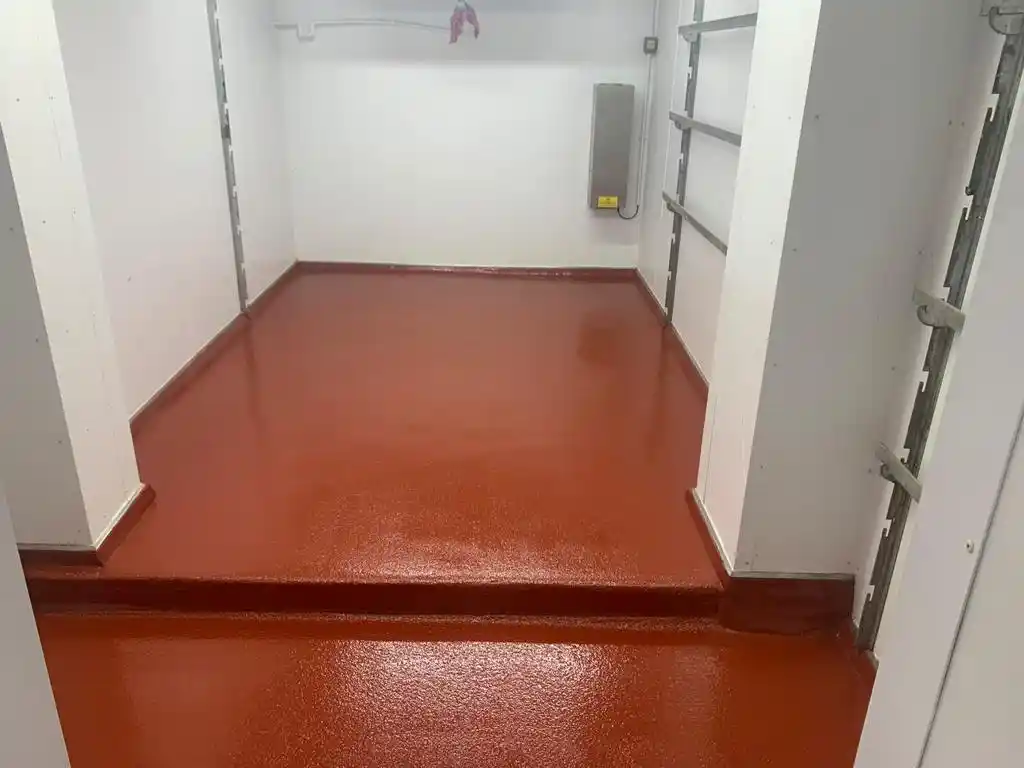
The middle of the floor is rarely the problem. Inspectors look at the junctions, the drains and the thresholds, because that is where residue collects and where a poorly detailed installation gives itself away.
A curved resin transition between floor and wall, so there is no square junction for residue to pack into and no gap for a hose to drive it further under.
Laid over a screed formed to falls, typically between 1:80 and 1:100, so water leaves the floor instead of standing on it. Stainless channels and gullies detailed in.
Doorways between chilled and ambient areas take the worst thermal cycling on site. Joint detailing there decides whether the floor lasts or lifts at the edge.
Washdown, animal fats, organic acids and cleaning chemicals. Usually the most demanding chemical picture on sites we survey.
Lactic acid attacks standard concrete, and hot caustic washes finish what the acid starts. A PU screed is effectively the only sensible answer.
Hot wort up to 100°C, CIP chemicals, sugary spillage and constant wet traffic. Falls to drain matter here as much as the resin does.
Flour dust underfoot is a slip hazard in its own right, and oven areas cycle between hot and ambient all shift.
Hot oil, grease mist and water in a confined space with staff carrying things. Coving and drainage detailing matter more than the finish.
Zero particle shedding, sealed junctions and a surface that survives a validated cleaning regime without degrading between audits.
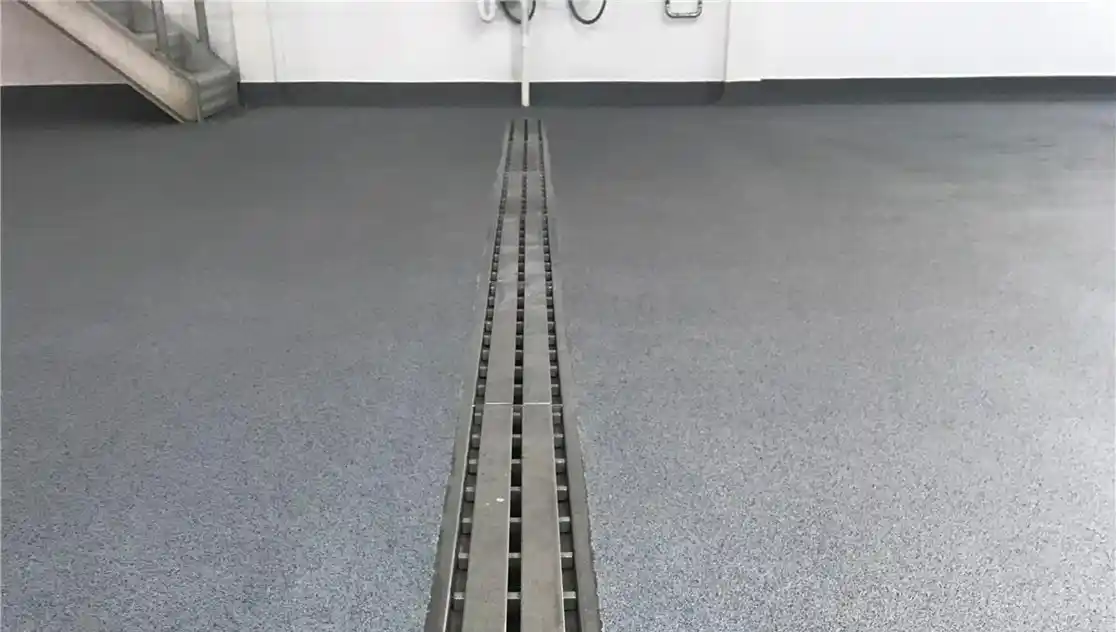
Production areas are wet by design, so a textured anti-slip finish is normal here, typically R11 and often R12 where the floor is permanently wet or falls to a drain.
The tension is that texture holds soil, and a food floor has to be cleanable to a standard an auditor will accept. Specify the most aggressive surface everywhere and you build a floor that passes a pendulum test and fails a hygiene one.
The workable answer is usually to grade it: full texture in washdown and drain zones, a lighter finish in packing and dry storage, agreed against your actual cleaning regime rather than assumed from a datasheet.
Standard epoxy is rigid. When steam or boiling liquid hits a floor sitting at ambient temperature, the resin and the concrete expand at different rates and the coating cannot flex to absorb it, so it cracks and delaminates. Polyurethane screeds are formulated with that flexibility built in.
A heavy-duty polyurethane screed at 6 to 9mm typically tolerates roughly −40°C to +120°C and handles repeated steam cleaning. As a general rule resin flooring should not be in direct contact with anything above 100°C on a sustained basis.
In almost every food or pharmaceutical environment, yes. A square floor-to-wall junction is a residue trap and it is one of the first things an inspector looks at. Coving creates a curved resin transition with nothing to pack into and nothing for a hose to drive residue under.
Yes. Falls are formed in the screed beneath the resin, typically between 1:80 and 1:100, with stainless steel channels and gullies detailed in. Retrofitting falls into an existing flat floor is a bigger job than most people expect, so it is worth raising at survey.
Once cured, the systems we install are inert and suitable for food production environments, seamless and non-porous so there is nowhere for bacteria to harbour. What matters as much is the detailing, because a food-safe product installed with open junctions still fails an audit.
Usually. Food sites tend to work in defined washdown or shutdown windows, and we programme into those, taking one room or line at a time. Fast-curing systems can return an area to service the same day where the schedule is tight.
Tell us what is spilled on the floor, how it is cleaned and at what temperature, and when the area can be released. We survey, specify against those conditions and quote the detailing as well as the floor.