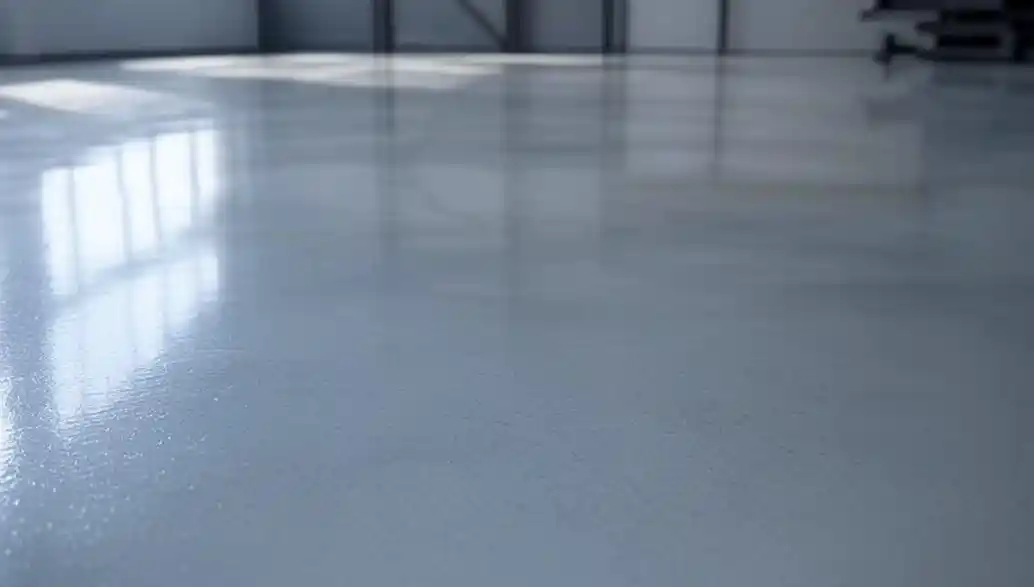
Resin flooring contractors Chester businesses use for slip-resistant entrances, hygienic kitchens and hard-wearing distribution floors. Supporting commercial, hospitality and industrial facilities across Sealand, Bumpers Lane, Chester Business Park and the wider Chester area, including back-of-house zones serving the city centre and Cheshire Oaks.
Working for national manufacturers, logistics operators and public sector estates since 1999.











As resin flooring contractors Chester operators call on regularly, we see something most Cheshire towns do not have. Most are single-sector. Chester is not, and that changes what a floor has to do. The city pairs a high-footfall retail and hospitality core with an industrial and distribution belt to the north and west, feeding North East Wales along the A55 and M53.
In the centre, what fails is kitchens, cellars, goods-in doorways, plant rooms and staff corridors. Wet feet meet hard heritage finishes at entrances, which is the commonest slip risk in the city. Out on Sealand and Chester Gates the story is different: worn concrete under forklift traffic, dusting slabs and joints breaking down on estates whose floors were laid decades ago.
The two briefs meet in one constraint. Public-facing work is governed by the trading window, so how quickly a floor returns to service usually matters as much as what it is made of.
A large manufacturing, storage and distribution area with many established slabs. Abrasion, dusting and saw-cut joints breaking down under forklift traffic are the usual reasons we are called.
Warehousing, trade counters and industrial support units with frequent deliveries and mixed vehicle movement. Goods-in aprons and dock approaches take the heaviest wear.
Newer mixed industrial and logistics stock positioned for the M53 and A55. Younger slabs, so specification is usually about protecting a sound floor rather than rescuing a failed one.
Office-industrial hybrids, technical facilities, controlled environments and plant rooms. Seamless finishes and static control matter more here than load capacity.
Trade counters, wholesalers and vehicle related units where the floor is both a working surface and the first thing a customer sees. Durability and appearance carry equal weight.
Kitchens, cellars, goods-in points and service routes in the historic core and the out-of-town retail belt, where access is restricted and trading hours govern the programme.
Slip-resistant, coved and thermally tolerant polyurethane, laid to falls. Hot oil, water and staff carrying things in a confined space.
Sugar, alcohol and detergent residues that turn a floor dangerous when wet. Grip and cleanability have to be balanced deliberately.
Cleanable finishes that take roll-cage traffic without scuffing into lanes, on routes staff use dozens of times a shift.
Abrasion resistance and durable joint detailing on Sealand and Chester Gates, where forklift turning circles decide the spec.
Seamless, easily decontaminated finishes for controlled areas and plant rooms on Chester Business Park.
Where weather ingress meets hard heritage finishes. The single commonest slip risk in the city, and the easiest to design out.
An estuary climate, heavy visitor footfall and frequent cleaning put water on floors that were never designed for it. Measured pendulum values in wet and contaminated conditions are the only argument that stands up when an incident is investigated.
Pendulum testing on your actual floor, wet, after installation. PTV 36 or above is classed as low slip potential and is what our standard anti-slip system achieves.
Aggregate where the risk is. Entrances, kitchens and wet routes get texture; open retail and circulation stays smoother and easier to clean.
Deliberate colour contrast at level changes and doorways, which matters under the Equality Act in a city with high visitor traffic and a large listed building stock.
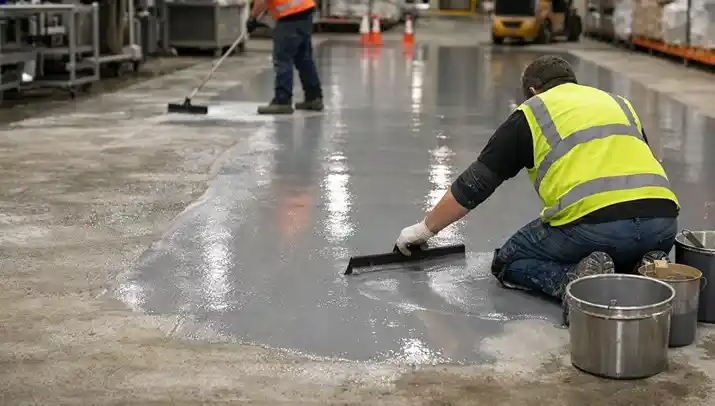
City centre work in Chester comes with constraints most industrial jobs do not have. Deliveries into the historic core are timed, service yards are shared, plant has to be walked in through occupied buildings, and the floor has to be back in use before doors open.
That makes the working window a specification driver rather than a scheduling detail. Polyaspartic is ready for traffic in around two hours, so a kitchen closed after service can be back on Monday morning. Where a system needs longer, the work is phased zone by zone so the rest of the premises keeps trading.
Out on Sealand and Chester Gates the constraint changes to shift patterns and shutdown windows, and the same principle applies: the programme is agreed at survey, not assumed on the quote.
Seamless surfaces, coved skirting at wall junctions and correct falls to drainage. What separates a food-safe floor from a floor that merely looks clean.
Pendulum values recorded wet on the finished floor, so the figure is evidenced for your insurer rather than quoted from a datasheet.
On escape corridors and back-of-house routes in public buildings the fl-classification should be specified rather than assumed.
REACH training records, method statements and COSHH assessments issued before mobilisation, not chased afterwards.
FeRFA classifies resin flooring into eight types by build-up and thickness. Polyaspartic and MMA sit outside that classification because they describe the resin chemistry rather than the build-up, and both matter in Chester because of how quickly they return a floor to service.

FeRFA Type 1. Two or more coats up to 150 microns, binding a dusting slab and giving a cleanable surface. From £8 per square metre.
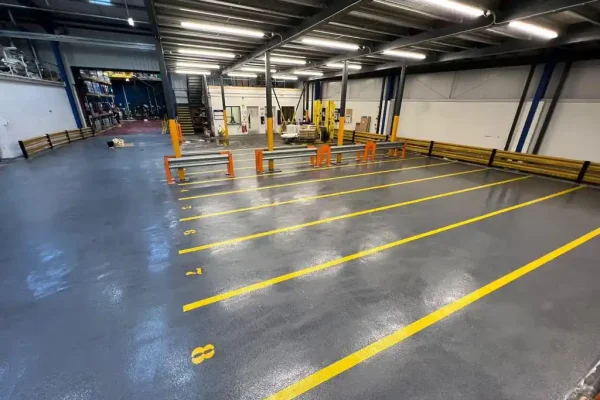
FeRFA Type 2. Dual component to 300 microns, solvent free, in gloss, matt or silk. Chemical resistance with a decorative finish.
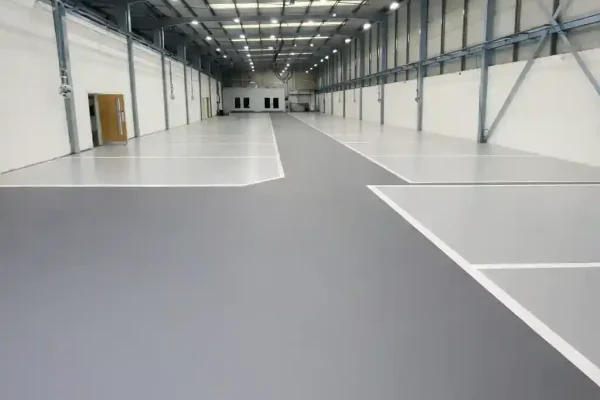
FeRFA Type 3. Up to 1000 microns over prepared concrete and the system specified on most industrial jobs. Takes colour well for demarcation.
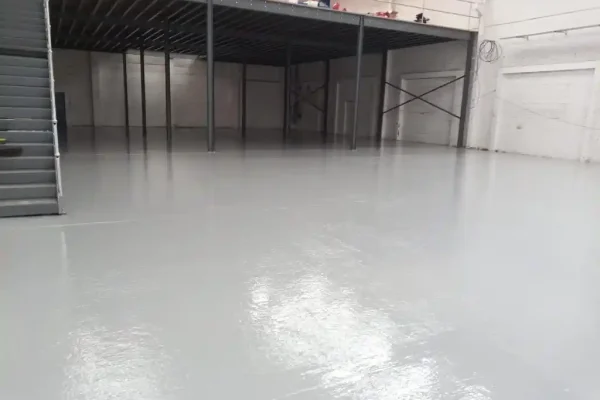
FeRFA Type 4. Multi-coat build at 1 to 3mm with aggregate broadcast between coats, for impact and constant wear.
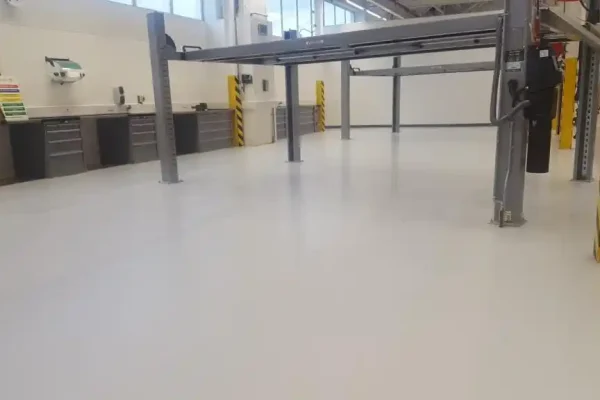
FeRFA Type 5. Flow-applied at 2 to 3mm for a seamless finish where hygiene and cleaning matter more than impact resistance.
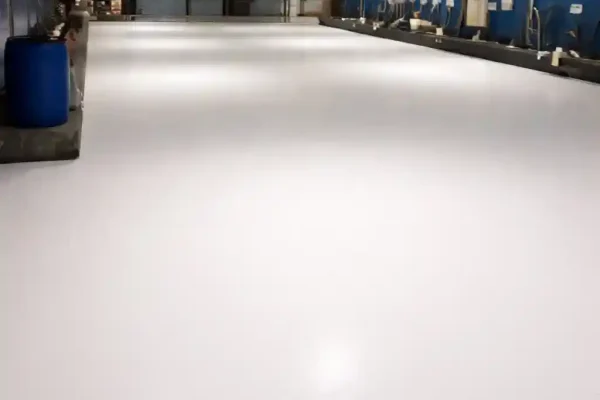
FeRFA Type 7. Three part filled system at 4 to 6mm thickness, giving a self-smoothing finish for heavy and very heavy duty areas.

FeRFA Types 7 and 8. Trowel-applied at 6 to 9mm to take thermal shock, steam cleaning and constant heavy forklift traffic.

Cures at temperatures down to −5°C and is ready in around two hours. Installed overnight or at a weekend it can remove the need to shutdown entirely.

Cures in hours, but the odour can taint food, fabrics and stock and the area must be cleared and ventilated. Better suited to new build and refurbishment projects.
Rates run from £8 per square metre for a floor seal to £45 for MMA, inclusive of preparation, labour and materials. On a trading site the second number matters more: closing during opening hours can cost more than the floor.
| System | FeRFA | Thickness | Per m² |
|---|---|---|---|
| Floor Seal | Type 1 | Up to 150µm | From £8 |
| Epoxy and PU Coating | Type 2 | 150 – 300µm | £8 – £12 |
| High Build Coating | Type 3 | 300 – 1000µm | £8 – £12 |
| Multi-Layer Flooring | Type 4 | 1 – 3mm | £12 – £16 |
| Self-Smoothing | Type 5 | 2 – 4mm | £20 – £30 |
| Heavy Duty Flowable | Type 7 | 4 – 6mm | £25 – £35 |
| Heavy Duty PU Screed | Type 8 | 6 – 9mm | £30 – £40 |
| Polyaspartic | Chemistry | 300 – 500µm | £38 |
| MMA | Chemistry | 2 – 6mm | £45 |
Inclusive of preparation, labour and materials. Rates assume a sound, accessible substrate and are indicative until the floor has been surveyed. Polyaspartic and MMA sit outside the FeRFA type classification because they describe the resin chemistry rather than the build-up.
A three day shutdown at a plant turning over £2,000 an hour is £120,000 of lost output. On most sites that is several times the price of the floor.
Five contractors quoted one timber processing plant. All five proposed the same system and a three to four day closure. None of them costed the closure.
We proposed a faster-curing system installed across a weekend. A higher rate per square metre, and no shutdown at all. On the client’s own figures the avoided losses exceeded the price of the floor.
We install evenings, weekends and one bay at a time.
Whether a shutdown costs you thousands an hour or simply gets in the way, you do not always have to close your site for a resin flooring installation.
Crack stitching, joint repair and spalled bay edges on the older Sealand and Bumpers Lane slabs, carried out bay by bay.
Traffic segregation, walkways and hazard hatching in resin rather than tape, so it survives forklift traffic and washdown.
Surface damp proof membrane for main contractors whose slab has failed a moisture test, supplied as a preparation package.
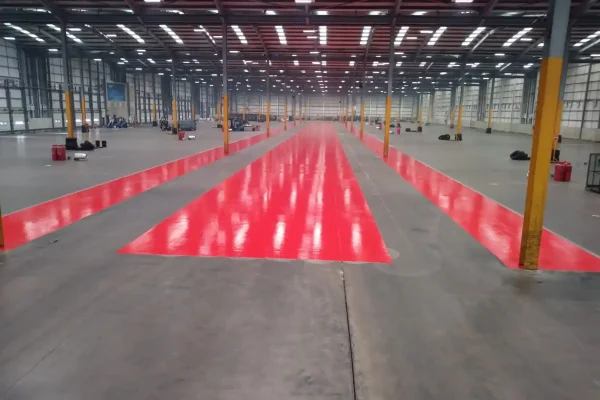
Heavy-duty screeds and demarcation across logistics facilities, sequenced into planned shutdown and holiday windows.
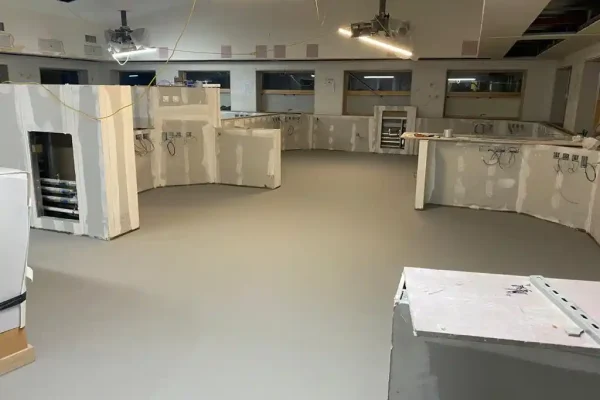
Hygienic finishes with coving and falls to drain for production kitchens and food storage working to audit standards.
Chemically resistant floors phased bay by bay around live production so that lines keep running throughout.
We work across the city regularly, from the Sealand and Chester Gates industrial belt through to back-of-house areas serving the city centre and the out-of-town retail area. We are Cheshire based rather than Chester based, which means a survey usually happens within days and there is no mobilisation charge for attending.
On most Chester jobs, yes. Work is phased zone by zone or programmed into evenings and overnight, and rapid-cure systems can return a floor to service in around two hours. The constraint is cure time rather than application time, which is why the programme is agreed at survey.
That is the commonest floor problem in the city, and it is fixable. Entrance and transition zones are finished with a graded anti-slip build-up so the wet route grips while the rest of the floor stays easy to clean. Pendulum testing after installation gives you a recorded figure rather than an assurance.
Usually a repair rather than a replacement. Damage on the older estates concentrates in traffic runs and at saw-cut joints. Cracks are stitched, joints repaired with flexible sealant rather than filled rigid, and the floor is ground back and resurfaced where the wear is general but the concrete is still sound.
Yes, and it is planned at survey rather than discovered on the day. Grinders and extraction are walked in where vehicle access is restricted, timed deliveries are arranged where the location requires them, and shared service yards are booked in advance with the building manager.
From £8 per square metre for a floor seal up to £45 for MMA, inclusive of preparation, labour and materials. Most commercial work in the city sits in the middle of that range. The full table by system is on the cost page, along with a calculator that adds the cost of lost trading.
Ellesmere Port · Runcorn · Widnes · Northwich · Winsford · Warrington · Wrexham · Crewe
Tell us where the floor is, what happens on it and when the area can be released. We attend, test the substrate, and put a written specification and a fixed price in front of you at no cost.