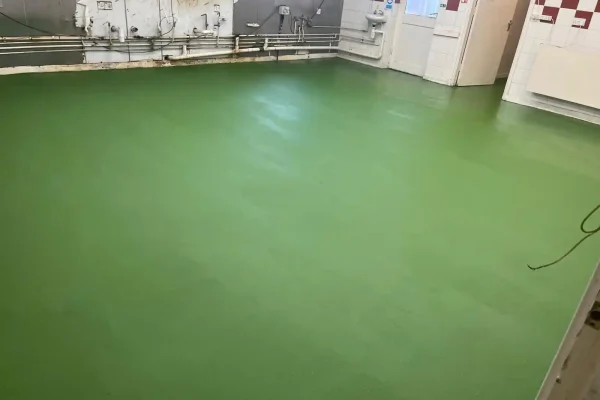
Resin flooring contractors Middlewich distribution, storage and food-related facilities rely on for dock edges that survive. Serving sites across Midpoint 18, Brooks Lane, Pochin Way and the wider Middlewich area alongside Junction 18 of the M6.
Working for national manufacturers, logistics operators and public sector estates since 1999.
As resin flooring contractors Middlewich operators call on regularly, we see a floor profile that sits between two bigger neighbours. This is a mid-box distribution and food storage town beside Junction 18 of the M6, without the site scale of Warrington and without the engineering base of Crewe.
Bays are shorter, vehicle turnaround is more frequent, and a far higher proportion of the total floor area is loading bay, dock apron, chill lobby and marshalling space rather than open racked warehouse.
So the failure is dock-edge and loading bay impact damage, compounded by standing water and by thermal cycling where chilled and ambient areas meet. The dock is the subject here, not a footnote at the end of a warehouse specification.
The principal modern distribution and industrial park, positioned for Junction 18 of the M6 and full of warehousing.
An established industrial and trade area with manufacturing, storage and servicing units, much of it older stock.
Industrial and distribution units carrying regular heavy vehicle movement throughout the whole working day.
Mixed industrial, storage and processing premises across the eastern and southern edges of the town.
Trade counters, servicing and storage premises linking the town toward Winsford, Northwich and Sandbach.
Older buildings at the Trent and Mersey and Middlewich branch junction, with notably variable substrates.
Impact-resistant screeds with reinforced arris and edge detailing where every wheel crosses.
Polyurethane screeds handling thermal differentials and condensation at chilled thresholds.
Hygienic, seamless, coved surfaces with correct falls to drainage throughout the wet areas.
Abrasion resistance and load tolerance around racking legs, drop zones and the pick faces.
Wet slip resistance and tolerance of grit ingress at every yard-to-building threshold.
Fuel and oil resistance on maintenance and trailer servicing floors that stay in use.
A dock apron takes the full impact of every wheel crossing the threshold, and the arris takes it first. Once that edge chips the damage widens, standing water gets into it, and the surrounding concrete follows.
Edges rebuilt in structural resin repair compound and detailed to take the impact rather than simply coated over it.
Where chilled meets ambient, polyurethane screeds absorb the cycling that cracks and debonds thinner epoxy build-ups.
Standing water at the dock is the accelerant. Falls and channel detailing take it away before it works into the joint.
A mid-box operation cannot release its whole dock. Vehicles are booked, chill chains have to hold, and the bays that need the work most are the ones in constant use.
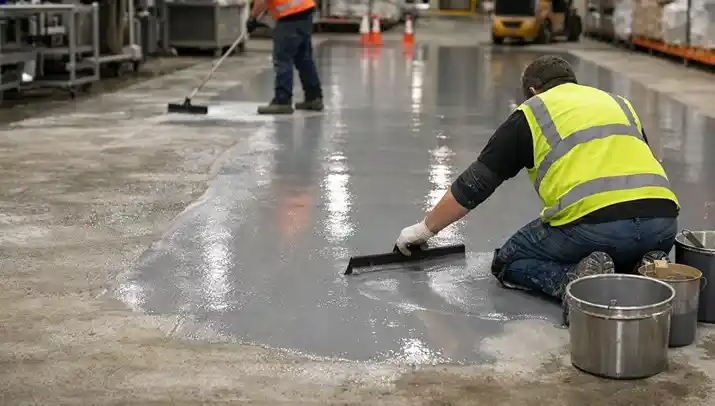
So dock work is taken bay by bay or door by door, sequenced around the booking schedule so the rest of the apron keeps working. Rapid-cure systems return an individual bay to service within hours rather than days.
Chilled areas are programmed differently again, into planned defrosts or quiet periods, with systems selected to cure at the temperatures the space actually runs at rather than requiring it to be warmed up first.
Coving at wall and plinth junctions, sealed penetrations and correct falls. Detailing fails audits, not resin.
Thickness, load class and installation tolerance stated for dock and cold-adjacent areas rather than left open.
BS 7976 pendulum values where grit, condensation and packaging debris combine on aprons and chill lobbies.
HSE L24 and the 1992 Workplace Regulations support demarcated pedestrian routes right across dock areas.
FeRFA classifies resin flooring into eight types by build-up and thickness, and EN 13813 governs screed class where one is specified. Polyaspartic and MMA sit outside that classification because they describe the resin chemistry rather than the build-up. At a Middlewich dock the screed types lead, because impact decides the specification.
FeRFA Type 1. Two or more coats up to 150 microns, binding a dusting substrate and giving a cleanable surface. From £8 per square metre.
FeRFA Type 2. Dual component to 300 microns, solvent free, in gloss, matt or silk. Chemical resistance with a decorative finish.
FeRFA Type 3. Up to 1000 microns over prepared concrete and the system specified on most industrial jobs. Takes colour well for demarcation.
FeRFA Type 4. Multi-coat build at 1 to 3mm with aggregate broadcast between coats, for impact and constant wear.
FeRFA Type 5. Flow-applied at 2 to 3mm for a seamless finish where hygiene and cleaning matter more than impact resistance.
FeRFA Type 7. Three part filled system at 4 to 6mm thickness, giving a self-smoothing finish for heavy and very heavy duty areas.
FeRFA Types 7 and 8. Trowel-applied at 6 to 9mm to take thermal shock, steam cleaning and constant heavy forklift traffic.
Cures at temperatures down to −5°C and is ready in around two hours. Installed overnight or at a weekend it can remove the need to shutdown entirely.
Cures in hours, but the odour can taint food, fabrics and stock and the area must be cleared and ventilated. Better suited to new build and refurbishment projects.
Rates run from £8 per square metre for a floor seal to £45 for MMA, inclusive of preparation, labour and materials. Dock and chill areas sit at the upper end because thickness and edge detailing are what make them last.
| System | FeRFA | Thickness | Per m² |
|---|---|---|---|
| Floor Seal | Type 1 | Up to 150µm | From £8 |
| Epoxy and PU Coating | Type 2 | 150 – 300µm | £8 – £12 |
| High Build Coating | Type 3 | 300 – 1000µm | £8 – £12 |
| Multi-Layer Flooring | Type 4 | 1 – 3mm | £12 – £16 |
| Self-Smoothing | Type 5 | 2 – 4mm | £20 – £30 |
| Heavy Duty Flowable | Type 7 | 4 – 6mm | £25 – £35 |
| Heavy Duty PU Screed | Type 8 | 6 – 9mm | £30 – £40 |
| Polyaspartic | Chemistry | 300 – 500µm | £38 |
| MMA | Chemistry | 2 – 6mm | £45 |
Inclusive of preparation, labour and materials. Rates assume a sound, accessible substrate and are indicative until the floor has been surveyed. Polyaspartic and MMA sit outside the FeRFA type classification because they describe the resin chemistry rather than the build-up.
A three day shutdown at a plant turning over £2,000 an hour is £120,000 of lost output. On most sites that is several times the price of the floor.
Five contractors quoted one timber processing plant. All five proposed the same system and a three to four day closure. None of them costed the closure.
We proposed a faster-curing system installed across a weekend. A higher rate per square metre, and no shutdown at all. On the client’s own figures the avoided losses exceeded the price of the floor.
We install evenings, weekends and one bay at a time.
Whether a shutdown costs you thousands an hour or simply gets in the way, you do not always have to close your site for a resin flooring installation.
Arris rebuilding, crack stitching and flexible joint sealing across aprons and dock approaches.
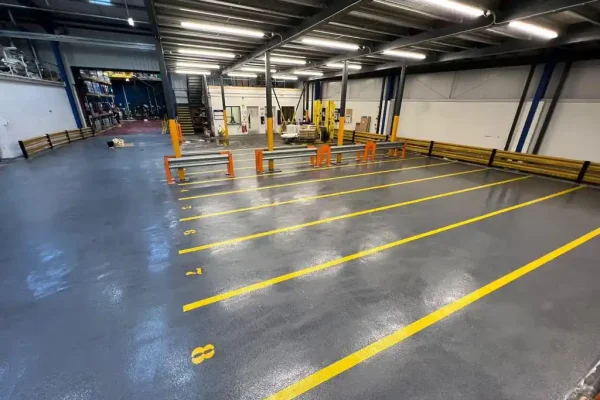
Pedestrian routes and vehicle segregation across goods-in, applied in resin rather than in tape.
Damp proof membrane where a substrate fails moisture testing, supplied as a standalone package.
Impact-resistant screeds with rebuilt arrises, installed door by door around the booking schedule.
Hygienic screeds with coving and falls to drain, programmed into defrost and quiet periods.
Abrasion resistant floors and joint repairs, sequenced aisle by aisle without closing the unit.
We work across the town regularly, from Midpoint 18 and Brooks Lane through to Pochin Way and the Cledford Lane corridor. We are Cheshire based rather than Middlewich based, so a survey usually happens within days and there is no mobilisation charge for attending.
Because the arris takes the full impact of every wheel crossing the threshold, and once it chips the damage widens. Standing water accelerates it. The repair is to rebuild the edge in structural resin repair compound and detail it to take impact, not simply to coat over what is left.

Usually. Systems are selected to cure at the temperature the space actually runs at rather than requiring it to be warmed up, and the work is programmed into planned defrosts or quiet periods where a full shutdown is unavoidable.
Thermal differential. Where chilled meets ambient the concrete and a rigid epoxy expand at different rates, and the coating cracks and debonds. Polyurethane screeds are formulated with the flexibility to absorb that cycling, which is why they are specified at those thresholds.
Yes, and that is normally how it is done. Dock work is taken bay by bay or door by door around the booking schedule, and rapid-cure systems return an individual bay to service within hours rather than days.
From £8 per square metre for a floor seal up to £45 for MMA, inclusive of preparation, labour and materials. Dock and chilled areas sit at the upper end. The full table by system is on the cost page.
Tell us which bays need the work, what crosses them and when they can be released. We attend, test the substrate, and put a written specification and a fixed price in front of you at no cost.