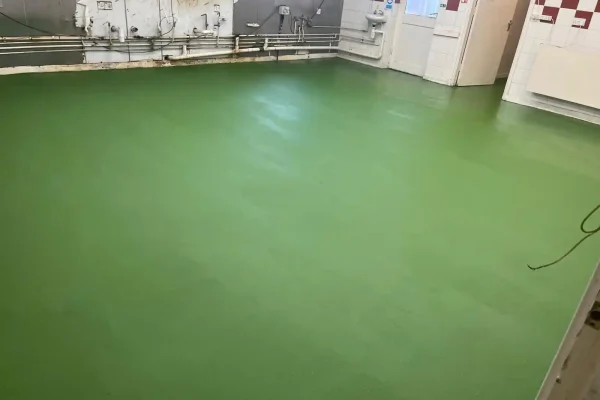
Resin flooring contractors Widnes process and manufacturing operators rely on for floors that survive hot washdown and thermal cycling. Supporting industrial and production facilities across the Widnes Waterfront, Halebank, Tanhouse, Ditton and the wider Widnes area.
Working for national manufacturers, logistics operators and public sector estates since 1999.
As resin flooring contractors Widnes operators call on regularly, we correct a diagnosis more often than we correct a chemical specification. Widnes was the birthplace of the British chemical industry, and it still carries process and manufacturing activity across the Waterfront, Halebank and Tanhouse, with the Mersey Gateway and the A562 tying it into the wider corridor.
The failure that brings us in is thermal. Hot washdown, steam cleaning and process heat cycle the floor through large temperature swings, and a resin system expands at a different rate to the concrete beneath it. The result is cracking, debonding and lifting.
It is routinely reported as chemical attack, because the damage appears in areas where chemicals are present. Getting that diagnosis right changes the system, the thickness and the cost, which is why we test rather than assume.
The principal regeneration and industrial area on the estuary, mixing process, manufacturing and storage.
An established industrial and distribution area with manufacturing and warehousing on older concrete.
Process and industrial premises where exposure history matters as much as the current occupier.
Handling, storage and transfer premises around the rail interchange and its approach roads.
Trade, servicing and light industrial units along Moor Lane and the Dennis Road approaches.
Older industrial buildings toward Spike Island, with notably variable substrate condition.
Polyurethane screeds at the thickness the temperature swing actually requires.
Systems rated for thermal cycling rather than for a single peak temperature.
Chemically resistant build-ups specified against a documented exposure profile.
Hygienic, coved, cleanable finishes that also tolerate repeated hot cleaning.
Durable finishes where localised process heat and spillage occur together.
Abrasion resistance and joint durability across the estates and transfer areas.
Cracking and lifting in a washdown area gets reported as chemical damage because chemicals are present. More often the cause is the temperature swing, and a floor replaced on the wrong diagnosis fails again in the same place.
Resin and concrete expand at different rates, and under hot washdown that difference tears the bond apart whatever the chemical resistance.
Polyurethane screeds absorb thermal cycling, but only at the right build-up. Steam and washdown areas need genuine screed thickness.
Testing decides whether the answer is a chemical specification or a thermal one, and those two carry very different prices.
Most Widnes work happens on operating sites with production continuing nearby, and much of it sits on concrete laid decades ago. Both facts shape the programme before the system is chosen.
Preparation releases respirable crystalline silica, limited under EH40 to 0.1 mg per cubic metre over an eight-hour period, so machines run coupled to H-class extraction and shared areas are screened. On legacy buildings that also keeps historic residues contained rather than airborne.
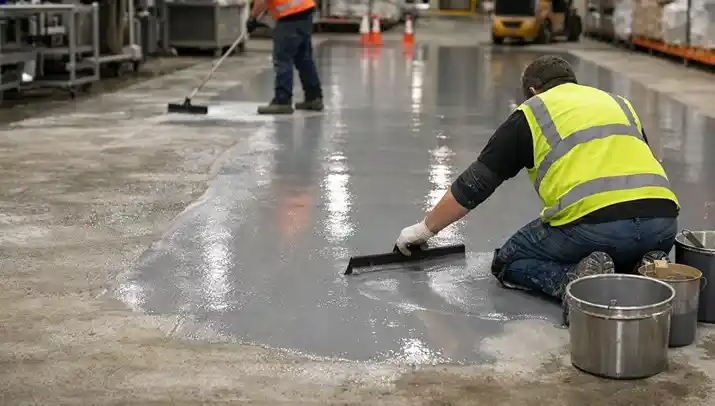
The floor is then taken line by line or into planned shutdowns, with rapid-cure systems where a washdown area has to be back in service for the next production run rather than the next week.
Build-up is selected against the temperature range and cycle frequency, not against a single peak figure.
Where resin protects the structural concrete from ingress rather than simply providing a wearing surface.
Moisture and soundness testing on legacy concrete, which decides whether a system will bond and stay bonded.
Respirable crystalline silica is limited to 0.1 mg per cubic metre over eight hours, so extraction is standard.
FeRFA classifies resin flooring into eight types by build-up and thickness, and BS 8204-6 governs which one a floor actually needs. Polyaspartic and MMA sit outside that classification because they describe the resin chemistry rather than the build-up. In Widnes the heavy-duty polyurethane screeds usually lead, because thermal cycling decides the specification.
FeRFA Type 1. Two or more coats up to 150 microns, binding a dusting substrate and giving a cleanable surface. From £8 per square metre.
FeRFA Type 2. Dual component to 300 microns, solvent free, in gloss, matt or silk. Chemical resistance with a decorative finish.
FeRFA Type 3. Up to 1000 microns over prepared concrete and the system specified on most industrial jobs. Takes colour well for demarcation.
FeRFA Type 4. Multi-coat build at 1 to 3mm with aggregate broadcast between coats, for impact and constant wear.
FeRFA Type 5. Flow-applied at 2 to 3mm for a seamless finish where hygiene and cleaning matter more than impact resistance.
FeRFA Type 7. Three part filled system at 4 to 6mm thickness, giving a self-smoothing finish for heavy and very heavy duty areas.
FeRFA Types 7 and 8. Trowel-applied at 6 to 9mm to take thermal shock, steam cleaning and constant heavy forklift traffic.
Cures at temperatures down to −5°C and is ready in around two hours. Installed overnight or at a weekend it can remove the need to shutdown entirely.
Cures in hours, but the odour can taint food, fabrics and stock and the area must be cleared and ventilated. Better suited to new build and refurbishment projects.
Rates run from £8 per square metre for a floor seal to £45 for MMA, inclusive of preparation, labour and materials. Hot washdown areas sit at the upper end, because thickness is what buys the thermal tolerance.
| System | FeRFA | Thickness | Per m² |
|---|---|---|---|
| Floor Seal | Type 1 | Up to 150µm | From £8 |
| Epoxy and PU Coating | Type 2 | 150 – 300µm | £8 – £12 |
| High Build Coating | Type 3 | 300 – 1000µm | £8 – £12 |
| Multi-Layer Flooring | Type 4 | 1 – 3mm | £12 – £16 |
| Self-Smoothing | Type 5 | 2 – 4mm | £20 – £30 |
| Heavy Duty Flowable | Type 7 | 4 – 6mm | £25 – £35 |
| Heavy Duty PU Screed | Type 8 | 6 – 9mm | £30 – £40 |
| Polyaspartic | Chemistry | 300 – 500µm | £38 |
| MMA | Chemistry | 2 – 6mm | £45 |
Inclusive of preparation, labour and materials. Rates assume a sound, accessible substrate and are indicative until the floor has been surveyed. Polyaspartic and MMA sit outside the FeRFA type classification because they describe the resin chemistry rather than the build-up.
A three day shutdown at a plant turning over £2,000 an hour is £120,000 of lost output. On most sites that is several times the price of the floor.
Five contractors quoted one timber processing plant. All five proposed the same system and a three to four day closure. None of them costed the closure.
We proposed a faster-curing system installed across a weekend. A higher rate per square metre, and no shutdown at all. On the client’s own figures the avoided losses exceeded the price of the floor.
We install evenings, weekends and one bay at a time.
Whether a shutdown costs you thousands an hour or simply gets in the way, you do not always have to close your site for a resin flooring installation.
Crack stitching, patch repair and joint sealing on the older Halebank and Tanhouse units.
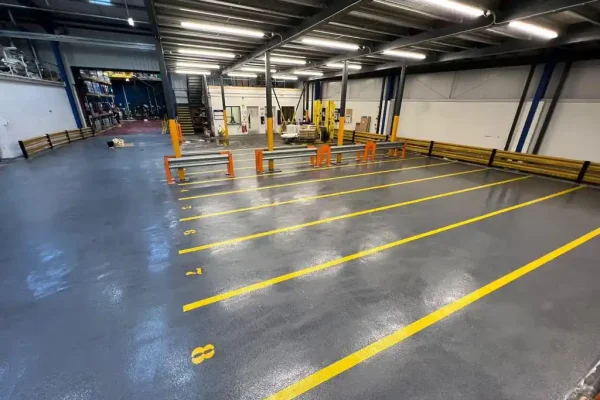
Traffic routes, walkways and process zone separation applied in resin rather than in tape.
Damp proof membrane where a substrate fails moisture testing, supplied as a standalone package.
Polyurethane screeds at full thickness, installed line by line around continuing production.
Resistant build-ups laid on tested and repaired concrete, phased into shutdown windows.
Abrasion resistant floors and joint repairs across the estates and rail-adjacent premises.
We work across the town regularly, from the Waterfront and Halebank through to Tanhouse, Ditton and the Moor Lane corridor. We are Cheshire based rather than Widnes based, so a survey usually happens within days and there is no mobilisation charge for attending.
Usually not, although it is almost always reported that way because chemicals are present. Hot washdown cycles the floor through large temperature swings, and resin and concrete expand at different rates, which tears the bond apart. Replacing it on the wrong diagnosis means it fails again in the same place.

Because thickness is what absorbs the movement. A thin coating has nowhere to accommodate the differential expansion, so it cracks and debonds. Polyurethane screeds handle thermal cycling well, but only when specified at a genuine screed build-up rather than as a heavy coating.
Yes, and that is normally how it is done here. Work is taken line by line or programmed into planned shutdowns, with rapid-cure systems where a washdown area has to be back in service for the next production run rather than the next week.
Only if it is tested first. Much of the industrial concrete in Widnes was laid decades ago and may carry moisture, contamination or laitance, any of which will stop a system bonding. We test soundness and moisture at survey and price any repair separately rather than discovering it mid-installation.
From £8 per square metre for a floor seal up to £45 for MMA, inclusive of preparation, labour and materials. Hot washdown and heavy-duty screed areas sit at the upper end. The full table by system is on the cost page.
Runcorn · Warrington · Ellesmere Port · Northwich · St Helens · Liverpool · Prescot
Tell us how hot the area gets, how often it is washed down and when the line can be released. We attend, test the substrate, and put a written specification and a fixed price in front of you at no cost.