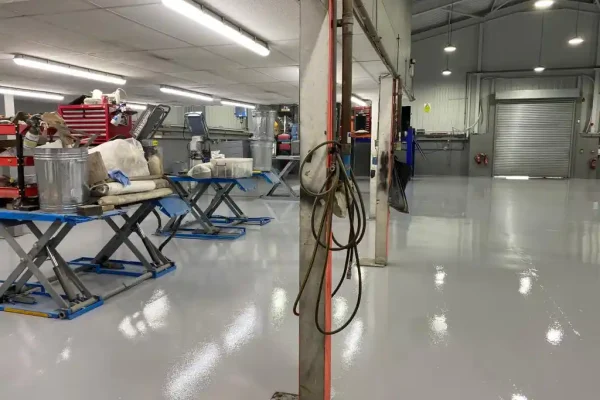
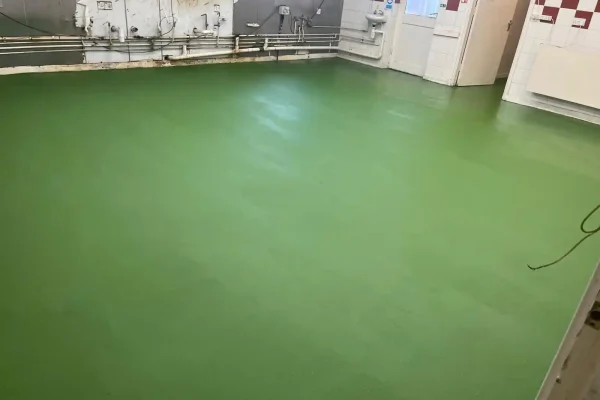
Resin flooring contractors Liverpool logistics, food production and hospitality operators rely on for measured slip resistance and hard-wearing finishes. Supporting facilities across Speke, Garston, Wavertree, the Baltic Triangle and city centre back-of-house environments.
Working for national manufacturers, logistics operators and public sector estates since 1999.
As resin flooring contractors Liverpool operators call on regularly, we specify across a breadth no surrounding town produces. Within a few kilometres the city runs port-linked logistics, food production and cold chain, manufacturing and engineering, and a dense layer of hospitality, cultural and public back-of-house that nowhere else on Merseyside carries at this concentration.
What connects them is water. Coastal weather, quayside activity, plant and kitchen wash-down and heavy public footfall keep entrances, transitions and goods-in areas wet, and slip incidents at those points are the city’s most common and most costly floor failure.
So the argument here is measurement rather than assertion. A kitchen, a dock apron and a museum threshold need different values, and the only honest way to state any of them is a pendulum test in the wet condition.
Warehousing, logistics and light manufacturing close to the airport and the A561 in the south.
Modern manufacturing, technical and distribution units on the southern edge of the city.
Industrial storage, processing and trade facilities along the southern river frontage.
Technical, laboratory, data and office-industrial premises on the Edge Lane corridor.
Converted warehouse stock in commercial, marine, creative and food and drink use.
Service corridors, goods-in, kitchens, cellars and plant rooms behind retail and leisure.
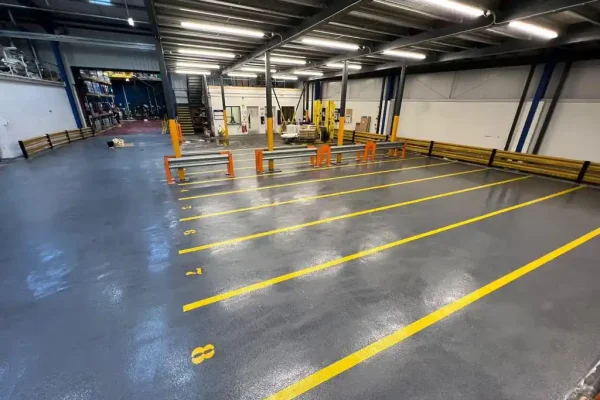
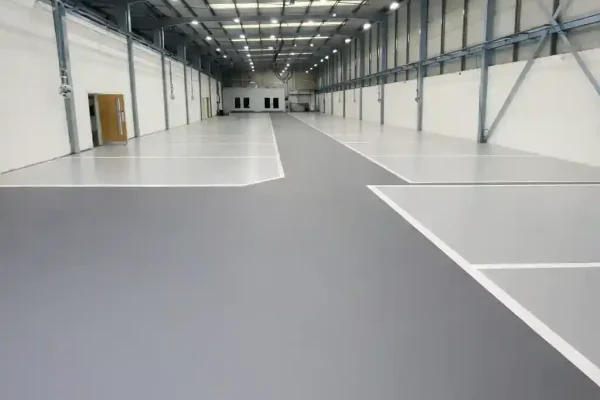
Abrasion resistance, joint protection and load tolerance with designed-in demarcation.
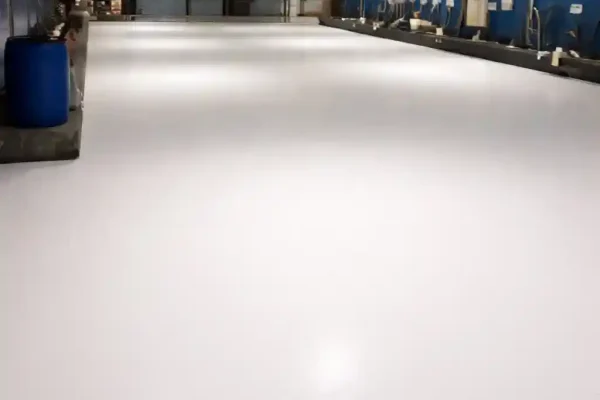
Wash-down tolerance, hygiene detailing and correct falls to drainage throughout.
Grease, hot spillage and slip risk handled inside very short installation windows.
Seamless, appearance-critical finishes with contrast at thresholds and heavy footfall.
Oil, coolant and solvent exposure with impact tolerance under machine bases.
Vehicle areas, stores and cleaning bays with falls, drainage and measured grip.
Slip incidents at entrances and transition points are the most common and most expensive floor failure in the city. Coastal weather, wash-down and footfall mean these areas are rarely dry, so the specification has to answer the wet condition.
BS 7976 produces a number. Anti-slip claimed without a pendulum value in the wet condition is marketing rather than specification.
Almost any floor performs dry. These areas are wet from weather, wash-down and footfall, so that is the state the value must describe.
A kitchen, a dock apron and a venue threshold need different values. One figure applied across a whole building helps nobody.
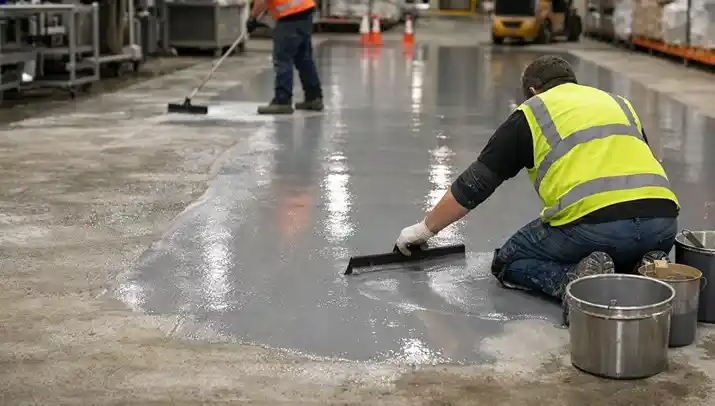
Very little Liverpool work happens in an empty building. A kitchen has a service to get through, a venue has an event booked, and a warehouse runs shifts, so the window is usually hours rather than days.
That makes rapid-cure systems a routine part of the conversation instead of an upgrade, and we state their compromises plainly rather than selling cure speed as free. Hospitality and venue areas are taken overnight or during closed periods, industrial areas bay by bay or into shift changeovers.
Preparation runs under H-class extraction with shared areas screened, because a city centre building cannot have dust travelling into stock, seating or public space while the rest of it stays open.
Pendulum values in the wet condition at entrances, wash-down zones and goods-in areas.
Seamless, non-porous finishes with coved skirtings and correct falls across food and cold chain.
The FeRFA range framing abrasion, impact and lifecycle in port-linked and logistics buildings.
Equality Act contrast at thresholds and EN 13501-1 reaction to fire in public buildings.
FeRFA classifies resin flooring into eight types by build-up and thickness, and BS 8204-6 governs which one a floor actually needs. Polyaspartic and MMA sit outside that classification because they describe the resin chemistry rather than the build-up, and in Liverpool they are frequently chosen for cure speed where the window is a single night.
FeRFA Type 1. Two or more coats up to 150 microns, binding a dusting substrate and giving a cleanable surface. From £8 per square metre.
FeRFA Type 2. Dual component to 300 microns, solvent free, in gloss, matt or silk. Chemical resistance with a decorative finish.
FeRFA Type 3. Up to 1000 microns over prepared concrete and the system specified on most industrial jobs. Takes colour well for demarcation.
FeRFA Type 4. Multi-coat build at 1 to 3mm with aggregate broadcast between coats, for impact and constant wear.
FeRFA Type 5. Flow-applied at 2 to 3mm for a seamless finish where hygiene and cleaning matter more than impact resistance.
FeRFA Type 7. Three part filled system at 4 to 6mm thickness, giving a self-smoothing finish for heavy and very heavy duty areas.
FeRFA Types 7 and 8. Trowel-applied at 6 to 9mm to take thermal shock, steam cleaning and constant heavy forklift traffic.
Cures at temperatures down to −5°C and is ready in around two hours. Installed overnight or at a weekend it can remove the need to shutdown entirely.
Cures in hours, but the odour can taint food, fabrics and stock and the area must be cleared and ventilated. Better suited to new build and refurbishment projects.
Rates run from £8 per square metre for a floor seal to £45 for MMA, inclusive of preparation, labour and materials. Where the window is one night, the faster system is often the cheaper project once lost trading is counted.
| System | FeRFA | Thickness | Per m² |
|---|---|---|---|
| Floor Seal | Type 1 | Up to 150µm | From £8 |
| Epoxy and PU Coating | Type 2 | 150 – 300µm | £8 – £12 |
| High Build Coating | Type 3 | 300 – 1000µm | £8 – £12 |
| Multi-Layer Flooring | Type 4 | 1 – 3mm | £12 – £16 |
| Self-Smoothing | Type 5 | 2 – 4mm | £20 – £30 |
| Heavy Duty Flowable | Type 7 | 4 – 6mm | £25 – £35 |
| Heavy Duty PU Screed | Type 8 | 6 – 9mm | £30 – £40 |
| Polyaspartic | Chemistry | 300 – 500µm | £38 |
| MMA | Chemistry | 2 – 6mm | £45 |
Inclusive of preparation, labour and materials. Rates assume a sound, accessible substrate and are indicative until the floor has been surveyed. Polyaspartic and MMA sit outside the FeRFA type classification because they describe the resin chemistry rather than the build-up.
A three day shutdown at a plant turning over £2,000 an hour is £120,000 of lost output. On most sites that is several times the price of the floor.
Five contractors quoted one timber processing plant. All five proposed the same system and a three to four day closure. None of them costed the closure.
We proposed a faster-curing system installed across a weekend. A higher rate per square metre, and no shutdown at all. On the client’s own figures the avoided losses exceeded the price of the floor.
We install evenings, weekends and one bay at a time.
Whether a shutdown costs you thousands an hour or simply gets in the way, you do not always have to close your site for a resin flooring installation.
Crack stitching, arris rebuilding and joint sealing across logistics and industrial units.
Vehicle routes, walkways and exclusion zones applied in resin rather than painted on top.
Damp proof membrane where a substrate fails moisture testing, as a standalone package.
Abrasion resistant floors and joint repairs installed around shifts and continuing operations.
Hygienic, slip-measured finishes with coving and falls, laid overnight between services.
Seamless appearance-critical floors with threshold contrast, installed in closed periods.
We work across the city regularly, from Speke, Estuary Commerce Park and Garston through to Wavertree, the Baltic Triangle and city centre back-of-house. We are Cheshire based rather than Liverpool based, so a survey usually happens within days and there is no mobilisation charge for attending.

On its own, nothing. It should be a pendulum value measured to BS 7976 in the wet condition, because that is the state your entrance or wash-down area is actually in. If a quotation says anti-slip without a number and a test condition, ask what the number is before comparing prices.
Aggregate graded to the measured requirement, applied where the water actually is. Coastal weather and footfall mean the transition from outside to inside stays wet for most of the day, so the specification is written for that zone rather than applied at one level across the whole building.
Yes. Hospitality areas are taken overnight or during closed periods, and rapid-cure systems can return a floor to service in around two hours. The programme is agreed at survey so handback lands before service rather than after it.
No. Those three have different duties, different exposure and different compliance drivers, so they are specified separately. Averaging them into one system produces a floor that is over-specified in one area, under-specified in another and correct in none.
From £8 per square metre for a floor seal up to £45 for MMA, inclusive of preparation, labour and materials. Where an area can only be closed for one night, the faster system often works out cheaper overall. The full table by system is on the cost page.
Tell us what the area is used for, how wet it gets and how long it can be closed. We attend, test the substrate, and put a written specification and a fixed price in front of you at no cost.