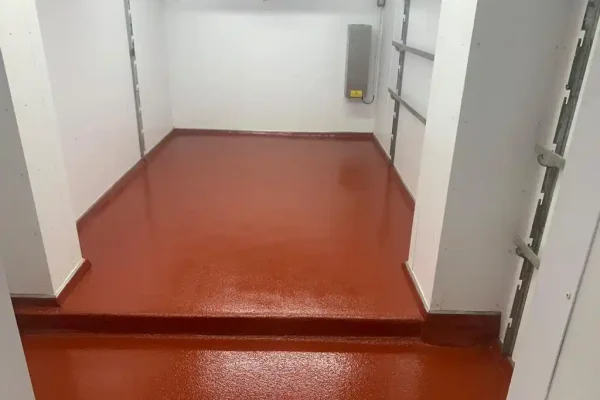
Resin flooring contractors Bootle port-linked warehousing and logistics operators rely on for floors that take container plant loads. Serving dock estate and distribution facilities from the Seaforth and Gladstone frontages to Atlantic Park and the Dunnings Bridge Road corridor.
Working for national manufacturers, logistics operators and public sector estates since 1999.
As resin flooring contractors Bootle operators call on regularly, we work where the heaviest loads in the region meet the largest floor areas. The dock estate runs the length of the town along Regent Road and Derby Road, with the deep-water container berths at Seaforth at its northern edge and the A5036 carrying port freight out to the M57 and M58.
Container plant concentrates very high loads through small contact patches, and repeated turning and braking works joints and arrises apart. Where a distribution town wears out gradually, a Bootle floor breaks down at the edges, and once a saw-cut joint edge goes the deterioration runs the length of the traffic route within months.
Weather makes it worse. Wind-driven rain off the estuary, plant wash-down and yard run-off keep goods-in areas permanently wet, which turns a wear problem into a slip problem at the same time.
The deep-water container terminal, with handling, stacking, storage and inspection buildings.
Bulk, ro-ro and general cargo quaysides with their transit sheds and open storage areas.
The road spine behind the dock wall, lined with storage, haulage and trade premises.
Modern industrial and distribution units on the A5036 port freight route to the motorways.
Mixed manufacturing, storage and trade units on the eastern side of the town at Netherton.
Smaller service, storage and workshop premises along Stanley Road, serving the dock estate.
Extreme point loads, tracked plant and constant exposure to weather off the estuary.
Abrasion, joint protection, racking baseplate loads and very long forklift runs.
Wear concentrated at levellers, dock aprons and the turning circles between them.
Abrasive product, dropped material and heavy shovel and loader traffic all day.
Falls to drainage, diesel and oil resistance and measured slip performance.
Thermal shock, hygiene detailing and systems able to cure at low temperatures.
Reach stackers, empty handlers and terminal tractors put very high loads through small contact patches, then turn and brake on them. The joint arris takes that first, and standing water off the estuary keeps working into whatever it opens up.
BS 8204-6 and the FeRFA range give the honest basis for a heavy-duty flowable or screed where container and plant loads apply.
Saw-cut joint edges break down long before the field of the floor does, so arrises are rebuilt in resin and sealed to move.
Wind-driven rain and wash-down keep goods-in wet, so falls, drainage and measured slip performance are specified together.
The port and the warehousing behind it run continuously, so phased and zoned installation is a commercial requirement here rather than a preference. Nothing is specified without the sequence being agreed first.
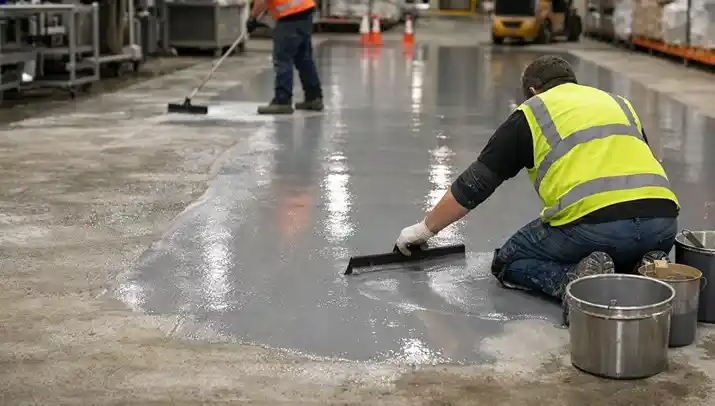
Work is taken bay by bay, aisle by aisle or door by door, so trailer movements and container flows continue while the floor is replaced around them. Where downtime cost dominates, polyaspartic and MMA are the right technical conversation, and we state the compromises plainly rather than selling cure speed as free.
Preparation runs under H-class extraction with shared areas screened, because a working transit shed cannot absorb dust drifting across stock or into container inspection areas.
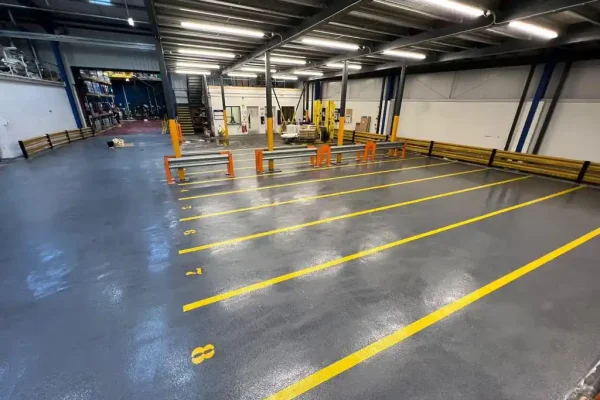
Where container plant, HGVs, forklifts and people share surfaces, demarcation is designed into the floor.
BS 8204-6 and the FeRFA range justify a flowable or a screed over a coating, with EN 13813 for the screed.
BS 7976 pendulum testing frames every anti-slip claim at dock aprons and at the wash-down bays.
Pollution control rules require bunding to 110% of capacity at fuel points and at oil stores.
FeRFA classifies resin flooring into eight types by build-up and thickness, and BS 8204-6 governs which one a floor actually needs, with EN 13813 covering the screed material. Polyaspartic and MMA sit outside that classification because they describe the resin chemistry rather than the build-up. In Bootle the heavy-duty flowable and screed types lead, because load class decides the specification.
FeRFA Type 1. Two or more coats up to 150 microns, binding a dusting substrate and giving a cleanable surface. From £8 per square metre.
FeRFA Type 2. Dual component to 300 microns, solvent free, in gloss, matt or silk. Chemical resistance with a decorative finish.
FeRFA Type 3. Up to 1000 microns over prepared concrete and the system specified on most industrial jobs. Takes colour well for demarcation.
FeRFA Type 4. Multi-coat build at 1 to 3mm with aggregate broadcast between coats, for impact and constant wear.
FeRFA Type 5. Flow-applied at 2 to 3mm for a seamless finish where hygiene and cleaning matter more than impact resistance.
FeRFA Type 7. Three part filled system at 4 to 6mm thickness, giving a self-smoothing finish for heavy and very heavy duty areas.
FeRFA Types 7 and 8. Trowel-applied at 6 to 9mm to take thermal shock, steam cleaning and constant heavy forklift traffic.
Cures at temperatures down to −5°C and is ready in around two hours. Installed overnight or at a weekend it can remove the need to shutdown entirely.
Cures in hours, but the odour can taint food, fabrics and stock and the area must be cleared and ventilated. Better suited to new build and refurbishment projects.
Rates run from £8 per square metre for a floor seal to £45 for MMA, inclusive of preparation, labour and materials. On a port-linked operation the second number matters more: stopped throughput usually costs more than the floor.
| System | FeRFA | Thickness | Per m² |
|---|---|---|---|
| Floor Seal | Type 1 | Up to 150µm | From £8 |
| Epoxy and PU Coating | Type 2 | 150 – 300µm | £8 – £12 |
| High Build Coating | Type 3 | 300 – 1000µm | £8 – £12 |
| Multi-Layer Flooring | Type 4 | 1 – 3mm | £12 – £16 |
| Self-Smoothing | Type 5 | 2 – 4mm | £20 – £30 |
| Heavy Duty Flowable | Type 7 | 4 – 6mm | £25 – £35 |
| Heavy Duty PU Screed | Type 8 | 6 – 9mm | £30 – £40 |
| Polyaspartic | Chemistry | 300 – 500µm | £38 |
| MMA | Chemistry | 2 – 6mm | £45 |
Inclusive of preparation, labour and materials. Rates assume a sound, accessible substrate and are indicative until the floor has been surveyed. Polyaspartic and MMA sit outside the FeRFA type classification because they describe the resin chemistry rather than the build-up.
A three day shutdown at a plant turning over £2,000 an hour is £120,000 of lost output. On most sites that is several times the price of the floor.
Five contractors quoted one timber processing plant. All five proposed the same system and a three to four day closure. None of them costed the closure.
We proposed a faster-curing system installed across a weekend. A higher rate per square metre, and no shutdown at all. On the client’s own figures the avoided losses exceeded the price of the floor.
We install evenings, weekends and one bay at a time.
Whether a shutdown costs you thousands an hour or simply gets in the way, you do not always have to close your site for a resin flooring installation.
Arris rebuilding, crack stitching and flexible sealing across trafficked joints and aprons.
Walkways, crossing points and plant routes applied in resin rather than painted on top.
Damp proof membrane where a substrate fails moisture testing, as a standalone package.
Load-rated floors and joint repairs installed aisle by aisle with the operation running.
Impact-resistant screeds with rebuilt arrises, phased door by door around trailer flows.
Falls, drainage and contained detailing across plant cleaning and fuel point areas.
We work across the town regularly, from the Seaforth and Gladstone frontages and the Regent Road corridor through to Atlantic Park, Bridle Road and the Dunnings Bridge Road units. We are Cheshire based, so a survey usually happens within days and there is no mobilisation charge for attending.
Because container plant concentrates very high loads through small contact patches, then turns and brakes on them. The joint arris takes that stress first, and once an edge goes the deterioration runs the length of the route within months. Rebuilding arrises early is far cheaper than replacing a lane.
No. BS 8204-6 and the FeRFA range exist precisely to make that judgement honestly, and container plant loads put you into heavy-duty flowable or polyurethane screed territory. Specifying a coating to save money simply moves the cost into repairs within a year or two.
Wind-driven rain, wash-down and yard run-off make that normal here rather than a fault. It is specified as a slip problem and a wear problem at the same time, using BS 7976 pendulum values in the wet condition, with falls and drainage detailing to take the water away rather than let it stand.
Yes, and it is planned that way from the outset. Work is taken bay by bay, aisle by aisle or door by door so trailer movements and container flows continue. Where downtime cost dominates, rapid-cure systems return an area to service in hours, and we state their compromises plainly.

From £8 per square metre for a floor seal up to £45 for MMA, inclusive of preparation, labour and materials. Load-rated screeds sit at the upper end. The full table by system is on the cost page, with a calculator that adds the cost of stopped throughput.
Liverpool · Kirkby · Birkenhead · St Helens · Southport · Skelmersdale · Wigan
Tell us what plant crosses the floor, where the joints are going and which bays can be released. We attend, test the substrate, and put a written specification and a fixed price in front of you at no cost.