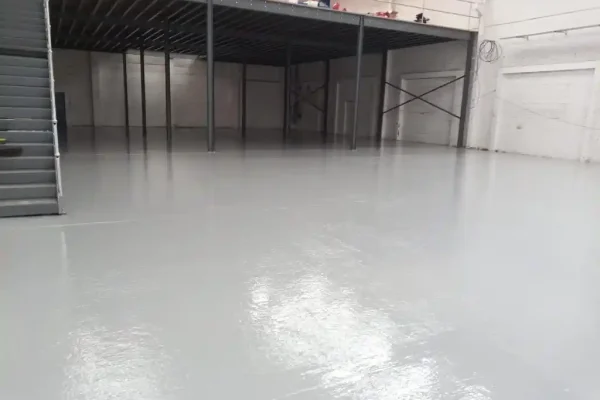
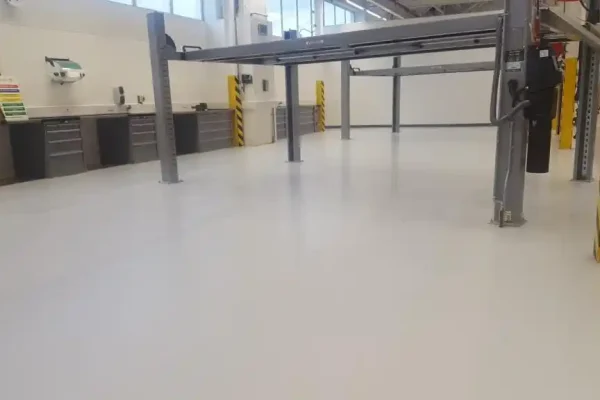
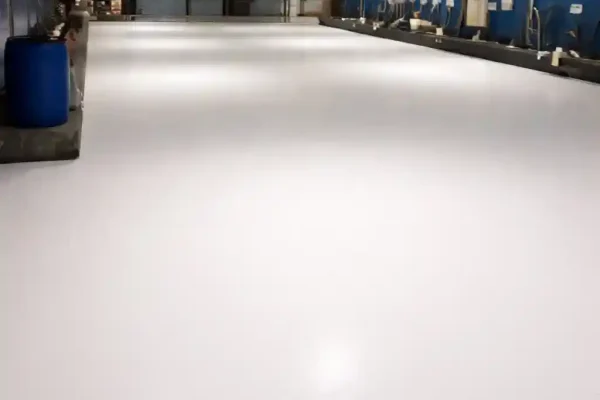
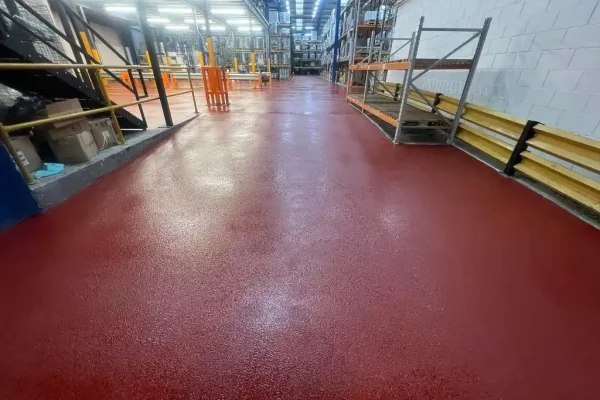
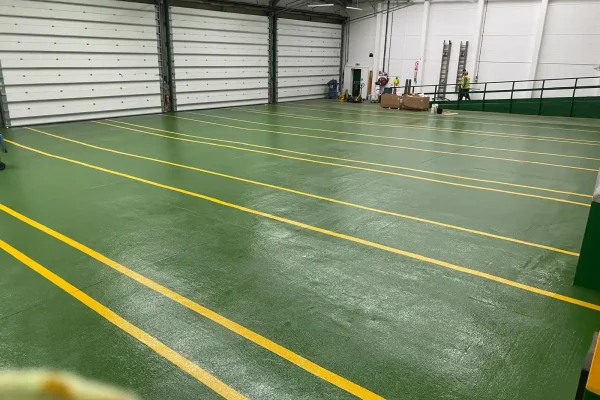
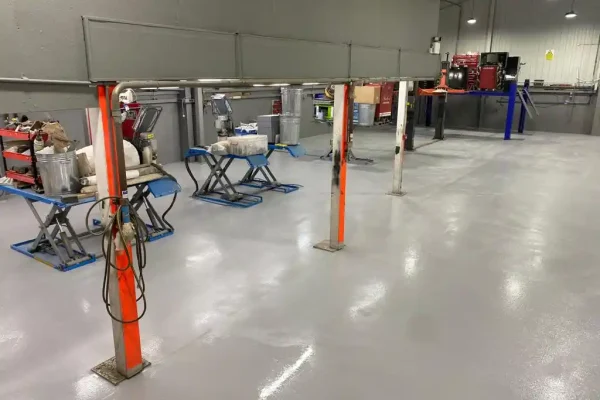
Resin flooring contractors Birkenhead marine engineering and fabrication operators rely on for floors that take dropped steel and damp concrete. Supporting fabrication, ship repair and industrial facilities from the East and West Float quaysides to North Cheshire Trading Estate.
Working for national manufacturers, logistics operators and public sector estates since 1999.
As resin flooring contractors Birkenhead operators call on regularly, we specify against a duty no warehouse produces. The town has spent two centuries doing the heavy end of the river’s work, and it still fabricates and repairs at scale in tall, old, heavily serviced buildings sitting directly on a tidal dock system.
A warehouse floor fails from wear. A fabrication hall floor fails from impact, heat, oil and moisture arriving from below, frequently all at once, on concrete that has carried chlorides for decades.
So the two arguments that matter here are impact tolerance and what is done to the substrate before any resin is mixed. Dropped tooling, plate and sections destroy thin-film coatings, and salt-laden, damp dock-level concrete destroys the adhesion of whatever is put on top of it.
The enclosed float system, with quaysides, transit sheds, fabrication halls and open storage areas.
Marine engineering, ship repair and lay-up berths with their associated workshop buildings.
The ro-ro freight terminal with its marshalling, linkspan and cargo handling areas.
A substantial mixed manufacturing, storage and trade estate at Prenton, south of the centre.
Industrial and storage frontage running along the northern edge of the dock system.
Smaller engineering, service and trade premises on Campbeltown Road, close to the river.
Heavy-duty screeds taking dropped steel, hot work and constant plant tracking.
Moisture-tolerant systems with abrasion resistance and clear route demarcation.
Fuel, hydraulic oil and coolant resistance with impact tolerance at machine bases.
Correct falls, drainage detailing, chemical resistance and measured slip performance.
Containment integrity and resistance to the products actually being stored.
Hard-wheeled trailer traffic, weather ingress and pedestrian routes crossing vehicles.
A fabrication hall punishes a floor from both directions at once. Plate and tooling hit it from above, while salt-laden moisture pushes up from dock-level concrete that has never had a working damp-proof membrane.
BS 8204-6 and the FeRFA range make the case plainly. No thin-film coating survives dropped steel, so an impact hall needs a real screed.
Salt contamination and carbonation attack adhesion, which makes moisture testing and priming the decisive part of the specification.
Welding, cutting and grinding put spatter and localised heat onto the floor, so the system is chosen to take both of them.
Birkenhead work happens in buildings that are still running. Repair programmes, berths and freight movements do not pause for a floor, so the sequence is agreed before mobilisation rather than negotiated on arrival.
Where polyurethane systems are specified, and in impact and thermal environments they frequently are, ISOPA and ALIPA diisocyanate training records matter directly. Every operative handling them holds current REACH certification.
Work is then taken bay by bay or into shift and weekend windows, with preparation run under H-class extraction so grinding old dock concrete does not put dust through a working shop.
Surface protection of concrete, with moisture testing before specification as the honest starting point.
Pollution control rules require bunding to 110% of the largest container near a tidal dock system.
The FeRFA range makes the case for a heavy-duty screed rather than a coating in impact environments.
The 1992 Workplace Regulations apply sharply where cranes, plant and foot traffic share a hall.
FeRFA classifies resin flooring into eight types by build-up and thickness, and BS 8204-6 governs which one a floor actually needs, with EN 13813 covering the screed material itself. Polyaspartic and MMA sit outside that classification because they describe the resin chemistry rather than the build-up. In Birkenhead the heavy-duty screed types lead, because impact decides the specification.
FeRFA Type 1. Two or more coats up to 150 microns, binding a dusting substrate and giving a cleanable surface. From £8 per square metre.
FeRFA Type 2. Dual component to 300 microns, solvent free, in gloss, matt or silk. Chemical resistance with a decorative finish.
FeRFA Type 3. Up to 1000 microns over prepared concrete and the system specified on most industrial jobs. Takes colour well for demarcation.
FeRFA Type 4. Multi-coat build at 1 to 3mm with aggregate broadcast between coats, for impact and constant wear.
FeRFA Type 5. Flow-applied at 2 to 3mm for a seamless finish where hygiene and cleaning matter more than impact resistance.
FeRFA Type 7. Three part filled system at 4 to 6mm thickness, giving a self-smoothing finish for heavy and very heavy duty areas.
FeRFA Types 7 and 8. Trowel-applied at 6 to 9mm to take thermal shock, steam cleaning and constant heavy forklift traffic.
Cures at temperatures down to −5°C and is ready in around two hours. Installed overnight or at a weekend it can remove the need to shutdown entirely.
Cures in hours, but the odour can taint food, fabrics and stock and the area must be cleared and ventilated. Better suited to new build and refurbishment projects.
Rates run from £8 per square metre for a floor seal to £45 for MMA, inclusive of preparation, labour and materials. Fabrication and marine areas sit at the upper end, and moisture control is priced separately because it is testing rather than area.
| System | FeRFA | Thickness | Per m² |
|---|---|---|---|
| Floor Seal | Type 1 | Up to 150µm | From £8 |
| Epoxy and PU Coating | Type 2 | 150 – 300µm | £8 – £12 |
| High Build Coating | Type 3 | 300 – 1000µm | £8 – £12 |
| Multi-Layer Flooring | Type 4 | 1 – 3mm | £12 – £16 |
| Self-Smoothing | Type 5 | 2 – 4mm | £20 – £30 |
| Heavy Duty Flowable | Type 7 | 4 – 6mm | £25 – £35 |
| Heavy Duty PU Screed | Type 8 | 6 – 9mm | £30 – £40 |
| Polyaspartic | Chemistry | 300 – 500µm | £38 |
| MMA | Chemistry | 2 – 6mm | £45 |
Inclusive of preparation, labour and materials. Rates assume a sound, accessible substrate and are indicative until the floor has been surveyed. Polyaspartic and MMA sit outside the FeRFA type classification because they describe the resin chemistry rather than the build-up.
A three day shutdown at a plant turning over £2,000 an hour is £120,000 of lost output. On most sites that is several times the price of the floor.
Five contractors quoted one timber processing plant. All five proposed the same system and a three to four day closure. None of them costed the closure.
We proposed a faster-curing system installed across a weekend. A higher rate per square metre, and no shutdown at all. On the client’s own figures the avoided losses exceeded the price of the floor.
We install evenings, weekends and one bay at a time.
Whether a shutdown costs you thousands an hour or simply gets in the way, you do not always have to close your site for a resin flooring installation.
Crack stitching, patch repair and joint sealing on ageing quayside and workshop concrete.
Vehicle routes, walkways and crane zones applied in resin rather than in tape or paint.
Damp proof membrane where a substrate fails moisture testing, as a standalone package.
Heavy-duty screeds laid on tested and primed concrete, phased around live repair programmes.
Moisture-tolerant systems with demarcation, installed around continuing freight movements.
Oil resistant floors and bunded detailing across plant workshops and fuel storage areas.
We work across the town regularly, from the East and West Float quaysides and Vittoria Dock through to North Cheshire Trading Estate at Prenton and the Wallasey Bridge Road corridor. We are Cheshire based, so a survey usually happens within days and there is no mobilisation charge for attending.
Almost always moisture and chlorides rather than the resin. Dock-level concrete is frequently damp with no functioning damp-proof membrane, and decades of salt-laden air leave contamination that attacks adhesion. Both are found by testing, and both are solvable, but not by simply specifying a better coating.

No. Dropped tooling, plate and sections produce localised failure that no thin-film coating survives, which is why BS 8204-6 and the FeRFA range matter here. An impact environment needs a genuine heavy-duty screed, and specifying a coating to save money simply moves the cost into the repair.
The system is chosen to tolerate it. Welding, cutting and grinding put spatter and localised heat onto the floor, and polyurethane screeds handle that far better than epoxy. Where hot work is routine we specify for it rather than treating it as incidental damage.
Yes. Repair programmes, berths and freight movements do not pause for a floor, so work is taken bay by bay or into shift and weekend windows agreed before mobilisation. Preparation runs under H-class extraction so dust does not travel into a working shop.
From £8 per square metre for a floor seal up to £45 for MMA, inclusive of preparation, labour and materials. Fabrication and marine areas sit at the upper end. The full table by system is on the cost page.
Tell us what hits the floor, how damp the building is and when the bay can be released. We attend, test the substrate, and put a written specification and a fixed price in front of you at no cost.