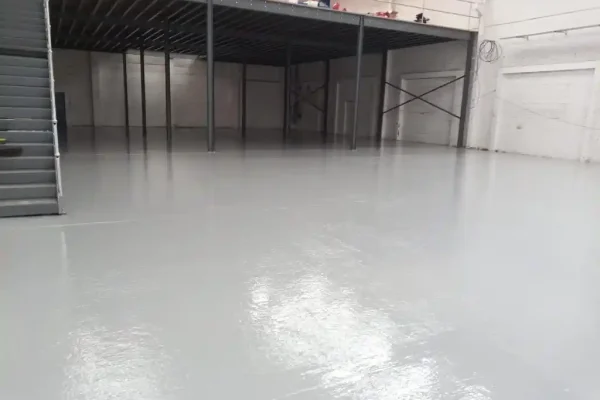
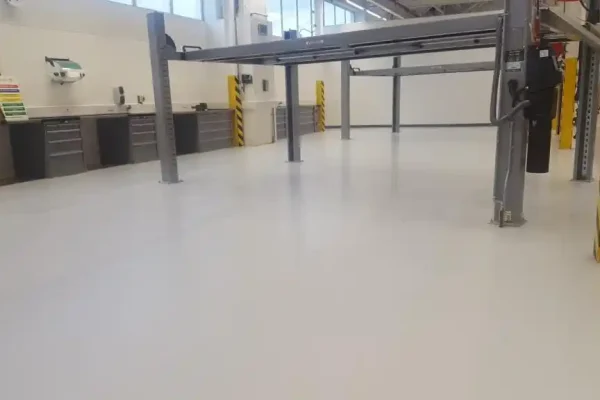
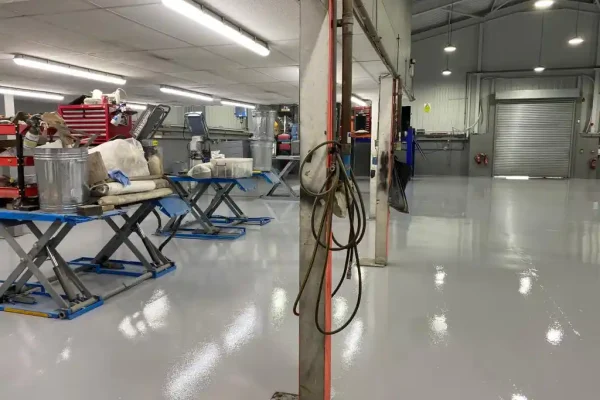
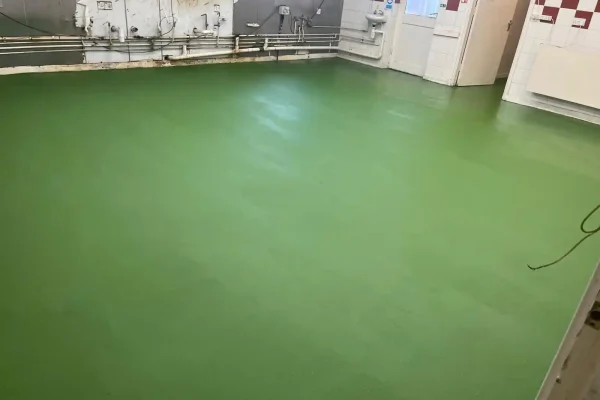
Resin flooring contractors Heywood distribution and cross-dock operators rely on for the joints and dock edges rather than the open floor. Supporting warehousing across Heywood Distribution Park and the Hareshill Road corridor beside Junction 19 of the M62.
Working for national manufacturers, logistics operators and public sector estates since 1999.
As resin flooring contractors Heywood operators call on regularly, we work in one of the purest distribution towns in Greater Manchester. Position on the M62, with the M66 and M60 minutes away, produced a concentration of high-bay warehousing, cross-dock and fulfilment floorspace.
Those buildings share a very particular problem set: enormous areas, continuous mechanical handling, narrow aisle operations and almost no tolerance for downtime.
Floors here are rarely worn out uniformly. They fail at discrete, predictable points: the arris of a saw-cut joint under hard wheels, the leading edge of a dock leveller, the pinch points where routes converge, and beneath racking legs where point loads concentrate.
The town’s defining employment location, with large-scale warehousing and logistics space.
Distribution and storage floorspace linking the park towards the motorway junction.
The continuous run of distribution units straddling the Rochdale and Bury boundary.
Warehousing, trade and service units taking direct advantage of the motorway access.
Smaller-scale trolley and pallet traffic in units serving businesses across the town.
Light manufacturing and storage on aged concrete, a consistent refurbishment stream.
Aisle abrasion, joint arris protection and point loading beneath the racking legs.
Continuous pallet and cage movement wearing the whole plate rather than lanes.
Impact, point load, thermal exposure and water ingress in a few square metres.
Pallet drop impact, turning wear and the need for legible, durable demarcation.
Thermal cycling and condensation management pointing towards polyurethane.
Acid and oil resistance with containment and bunding brought into scope.
Most distribution floor failures start at a joint. The arris chips under hard wheels, the damage widens along the route, and the wearing surface either side is still perfectly sound. Treating the whole plate identically wastes money in one place and under-specifies another.
Joint repair, correct filler hardness and re-cutting where movement demands it belong in the scope.
BS 8204-6 and FeRFA Types 1 to 8 support screeds at docks with lighter build-ups in storage areas.
At this traffic density demarcation is a safety control that has to survive hard-wheeled traffic.
We plan for a working building rather than assuming a shutdown. Narrow-aisle and high-bay operations restrict access, so repairs and installation are zoned and phased around the operational plan from the first conversation.
Work is taken aisle by aisle, bay by bay or door by door, with racking left loaded wherever it can be. Where a zone has to be back under traffic quickly, cure behaviour is set out rather than a completion time promised.
Preparation runs under H-class extraction with areas screened, because a live fulfilment operation cannot absorb dust drifting across stock or pick faces.
The 1992 Regulations and HSE L24 on suitable traffic routes, crossings and segregation.
Arris repair and correct filler selection treated as a durability decision, not a finish.
BS 8204-6 with FeRFA Types 1 to 8, varied across the plate rather than applied uniformly.
Bunding and chemically resistant falls where batteries are charged or fuel is stored.
FeRFA classifies resin flooring into eight types by build-up and thickness, and BS 8204-6 governs which one a floor actually needs, with EN 13813 for the screed. Polyaspartic and MMA sit outside that classification because they describe the resin chemistry rather than the build-up. In Heywood the type changes across a single building, which is the point.
FeRFA Type 1. Two or more coats up to 150 microns, binding a dusting substrate and giving a cleanable surface. From £8 per square metre.
FeRFA Type 2. Dual component to 300 microns, solvent free, in gloss, matt or silk. Chemical resistance with a decorative finish.
FeRFA Type 3. Up to 1000 microns over prepared concrete and the system specified on most industrial jobs. Takes colour well for demarcation.
FeRFA Type 4. Multi-coat build at 1 to 3mm with aggregate broadcast between coats, for impact and constant wear.
FeRFA Type 5. Flow-applied at 2 to 3mm for a seamless finish where hygiene and cleaning matter more than impact resistance.
FeRFA Type 7. Three part filled system at 4 to 6mm thickness, giving a self-smoothing finish for heavy and very heavy duty areas.
FeRFA Types 7 and 8. Trowel-applied at 6 to 9mm to take thermal shock, steam cleaning and constant heavy forklift traffic.
Cures at temperatures down to −5°C and is ready in around two hours. Installed overnight or at a weekend it can remove the need to shutdown entirely.
Cures in hours, but the odour can taint food, fabrics and stock and the area must be cleared and ventilated. Better suited to new build and refurbishment projects.
Rates run from £8 per square metre for a floor seal to £45 for MMA, inclusive of preparation, labour and materials. Varying the duty across the plate normally costs less than one system everywhere, because the heavy build-up goes only where it earns.
| System | FeRFA | Thickness | Per m² |
|---|---|---|---|
| Floor Seal | Type 1 | Up to 150µm | From £8 |
| Epoxy and PU Coating | Type 2 | 150 – 300µm | £8 – £12 |
| High Build Coating | Type 3 | 300 – 1000µm | £8 – £12 |
| Multi-Layer Flooring | Type 4 | 1 – 3mm | £12 – £16 |
| Self-Smoothing | Type 5 | 2 – 4mm | £20 – £30 |
| Heavy Duty Flowable | Type 7 | 4 – 6mm | £25 – £35 |
| Heavy Duty PU Screed | Type 8 | 6 – 9mm | £30 – £40 |
| Polyaspartic | Chemistry | 300 – 500µm | £38 |
| MMA | Chemistry | 2 – 6mm | £45 |
Inclusive of preparation, labour and materials. Rates assume a sound, accessible substrate and are indicative until the floor has been surveyed. Polyaspartic and MMA sit outside the FeRFA type classification because they describe the resin chemistry rather than the build-up.
A three day shutdown at a plant turning over £2,000 an hour is £120,000 of lost output. On most sites that is several times the price of the floor.
Five contractors quoted one timber processing plant. All five proposed the same system and a three to four day closure. None of them costed the closure.
We proposed a faster-curing system installed across a weekend. A higher rate per square metre, and no shutdown at all. On the client’s own figures the avoided losses exceeded the price of the floor.
We install evenings, weekends and one bay at a time.
Whether a shutdown costs you thousands an hour or simply gets in the way, you do not always have to close your site for a resin flooring installation.
Arris rebuilding, correct filler hardness and re-cutting where joint movement requires it.
Routes, crossings and staging set out to the operational plan and laid in resin, not paint.
Damp proof membrane where a substrate fails moisture testing, as a standalone package.
Zoned systems and joint repairs installed aisle by aisle with the operation running.
Heavy-duty build-ups at aprons and levellers, phased door by door around trailers.
Acid resistant floors with containment falls around battery and maintenance bays.
We work across the area regularly, from Heywood Distribution Park and the Hareshill Road corridor through to the Pilsworth Road belt, the units at Junction 19 and the trade premises along the A58. We are Cheshire based, so a survey usually happens within days and there is no mobilisation charge for attending.

It is the standard failure pattern in a distribution building. The arris takes the impact of every hard wheel crossing it, chips, and the damage then runs along the route while the surface either side stays sound. Repairing arrises early costs a fraction of replacing a lane later.
Almost never. Dock aprons, marshalling areas and main routes need a heavier duty than low-traffic storage, and applying one specification everywhere is usually wrong technically and commercially. Varying it across the plate normally costs less overall.
Yes, and we plan for that rather than assuming a shutdown. Work is zoned aisle by aisle, bay by bay or door by door with racking left loaded where possible, and the sequence is agreed against your operational plan before a system is chosen.
Because it is a safety control, and a control that has worn away is not doing its job. The 1992 Workplace Regulations and HSE guidance L24 require traffic routes to be suitable and properly organised, and at this traffic density painted lines simply do not survive long enough to satisfy that.
From £8 per square metre for a floor seal up to £45 for MMA, inclusive of preparation, labour and materials. Heavy-duty systems for docks and main routes sit at the upper end. The full table by system is on the cost page, with a calculator that adds the cost of stopped operations.
Tell us where the joints are going, which doors take the traffic and which aisles can be released. We attend, test the substrate, and put a written specification and a fixed price in front of you at no cost.