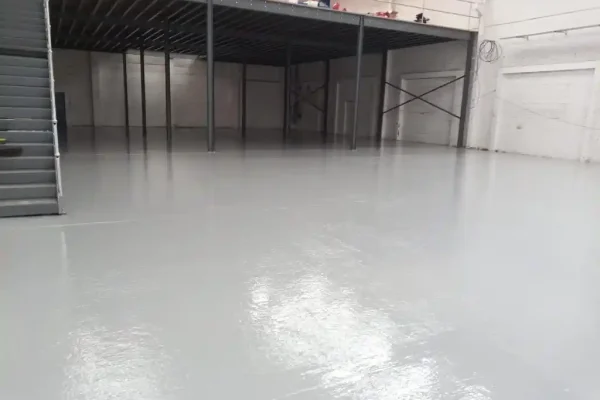
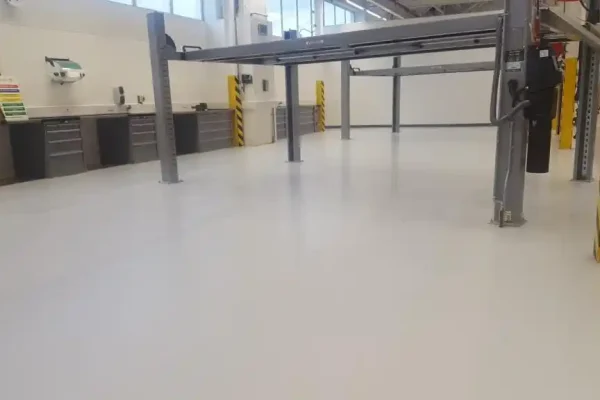
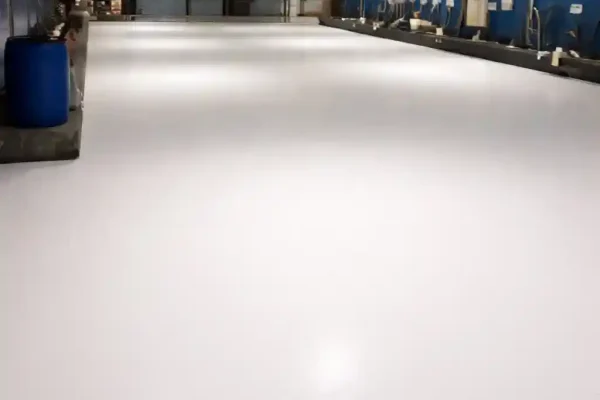
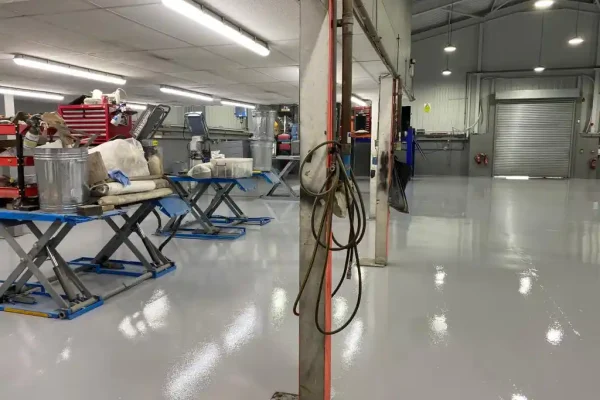
Resin flooring contractors Bury manufacturers, converters and distribution operators rely on for floors facing chemistry as well as traffic. Supporting facilities across Pilsworth, Hollins Brook, Heap Bridge and Chamberhall Business Park.
Working for national manufacturers, logistics operators and public sector estates since 1999.
As resin flooring contractors Bury operators call on regularly, we deal with a wear profile that is not the abrasion-and-impact pattern of a distribution shed. The town sits close to the M66 and M60, and the valleys around Heap Bridge and the Irwell were built on paper making, printing, converting and packaging.
Successor businesses around those sites still bring inks, adhesives, solvents, coating chemicals and fibre dust into contact with the floor, alongside heavy reel and roll handling that concentrates load onto very small contact areas.
Pilsworth then adds a conventional distribution and trade cluster on the motorway corridor, and the town centre market and retail economy adds its own back-of-house demands. It is a mixed manufacturing town rather than a logistics one.
One of the largest employment areas in the borough, with logistics, storage and trade units.
A mixed-use industrial estate carrying high forklift and heavy vehicle movement.
Manufacturing and distribution premises in the valley that carried the paper industry.
Light industrial and commercial units close to the town centre needing presentable floors.
Trade counters, wholesalers and merchants with trolley traffic and customer access.
Wet trading, produce handling and intensive cleaning behind the town centre market.
Ink, solvent and adhesive exposure with fibre dust and heavy reel handling.
Abrasion, joint breakdown and racking point loads across the Pilsworth cluster.
Oils, coolants and tool impact on floors that also have to sweep clean.
Washdown, drainage falls, coved detailing and thermal tolerance throughout.
Durability plus appearance under continuous trolley and customer traffic.
Dock-edge impact, chemical spillage and the need for a sealed, cleanable surface.
A paper reel or a heavy unit load stands on a very small contact area, and that pressure goes straight through a coating into the concrete. Combined with ink, solvent and adhesive attack, it is a duty that a warehouse specification simply does not answer.
Reel and roll handling concentrates weight onto inches, which is where a coating fails and a screed does not.
EN 1504-2 covers surface protection where ink, solvent and adhesive attack the structure rather than just the surface.
EN 13813 and FeRFA Types 1 to 8 prevent the recurring mistake of using a coating where a screed is required.
A converting line, a distribution shed and a market back-of-house all constrain the work differently, so the sequence is agreed per building rather than applied as a standard method.
Production areas are taken bay by bay or into planned shutdowns, distribution floors aisle by aisle, and retail and market areas overnight where they have to trade the next morning.
Preparation runs under H-class extraction with areas screened. Many Bury buildings have aged concrete that dusts under traffic, and the EH40 limit of 0.1 mg per cubic metre over eight hours applies to our work as much as to your finished floor.
Protecting the concrete itself where ink, solvent and adhesive exposure drives the specification.
EN 13813 material properties with FeRFA Types 1 to 8 matched to reel and forklift handling.
Coved skirtings, sealed junctions and correct falls, with polyurethane where steam cleaning runs.
The EH40 limit of 0.1 mg per cubic metre over eight hours supports sealing dusting substrates.
FeRFA classifies resin flooring into eight types by build-up and thickness, and BS 8204-6 governs which one a floor actually needs, with EN 13813 for the screed and EN 1504-2 where the concrete is being protected. Polyaspartic and MMA sit outside that classification because they describe the resin chemistry rather than the build-up. In Bury the exposure and the point loading decide it together.
FeRFA Type 1. Two or more coats up to 150 microns, binding a dusting substrate and giving a cleanable surface. From £8 per square metre.
FeRFA Type 2. Dual component to 300 microns, solvent free, in gloss, matt or silk. Chemical resistance with a decorative finish.
FeRFA Type 3. Up to 1000 microns over prepared concrete and the system specified on most industrial jobs. Takes colour well for demarcation.
FeRFA Type 4. Multi-coat build at 1 to 3mm with aggregate broadcast between coats, for impact and constant wear.
FeRFA Type 5. Flow-applied at 2 to 3mm for a seamless finish where hygiene and cleaning matter more than impact resistance.
FeRFA Type 7. Three part filled system at 4 to 6mm thickness, giving a self-smoothing finish for heavy and very heavy duty areas.
FeRFA Types 7 and 8. Trowel-applied at 6 to 9mm to take thermal shock, steam cleaning and constant heavy forklift traffic.
Cures at temperatures down to −5°C and is ready in around two hours. Installed overnight or at a weekend it can remove the need to shutdown entirely.
Cures in hours, but the odour can taint food, fabrics and stock and the area must be cleared and ventilated. Better suited to new build and refurbishment projects.
Rates run from £8 per square metre for a floor seal to £45 for MMA, inclusive of preparation, labour and materials. Chemically resistant and point-load rated systems sit at the upper end, and are specified by zone rather than across a whole building.
| System | FeRFA | Thickness | Per m² |
|---|---|---|---|
| Floor Seal | Type 1 | Up to 150µm | From £8 |
| Epoxy and PU Coating | Type 2 | 150 – 300µm | £8 – £12 |
| High Build Coating | Type 3 | 300 – 1000µm | £8 – £12 |
| Multi-Layer Flooring | Type 4 | 1 – 3mm | £12 – £16 |
| Self-Smoothing | Type 5 | 2 – 4mm | £20 – £30 |
| Heavy Duty Flowable | Type 7 | 4 – 6mm | £25 – £35 |
| Heavy Duty PU Screed | Type 8 | 6 – 9mm | £30 – £40 |
| Polyaspartic | Chemistry | 300 – 500µm | £38 |
| MMA | Chemistry | 2 – 6mm | £45 |
Inclusive of preparation, labour and materials. Rates assume a sound, accessible substrate and are indicative until the floor has been surveyed. Polyaspartic and MMA sit outside the FeRFA type classification because they describe the resin chemistry rather than the build-up.
A three day shutdown at a plant turning over £2,000 an hour is £120,000 of lost output. On most sites that is several times the price of the floor.
Five contractors quoted one timber processing plant. All five proposed the same system and a three to four day closure. None of them costed the closure.
We proposed a faster-curing system installed across a weekend. A higher rate per square metre, and no shutdown at all. On the client’s own figures the avoided losses exceeded the price of the floor.
We install evenings, weekends and one bay at a time.
Whether a shutdown costs you thousands an hour or simply gets in the way, you do not always have to close your site for a resin flooring installation.
Arris rebuilding, crack stitching and making good on aged valley-side concrete.
Forklift routes, walkways and vehicle-only zones applied in resin rather than paint.
Damp proof membrane where a substrate fails moisture testing, as a standalone package.
Chemically resistant, point-load rated systems where reels and inks meet the floor.
Abrasion resistant floors and joint repairs installed aisle by aisle around throughput.
Coved, cleanable systems with falls to drain, laid overnight between trading days.
We work across the borough regularly, from Pilsworth and Hollins Brook through to Heap Bridge, Chamberhall Business Park and the trade units along the A56 and A58 approaches. We are Cheshire based, so a survey usually happens within days and there is no mobilisation charge for attending.

Because a reel stands on a very small contact area and the pressure goes straight through a thin system into the concrete. It is point loading rather than general traffic, and EN 13813 and the FeRFA range exist to make that distinction. A screed handles it where a coating will not.
No, it is attacking the concrete. That makes EN 1504-2 surface protection the right frame rather than treating the resin as a wearing surface, and it means specifying against the products you actually use rather than assuming general chemical resistance.
It means the surface has worn through and is shedding fines, including respirable crystalline silica, limited under EH40 to 0.1 mg per cubic metre over eight hours. Sealing the floor stops the generation at source and makes housekeeping achievable rather than endless.
Yes, but not with one specification. Food areas need coving, falls and thermal tolerance, converting areas need chemical resistance and point-load capacity. We specify by zone and price them separately so you can see what each area is costing you.
From £8 per square metre for a floor seal up to £45 for MMA, inclusive of preparation, labour and materials. Chemically resistant and heavy-duty systems sit at the upper end. The full table by system is on the cost page.
Tell us what stands on the floor, what is spilled on it and when the area can be released. We attend, test the substrate, and put a written specification and a fixed price in front of you at no cost.