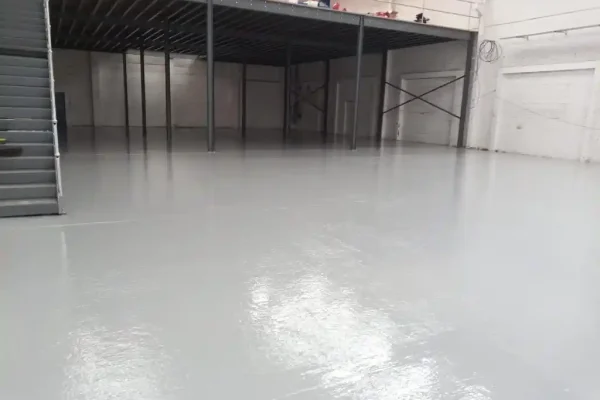
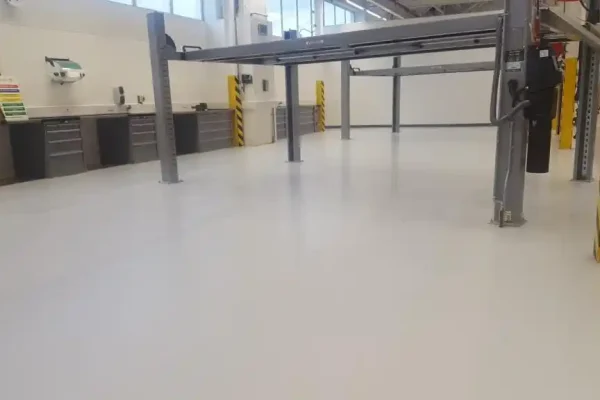
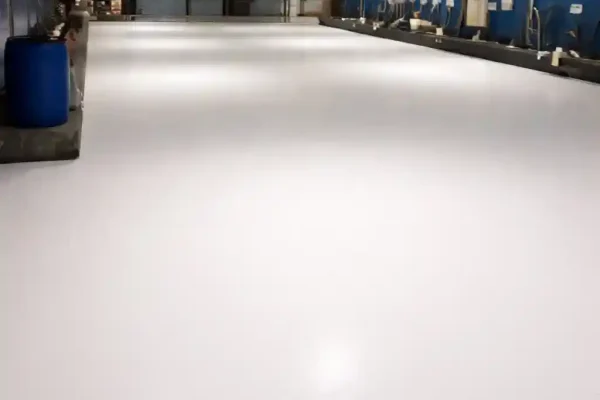
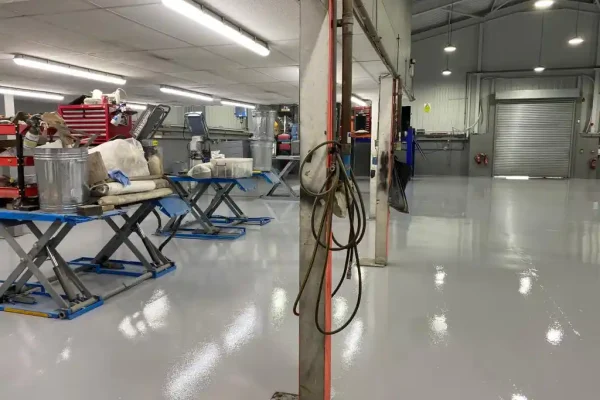
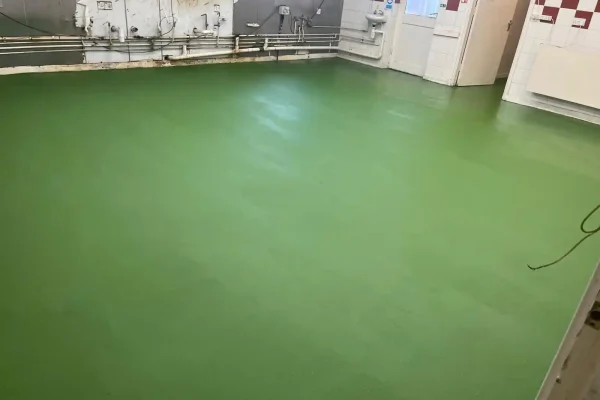
Resin flooring contractors Oldham engineering, manufacturing and storage occupiers rely on when the building is older than the specification. Supporting premises across Broadway Business Park, Hollinwood, Greenfield, Lees and the converted mill belt at Werneth and Chadderton.
Working for national manufacturers, logistics operators and public sector estates since 1999.
As resin flooring contractors Oldham occupiers call on regularly, we choose the system last. A large share of the town’s industrial floor area sits inside converted mills and mid-century factory buildings, close to the M60 and the A627(M), and those floors carry a century of history.
Oil and process contamination soaked into the concrete, previous coatings applied over unsound surfaces, patched repairs, moving joints, and sometimes composite construction never designed for today’s forklift loads.
So the headline risk here is delamination and joint failure caused by inadequate preparation and unassessed substrates, not simple wear. Survey, testing and preparation come first, and the system follows what is actually found.
A major industrial and logistics hub on the Chadderton side, close to the M60.
A mixed industrial and commercial area blending new-build and refurbished premises.
Light industrial and engineering use with regular vehicle movement to the east.
Manufacturing and storage units typical of the established industrial stock.
Multi-occupancy former textile buildings in light manufacturing and storage use.
Trade counters, wholesalers, vehicle workshops and roadside service units.
Uneven, contaminated and historically coated concrete needing full assessment first.
Cutting oils, coolants, swarf abrasion and dropped tooling impact at the benches.
Particle control, static considerations and cleanability around the machinery.
Trolley, pallet truck and customer traffic on floors that must also present well.
Fuel and solvent resistance plus measured grip around the wet inspection bays.
Hygiene detailing retrofitted into buildings never designed to carry any of it.
Most failures in Oldham’s converted stock trace back to preparation rather than product. Coating over an unsound, contaminated or damp surface reproduces the same failure on a new invoice, which is why the survey does the work here.
BS 8204-6 governs in-situ resin flooring, and pull-off testing establishes what the floor will hold.
Older concrete often has no damp-proof membrane, so testing is a survey outcome, not an upsell.
Inherited cracks and moving joints are detailed deliberately rather than covered and hoped over.
Multi-storey mills bring goods lifts, tight access and column grids into the project, so material handling and sequencing are worked out at survey rather than discovered on the first morning.
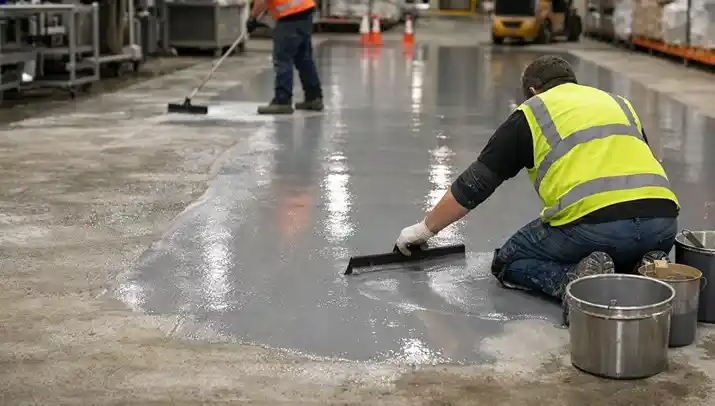
Work is taken floor by floor or bay by bay, with preparation time on unknown substrates built into the programme. On a converted floor that time is the variable, and we would rather price it honestly than discover it halfway through.
Preparation runs under H-class extraction with areas screened. Grinding contaminated mill concrete releases respirable crystalline silica, limited under EH40 to 0.1 mg per cubic metre over eight hours, and multi-occupancy buildings have neighbours throughout.
BS 8204-6 for in-situ resin flooring, where soundness and adhesion are established first.
Surface protection systems for concrete, the credible frame for repairing degraded floors.
The EH40 limit applies to our grinding works and to an untreated dusting floor in service.
EN 13501-1 with the fl suffix where floors sit in shared circulation in let buildings.
FeRFA classifies resin flooring into eight types by build-up and thickness, and BS 8204-6 governs which one a floor actually needs, with EN 13813 for the screed and EN 1504-2 where the concrete is being repaired. Polyaspartic and MMA sit outside that classification because they describe the resin chemistry rather than the build-up. In Oldham the substrate found decides the type.
FeRFA Type 1. Two or more coats up to 150 microns, binding a dusting substrate and giving a cleanable surface. From £8 per square metre.
FeRFA Type 2. Dual component to 300 microns, solvent free, in gloss, matt or silk. Chemical resistance with a decorative finish.
FeRFA Type 3. Up to 1000 microns over prepared concrete and the system specified on most industrial jobs. Takes colour well for demarcation.
FeRFA Type 4. Multi-coat build at 1 to 3mm with aggregate broadcast between coats, for impact and constant wear.
FeRFA Type 5. Flow-applied at 2 to 3mm for a seamless finish where hygiene and cleaning matter more than impact resistance.
FeRFA Type 7. Three part filled system at 4 to 6mm thickness, giving a self-smoothing finish for heavy and very heavy duty areas.
FeRFA Types 7 and 8. Trowel-applied at 6 to 9mm to take thermal shock, steam cleaning and constant heavy forklift traffic.
Cures at temperatures down to −5°C and is ready in around two hours. Installed overnight or at a weekend it can remove the need to shutdown entirely.
Cures in hours, but the odour can taint food, fabrics and stock and the area must be cleared and ventilated. Better suited to new build and refurbishment projects.
Rates run from £8 per square metre for a floor seal to £45 for MMA, inclusive of preparation, labour and materials. On converted stock the preparation and repair are priced separately, because that is where the cost actually varies.
| System | FeRFA | Thickness | Per m² |
|---|---|---|---|
| Floor Seal | Type 1 | Up to 150µm | From £8 |
| Epoxy and PU Coating | Type 2 | 150 – 300µm | £8 – £12 |
| High Build Coating | Type 3 | 300 – 1000µm | £8 – £12 |
| Multi-Layer Flooring | Type 4 | 1 – 3mm | £12 – £16 |
| Self-Smoothing | Type 5 | 2 – 4mm | £20 – £30 |
| Heavy Duty Flowable | Type 7 | 4 – 6mm | £25 – £35 |
| Heavy Duty PU Screed | Type 8 | 6 – 9mm | £30 – £40 |
| Polyaspartic | Chemistry | 300 – 500µm | £38 |
| MMA | Chemistry | 2 – 6mm | £45 |
Inclusive of preparation, labour and materials. Rates assume a sound, accessible substrate and are indicative until the floor has been surveyed. Polyaspartic and MMA sit outside the FeRFA type classification because they describe the resin chemistry rather than the build-up.
A three day shutdown at a plant turning over £2,000 an hour is £120,000 of lost output. On most sites that is several times the price of the floor.
Five contractors quoted one timber processing plant. All five proposed the same system and a three to four day closure. None of them costed the closure.
We proposed a faster-curing system installed across a weekend. A higher rate per square metre, and no shutdown at all. On the client’s own figures the avoided losses exceeded the price of the floor.
We install evenings, weekends and one bay at a time.
Whether a shutdown costs you thousands an hour or simply gets in the way, you do not always have to close your site for a resin flooring installation.
Mechanical removal of failed coatings and contamination, with crack and joint treatment.
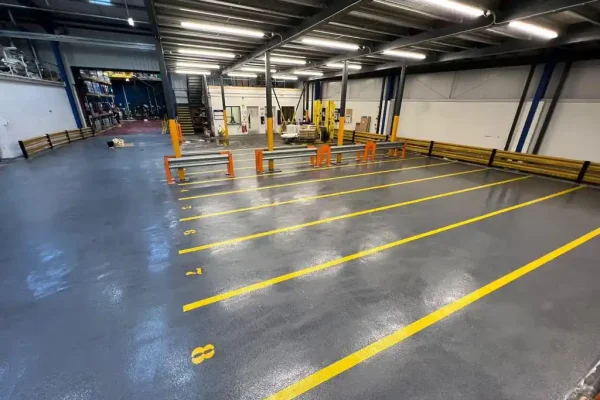
Pedestrian routes marked where segregation by distance is impossible in a mill layout.
Damp proof membrane where a substrate fails moisture testing, as a standalone package.
Contaminated, coated concrete assessed, prepared and overlaid rather than replaced.
Coolant and oil resistant systems detailed around benches and machine bases.
Coving, falls and drainage created in premises never designed to carry them.
We work across the borough regularly, from Broadway Business Park and Hollinwood through to Greenfield, Lees, the mill belt at Werneth and Chadderton and the trade units along the A62. We are Cheshire based, so a survey usually happens within days and there is no mobilisation charge for attending.

Only if what is underneath will hold it, and in converted stock it frequently will not. Coating over an unsound, contaminated or damp surface reproduces the same failure on a new invoice. We test adhesion and moisture first and tell you plainly what the floor will support.
Usually, once the contamination is removed. Historic oils and process residues stop anything bonding, so the affected concrete is ground out rather than sealed over. EN 1504-2 covers protecting and repairing degraded concrete, which is the honest frame for most of these floors.
They get a strategy rather than a coat of resin. Some are dormant and some are still moving, and the treatment differs. A finish laid across a live joint simply reproduces the crack at the surface within months, so they are detailed before anything is applied.
It is a constraint to plan for, not a barrier. Lift capacity, access routes and column grids affect material handling and sequencing, so we establish them at survey rather than on the first morning, and the programme is built around what can physically reach the floor.
From £8 per square metre for a floor seal up to £45 for MMA, inclusive of preparation, labour and materials. On converted stock preparation and repair are priced separately once the floor has been surveyed. The full table by system is on the cost page.
Rochdale · Middleton · Ashton-under-Lyne · Manchester · Denton · Heywood · Bury
Tell us how old the building is, what has been spilled on the floor and what failed last time. We attend, test the substrate, and put a written specification and a fixed price in front of you at no cost.