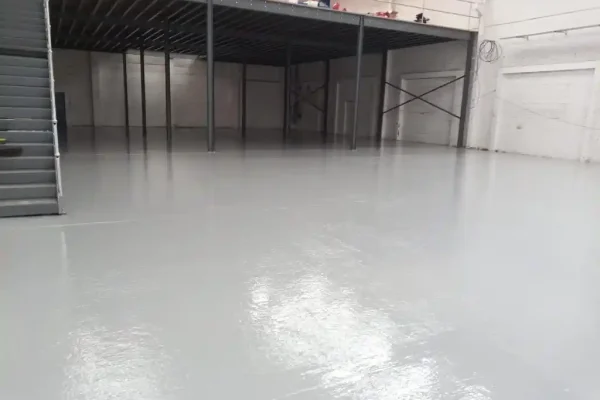
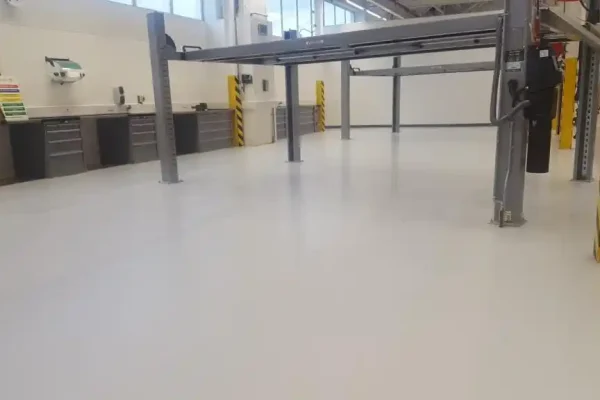
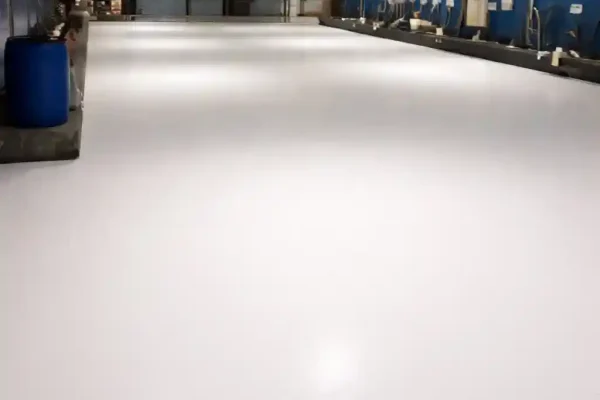
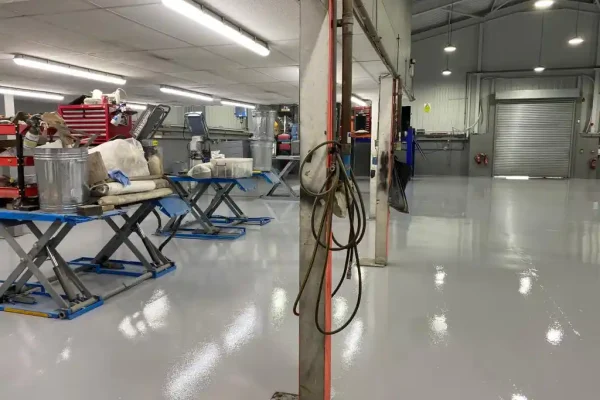
Resin flooring contractors Sheffield engineering, precision manufacturing and technical operators rely on for floors chosen around what is already in the concrete. Supporting facilities from Sheffield Business Park and the Advanced Manufacturing Park to Darnall, Attercliffe and the Lower Don Valley.
Working for national manufacturers, logistics operators and public sector estates since 1999.
As resin flooring contractors Sheffield operators call on regularly, we work where very old and very advanced industry sit in the same district. The Lower Don Valley runs from Attercliffe through Darnall to Tinsley, with the M1 skirting the eastern edge at Junctions 33 to 35 and the Parkway feeding the centre.
Along that spine the works stock carries concrete laid in an era of hot metal and heavy plant, patched repeatedly and saturated with decades of oil and coolant. Chemical staining and contamination, not gradual wear, is what ends the life of those floors.
Minutes away sit precision units, laboratory space and research-linked facilities where contamination control and non-dusting surfaces are the entire specification. It is the same city, and frequently the same street.
Manufacturing, engineering and logistics facilities at Junction 33 with high throughput.
High-precision manufacturing on the eastern edge with controlled production requirements.
Established industrial zones supporting fabrication, warehousing, engineering and trade.
The Brightside Lane, Carbrook and Shepcote Lane frontage running out towards Tinsley.
Manufacturing and industrial estates at Chapeltown on the northern edge of the city.
Converted Victorian stock in mixed commercial, food and light industrial use.
Non-dusting, seamless, chemically resistant and dimensionally stable production finishes.
Impact from dropped stock, abrasive scale and very heavy static machine base loads.
Seamless, coved, disinfectant-resistant and occasionally electrostatically controlled.
Washdown tolerance, hygiene detailing, coving and correct falls to the drainage.
Seamless infection-control surfaces under castor traffic and repeated chemical cleaning.
Oil tolerance, measured slip performance and durability in narrow high-use spaces.
A legacy works floor in the Don Valley has absorbed oil and coolant for decades. That single fact governs the preparation method and the system choice before anything on a datasheet does, and ignoring it guarantees the next floor fails too.
Oil ingress and its depth are established at survey, because adhesion depends on it far more than on which resin is chosen.
Worn power-floated and screeded surfaces shed fines that compromise air quality and quality-controlled production alike.
Heavy machine bases and light clean areas share buildings here, so one envelope can honestly need two specifications.
Across this city the buildings stay in use. A production line runs, a research programme continues, a ward or a teaching space has to reopen, so sequencing is agreed before a system is selected rather than afterwards.
Work is taken zone by zone, room by room or into planned shutdowns, with rapid-cure systems where an area has to be handed back for the next session or shift. Where polyurethane screeds are specified, ISOPA and ALIPA diisocyanate training records apply and every operative holds current REACH certification.
Preparation runs under H-class extraction with areas screened. Grinding legacy works concrete releases respirable crystalline silica, limited under EH40 to 0.1 mg per cubic metre over eight hours, and it can disturb historic contamination at the same time.
The EH40 limit of 0.1 mg per cubic metre over eight hours applies to the finished floor and to preparation.
Seamless, non-dusting systems with coving specified deliberately rather than added as an afterthought.
EN 1081 resistance testing for genuinely sensitive electronics, precision and laboratory environments.
EN 13501-1 reaction to fire with the fl suffix, and Equality Act contrast in public-access buildings.
FeRFA classifies resin flooring into eight types by build-up and thickness, and BS 8204-6 governs which one a floor actually needs, with EN 13813 for the screed and EN 1504-2 where the concrete is being protected. Polyaspartic and MMA sit outside that classification because they describe the resin chemistry rather than the build-up. In Sheffield the type is chosen area by area rather than building by building.
FeRFA Type 1. Two or more coats up to 150 microns, binding a dusting substrate and giving a cleanable surface. From £8 per square metre.
FeRFA Type 2. Dual component to 300 microns, solvent free, in gloss, matt or silk. Chemical resistance with a decorative finish.
FeRFA Type 3. Up to 1000 microns over prepared concrete and the system specified on most industrial jobs. Takes colour well for demarcation.
FeRFA Type 4. Multi-coat build at 1 to 3mm with aggregate broadcast between coats, for impact and constant wear.
FeRFA Type 5. Flow-applied at 2 to 3mm for a seamless finish where hygiene and cleaning matter more than impact resistance.
FeRFA Type 7. Three part filled system at 4 to 6mm thickness, giving a self-smoothing finish for heavy and very heavy duty areas.
FeRFA Types 7 and 8. Trowel-applied at 6 to 9mm to take thermal shock, steam cleaning and constant heavy forklift traffic.
Cures at temperatures down to −5°C and is ready in around two hours. Installed overnight or at a weekend it can remove the need to shutdown entirely.
Cures in hours, but the odour can taint food, fabrics and stock and the area must be cleared and ventilated. Better suited to new build and refurbishment projects.
Rates run from £8 per square metre for a floor seal to £45 for MMA, inclusive of preparation, labour and materials. On legacy works concrete the preparation is priced separately, because contamination is the variable nobody can quote by eye.
| System | FeRFA | Thickness | Per m² |
|---|---|---|---|
| Floor Seal | Type 1 | Up to 150µm | From £8 |
| Epoxy and PU Coating | Type 2 | 150 – 300µm | £8 – £12 |
| High Build Coating | Type 3 | 300 – 1000µm | £8 – £12 |
| Multi-Layer Flooring | Type 4 | 1 – 3mm | £12 – £16 |
| Self-Smoothing | Type 5 | 2 – 4mm | £20 – £30 |
| Heavy Duty Flowable | Type 7 | 4 – 6mm | £25 – £35 |
| Heavy Duty PU Screed | Type 8 | 6 – 9mm | £30 – £40 |
| Polyaspartic | Chemistry | 300 – 500µm | £38 |
| MMA | Chemistry | 2 – 6mm | £45 |
Inclusive of preparation, labour and materials. Rates assume a sound, accessible substrate and are indicative until the floor has been surveyed. Polyaspartic and MMA sit outside the FeRFA type classification because they describe the resin chemistry rather than the build-up.
A three day shutdown at a plant turning over £2,000 an hour is £120,000 of lost output. On most sites that is several times the price of the floor.
Five contractors quoted one timber processing plant. All five proposed the same system and a three to four day closure. None of them costed the closure.
We proposed a faster-curing system installed across a weekend. A higher rate per square metre, and no shutdown at all. On the client’s own figures the avoided losses exceeded the price of the floor.
We install evenings, weekends and one bay at a time.
Whether a shutdown costs you thousands an hour or simply gets in the way, you do not always have to close your site for a resin flooring installation.
Grinding out oil-ingressed concrete and making good around machine bases and old repairs.
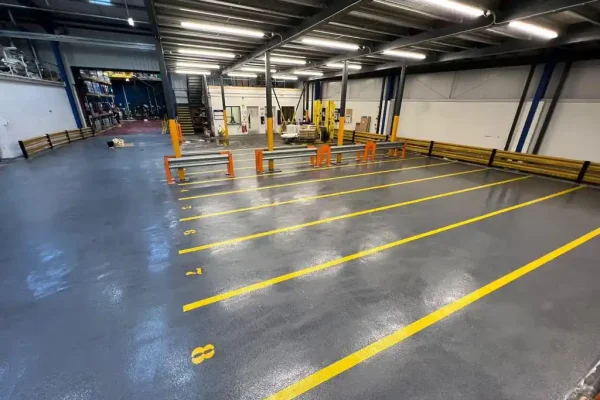
Traffic routes, walkways and process zone separation applied in resin rather than tape.
Damp proof membrane where a substrate fails moisture testing, as a standalone package.
Contaminated Don Valley concrete decontaminated, prepared under extraction and made good.
Non-dusting seamless finishes phased so production and research continue throughout.
Coved, cleanable systems installed room by room around continuing operational use.
We work across the city regularly, from Sheffield Business Park and the Advanced Manufacturing Park through to Darnall, Attercliffe, the Lower Don Valley frontage, Thorncliffe at Chapeltown and the Kelham Island units. We are Cheshire based, so a survey usually happens within days and there is no mobilisation charge for attending.
Yes, but only after the contamination is dealt with. Oil ingress governs the preparation method and the system choice before any datasheet does, so we establish how deep it goes at survey and grind it out. A system applied over saturated concrete will lift, whatever it cost.
Because the duties inside it genuinely differ. A heavy machine base area and a clean production or inspection area in the same envelope need different build-ups, and averaging them gives you a floor that is over-specified in one place and inadequate in another. We would rather quote two systems and explain why.
Yes. Worn works concrete sheds respirable crystalline silica, limited under EH40 to 0.1 mg per cubic metre over an eight-hour period, and that applies to our preparation works as much as to your finished floor. In quality-controlled production it is also a contamination problem for the product.
Yes. Those areas are taken room by room with H-class extraction and screening so dust does not travel, and seamless coved detailing is specified deliberately rather than added on. Where reaction to fire matters in an occupied public building, EN 13501-1 classification is stated rather than left open.
From £8 per square metre for a floor seal up to £45 for MMA, inclusive of preparation, labour and materials. Precision, laboratory and healthcare finishes sit at the upper end, with preparation on legacy concrete priced separately. The full table by system is on the cost page.
Rotherham · Barnsley · Chesterfield · Doncaster · Worksop · Mexborough · Huddersfield
Tell us how old the building is, what has soaked into the floor and how clean the area must stay. We attend, test the substrate, and put a written specification and a fixed price in front of you at no cost.