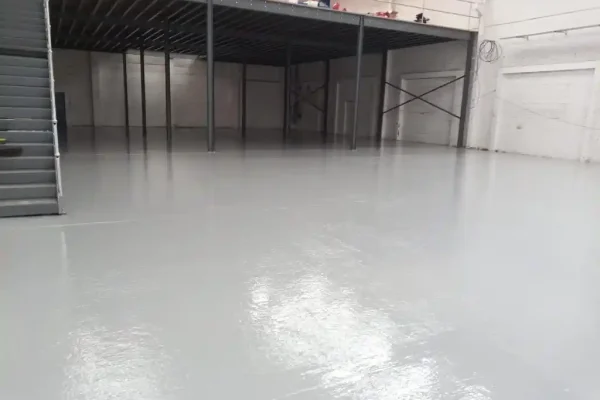
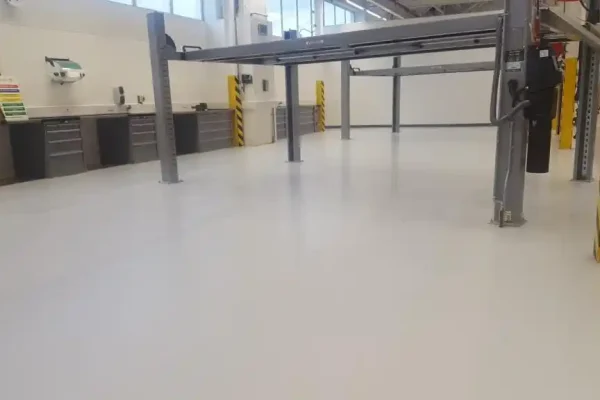
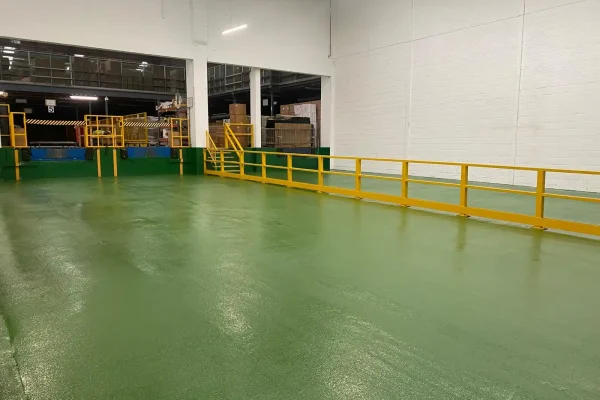
Resin flooring contractors Doncaster logistics, cold-chain and rail engineering operators rely on for floors that take constant transfer. Supporting distribution and industrial facilities from iPort and Gateway East to West Moor Park, Lakeside and Wheatley Hall Road.
Working for national manufacturers, logistics operators and public sector estates since 1999.
As resin flooring contractors Doncaster operators call on regularly, we specify around movement rather than storage. The town sits where the M18, the A1(M) and the East Coast Main Line meet, with the M180 running on towards the Humber, and its buildings work the interface between transport modes.
Rail sidings and terminals, an airport-linked business area, navigation wharves and a motorway network that keeps buildings loading around the clock. Goods here cross the floor rather than resting on it.
That changes the geometry of the damage. Wear concentrates at dock positions, along transfer routes and in turning circles instead of spreading evenly, so the heavier build-up belongs in specific lines and a lighter system elsewhere is the honest answer.
A nationally significant rail-linked distribution hub with large-format warehousing capacity.
Logistics, warehousing and industrial operations with consistently high vehicle movement.
Big-box warehousing and logistics at Junction 4 of the M18, alongside Armthorpe estate.
Manufacturing, logistics and trade units running along the A6182 corridor east of town.
Distribution and industrial units on the northern approach at Junction 38 of the A1(M).
Depot, maintenance and heavy engineering floorspace to the south of the town centre.
Abrasion resistance, joint protection and racking point-load tolerance over large areas.
Linear wear along transfer routes with heavy loading at every dock position.
Thermal cycling, condensation and slip risk at every temperature transition.
Washdown, hygiene detailing, coving and correct falls to drainage throughout.
Oils, fuels and greases with pit edges, jacking points and very high static loads.
Dock-edge deterioration and hard-wheeled trailer traffic across the yard interface.
Damage in a cross-dock building is not scattered. It sits at the levellers, runs along the transfer lines between doors and gathers in the turning circles, which means it can be specified for in advance rather than discovered later.
Trailer feet, dropped loads and hard wheels crossing a level change crater the same few metres every day.
Goods crossing between doors wear a line rather than an area, so the build-up follows the actual route.
Temperature differentials and condensation at chilled thresholds push the answer towards polyurethane.
Almost nothing here closes. Buildings load around the clock, so return to service is the specification driver rather than material cost, and phased and zoned working is the assumption before anything is priced.
Where cure speed matters, polyaspartic and MMA are explained through how they actually behave, including odour, temperature sensitivity and sequencing. We give you curing behaviour rather than a promised completion time, because a promise that slips on a live despatch operation costs far more than the floor.
Where polyurethane screeds are specified, and in chilled and washdown areas they usually are, ISOPA and ALIPA diisocyanate training records apply and every operative holds current REACH certification.
In dense cross-dock buildings, designed crossings and walkways rather than paint added afterwards.
BS 7976 pendulum values at dock thresholds, chilled transitions and washdown areas alike.
Seamless surfaces, coved skirtings and drainage falls across storage, packing and cold chain.
Bunding at 110% of capacity around depot refuelling, plant maintenance and bulk storage areas.
FeRFA classifies resin flooring into eight types by build-up and thickness, and BS 8204-6 governs which one a floor actually needs, with EN 13813 for the screed. Polyaspartic and MMA sit outside that classification because they describe the resin chemistry rather than the build-up, and in Doncaster they are chosen for return to service rather than for performance.
FeRFA Type 1. Two or more coats up to 150 microns, binding a dusting substrate and giving a cleanable surface. From £8 per square metre.
FeRFA Type 2. Dual component to 300 microns, solvent free, in gloss, matt or silk. Chemical resistance with a decorative finish.
FeRFA Type 3. Up to 1000 microns over prepared concrete and the system specified on most industrial jobs. Takes colour well for demarcation.
FeRFA Type 4. Multi-coat build at 1 to 3mm with aggregate broadcast between coats, for impact and constant wear.
FeRFA Type 5. Flow-applied at 2 to 3mm for a seamless finish where hygiene and cleaning matter more than impact resistance.
FeRFA Type 7. Three part filled system at 4 to 6mm thickness, giving a self-smoothing finish for heavy and very heavy duty areas.
FeRFA Types 7 and 8. Trowel-applied at 6 to 9mm to take thermal shock, steam cleaning and constant heavy forklift traffic.
Cures at temperatures down to −5°C and is ready in around two hours. Installed overnight or at a weekend it can remove the need to shutdown entirely.
Cures in hours, but the odour can taint food, fabrics and stock and the area must be cleared and ventilated. Better suited to new build and refurbishment projects.
Rates run from £8 per square metre for a floor seal to £45 for MMA, inclusive of preparation, labour and materials. On a 24-hour operation the second number matters more: lost despatch usually outweighs the rate on the quotation.
| System | FeRFA | Thickness | Per m² |
|---|---|---|---|
| Floor Seal | Type 1 | Up to 150µm | From £8 |
| Epoxy and PU Coating | Type 2 | 150 – 300µm | £8 – £12 |
| High Build Coating | Type 3 | 300 – 1000µm | £8 – £12 |
| Multi-Layer Flooring | Type 4 | 1 – 3mm | £12 – £16 |
| Self-Smoothing | Type 5 | 2 – 4mm | £20 – £30 |
| Heavy Duty Flowable | Type 7 | 4 – 6mm | £25 – £35 |
| Heavy Duty PU Screed | Type 8 | 6 – 9mm | £30 – £40 |
| Polyaspartic | Chemistry | 300 – 500µm | £38 |
| MMA | Chemistry | 2 – 6mm | £45 |
Inclusive of preparation, labour and materials. Rates assume a sound, accessible substrate and are indicative until the floor has been surveyed. Polyaspartic and MMA sit outside the FeRFA type classification because they describe the resin chemistry rather than the build-up.
A three day shutdown at a plant turning over £2,000 an hour is £120,000 of lost output. On most sites that is several times the price of the floor.
Five contractors quoted one timber processing plant. All five proposed the same system and a three to four day closure. None of them costed the closure.
We proposed a faster-curing system installed across a weekend. A higher rate per square metre, and no shutdown at all. On the client’s own figures the avoided losses exceeded the price of the floor.
We install evenings, weekends and one bay at a time.
Whether a shutdown costs you thousands an hour or simply gets in the way, you do not always have to close your site for a resin flooring installation.
Arris rebuilding, crack stitching and flexible sealing across aprons and leveller zones.
Crossings, walkways and exclusion zones set out as a scheme and applied in resin, not paint.
Damp proof membrane where a substrate fails moisture testing, as a standalone package.
Heavy-duty build-ups along transfer lines and at levellers, phased door by door.
Polyurethane screeds with coving and falls, installed at working store temperatures.
Oil and fuel resistant floors around pits, jacking points and heavy static loads.
We work across the borough regularly, from iPort at Rossington and the Gateway East area through to West Moor Park, Armthorpe, Lakeside, Redhouse Interchange and the Wheatley Hall Road units. We are Cheshire based, so a survey usually happens within days and there is no mobilisation charge for attending.

Because goods cross the building rather than sitting in it. In a cross-dock operation the traffic runs between specific doors along the same routes all day, so the wear follows those lines. It means the heavier build-up can be put where it is needed and a lighter system used honestly elsewhere.
Rebuilding the arris rather than recoating over it. Trailer feet, dropped loads and hard wheels crossing a level change concentrate impact into a very few metres, so those edges are repaired in structural resin and detailed to take the impact rather than treated as part of the main floor.
Usually. Systems are selected to cure at the temperature the store actually runs at, and polyurethane is specified rather than epoxy because it tolerates the thermal cycling and condensation at chilled transitions. The programme is built around the store, not the other way round.
That depends on the system and the conditions, and we will give you cure behaviour rather than a promised completion time. Polyaspartic and MMA return a floor to service quickly but carry compromises in odour, cost and temperature sensitivity, and we would rather set those out than have a promise slip on a live despatch operation.
From £8 per square metre for a floor seal up to £45 for MMA, inclusive of preparation, labour and materials. On a continuous operation the cost of lost despatch usually outweighs the rate. The full table by system is on the cost page, with a calculator that adds the cost of stopped operations.
Tell us which doors take the traffic, how cold the area runs and when a bay can be released. We attend, test the substrate, and put a written specification and a fixed price in front of you at no cost.