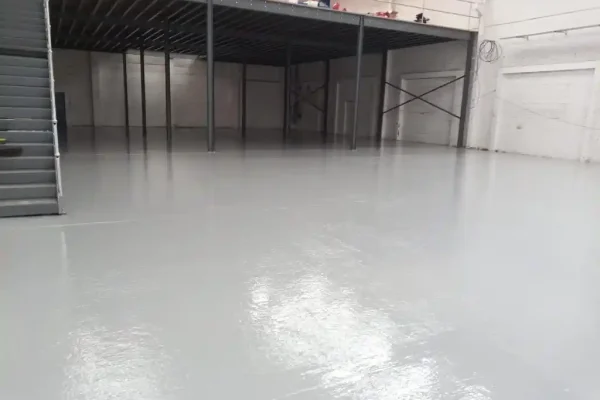
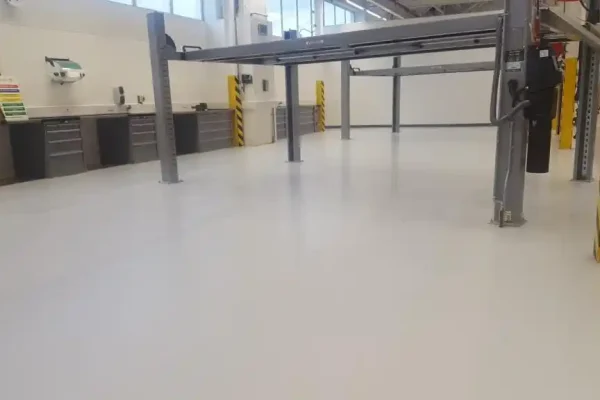
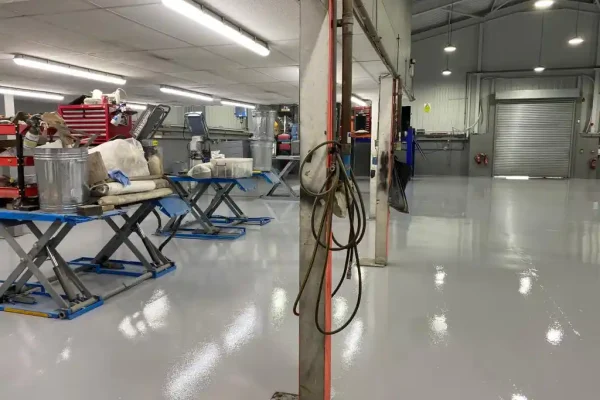
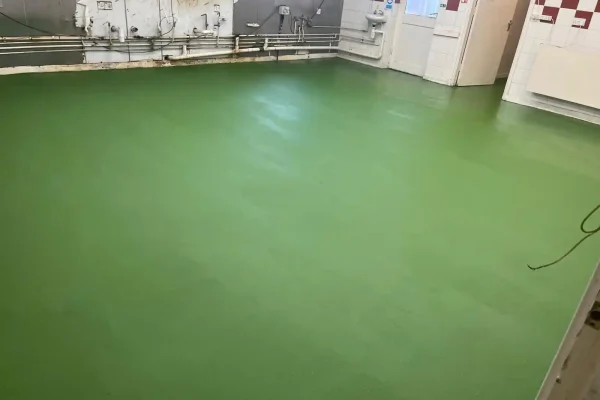
Resin flooring contractors Mexborough workshop, warehouse and trade occupiers rely on when the last floor did not last. Supporting small and mid-sized units from the Pastures Road industrial area and the Denaby premises to the Dearne Valley Parkway corridor.
Working for national manufacturers, logistics operators and public sector estates since 1999.
As resin flooring contractors Mexborough occupiers call on regularly, we spend the first visit working out what is already there. The town sits in the lower Dearne Valley where the Dearne joins the Don, on the A6023 between Swinton and Denaby, just off the Dearne Valley Parkway.
Its industrial character is set by unit size and building age rather than by one dominant sector. Multi-occupancy estates of small and mid-sized warehouse and workshop units predominate, and many have been fitted out several times over.
So floors here come with layered histories: old sealers, spot repairs, machine base grouting, oil staining and worn power-float finishes, one on top of another. What goes on next depends entirely on what comes off first.
Warehousing and industrial units linking the town to the Dearne Valley Parkway corridor.
Established industrial and storage units sitting immediately east of the town itself.
The main employment spine serving Mexborough, Swinton, Wath and Goldthorpe.
The nearest large reclaimed-coalfield employment area, at Wath upon Dearne.
Canal-side industrial and storage premises along the Don between here and Denaby.
Trade counters, motor trade and commercial premises running through the town.
Abrasion resistance and dust control across concrete of genuinely uncertain history.
Impact resistance, oil tolerance and cleanability around the fixed machine bases.
Fuel, oil and brake fluid exposure with pit edges and concentrated wheel loads.
Mixed public and forklift traffic with slip risk at wet and open entrances.
Cage and pallet truck wear running the length of long internal corridors.
Seamless, coved detailing with resistance to the cleaning chemicals in daily use.
Most floors we are called to here have been coated before, and the coating has lifted. The product on the tin was rarely the problem. A thin system over a contaminated or unsound surface has nothing to hold on to, and it will always come away.
Adhesion, soundness and moisture checked on what is actually there, because a layered floor cannot be judged by eye.
Older canal and river-side premises can carry moisture that needs establishing before any system is put forward.
Storage, workshop, counter and office areas share one floor here, so the changes between finishes are detailed.
Occupiers here usually hold a single building with nowhere to move to, so disruption tolerance is low and it shapes the programme rather than being accommodated at the end of it.
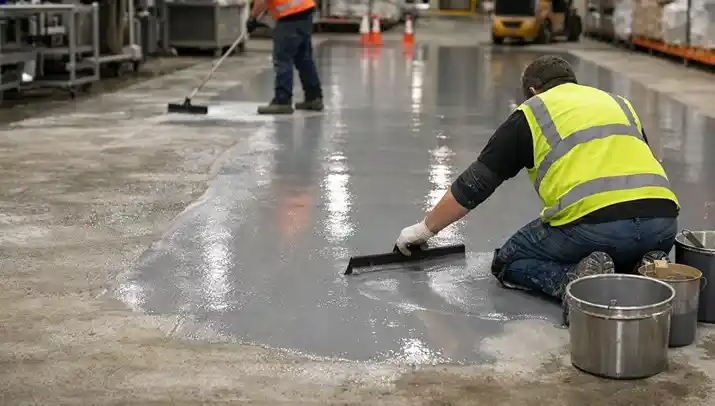
Floors are taken zone by zone or over a weekend, with storage, workshop and counter areas handed back in sequence so the business keeps trading throughout. A fit-out is the cheapest moment to get specification, transitions and demarcation right, and worth planning properly if the timing allows.
Preparation runs under H-class extraction with areas screened. Grinding a worn floor releases respirable crystalline silica, limited under EH40 to 0.1 mg per cubic metre over eight hours, and in a small unit there is nowhere for that dust to go.
The EH40 limit of 0.1 mg per cubic metre over eight hours makes sealing worn concrete a COSHH matter.
EN 1504-2 protection principles with BS 8204-6 explain why preparation and testing precede system choice.
The FeRFA range and EN 13813 show where a seal is genuinely adequate and where a screed is required.
BS 7976 pendulum values at trade counters, with Equality Act contrast at thresholds and level changes.
FeRFA classifies resin flooring into eight types by build-up and thickness, and BS 8204-6 governs which one a floor actually needs, with EN 13813 for the screed and EN 1504-2 where the concrete needs protecting. Polyaspartic and MMA sit outside that classification because they describe the resin chemistry rather than the build-up. In Mexborough the honest question is usually which of the lighter types is genuinely enough.
FeRFA Type 1. Two or more coats up to 150 microns, binding a dusting substrate and giving a cleanable surface. From £8 per square metre.
FeRFA Type 2. Dual component to 300 microns, solvent free, in gloss, matt or silk. Chemical resistance with a decorative finish.
FeRFA Type 3. Up to 1000 microns over prepared concrete and the system specified on most industrial jobs. Takes colour well for demarcation.
FeRFA Type 4. Multi-coat build at 1 to 3mm with aggregate broadcast between coats, for impact and constant wear.
FeRFA Type 5. Flow-applied at 2 to 3mm for a seamless finish where hygiene and cleaning matter more than impact resistance.
FeRFA Type 7. Three part filled system at 4 to 6mm thickness, giving a self-smoothing finish for heavy and very heavy duty areas.
FeRFA Types 7 and 8. Trowel-applied at 6 to 9mm to take thermal shock, steam cleaning and constant heavy forklift traffic.
Cures at temperatures down to −5°C and is ready in around two hours. Installed overnight or at a weekend it can remove the need to shutdown entirely.
Cures in hours, but the odour can taint food, fabrics and stock and the area must be cleared and ventilated. Better suited to new build and refurbishment projects.
Rates run from £8 per square metre for a floor seal to £45 for MMA, inclusive of preparation, labour and materials. On a floor with a history the preparation is priced separately, because that is the part nobody can quote by eye.
| System | FeRFA | Thickness | Per m² |
|---|---|---|---|
| Floor Seal | Type 1 | Up to 150µm | From £8 |
| Epoxy and PU Coating | Type 2 | 150 – 300µm | £8 – £12 |
| High Build Coating | Type 3 | 300 – 1000µm | £8 – £12 |
| Multi-Layer Flooring | Type 4 | 1 – 3mm | £12 – £16 |
| Self-Smoothing | Type 5 | 2 – 4mm | £20 – £30 |
| Heavy Duty Flowable | Type 7 | 4 – 6mm | £25 – £35 |
| Heavy Duty PU Screed | Type 8 | 6 – 9mm | £30 – £40 |
| Polyaspartic | Chemistry | 300 – 500µm | £38 |
| MMA | Chemistry | 2 – 6mm | £45 |
Inclusive of preparation, labour and materials. Rates assume a sound, accessible substrate and are indicative until the floor has been surveyed. Polyaspartic and MMA sit outside the FeRFA type classification because they describe the resin chemistry rather than the build-up.
A three day shutdown at a plant turning over £2,000 an hour is £120,000 of lost output. On most sites that is several times the price of the floor.
Five contractors quoted one timber processing plant. All five proposed the same system and a three to four day closure. None of them costed the closure.
We proposed a faster-curing system installed across a weekend. A higher rate per square metre, and no shutdown at all. On the client’s own figures the avoided losses exceeded the price of the floor.
We install evenings, weekends and one bay at a time.
Whether a shutdown costs you thousands an hour or simply gets in the way, you do not always have to close your site for a resin flooring installation.
Removing old coatings, filling spot repairs and making good around former machine bases.
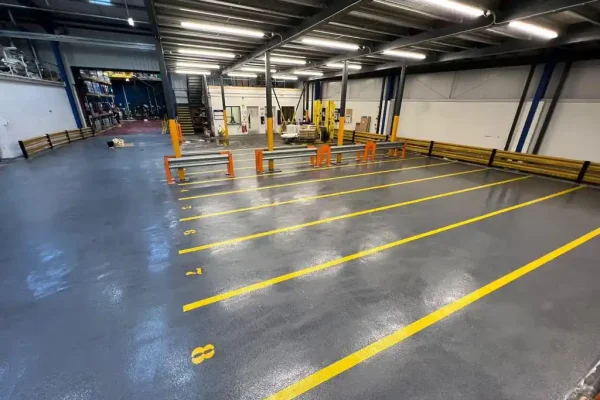
Forklift routes, walkways and customer separation applied in resin rather than in tape.
Damp proof membrane where a substrate fails moisture testing, as a standalone package.
Old coatings removed, concrete tested and a system matched to what is actually beneath.
Storage, workshop and counter areas finished separately with detailed transitions.
Slip-measured, presentable floors where public footfall meets forklift movement.
We work across the lower Dearne Valley regularly, from the Pastures Road area and the Denaby units through to the Dearne Valley Parkway corridor and the A6023 through the town. We are Cheshire based, so a survey usually happens within days and there is no mobilisation charge for attending.
Not if the reason is found first. Delamination is almost always a preparation failure rather than a product failure: a thin system applied over contaminated or unsound concrete has nothing to bond to. We grind back mechanically and test adhesion before specifying anything, so the same thing does not happen twice.
Yes, as a health matter rather than housekeeping. Worn concrete sheds fines continuously, contaminating stock and putting respirable crystalline silica into the air people work in. EH40 sets a limit of 0.1 mg per cubic metre over eight hours, so sealing the floor is a control measure.

In a lot of Mexborough units a coating or a seal is genuinely enough, and we would rather tell you that than sell you a screed. The FeRFA range exists so a seal, a coating and a multi-layer can be compared honestly against your actual duty and your budget.
Each area is specified for what it does, with the transitions between them detailed deliberately rather than left as a join. A fit-out is the cheapest time to get that right, so if the timing allows it is worth planning before the unit is occupied.
From £8 per square metre for a floor seal up to £45 for MMA, inclusive of preparation, labour and materials. Most work here sits at the lower end, with preparation priced separately. The full table by system is on the cost page.
Tell us what is on the floor now, how the unit is used and when it can be released. We attend, test the substrate, and put a written specification and a fixed price in front of you at no cost.