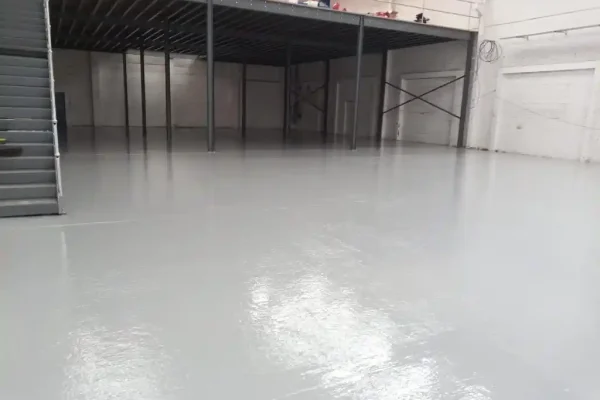
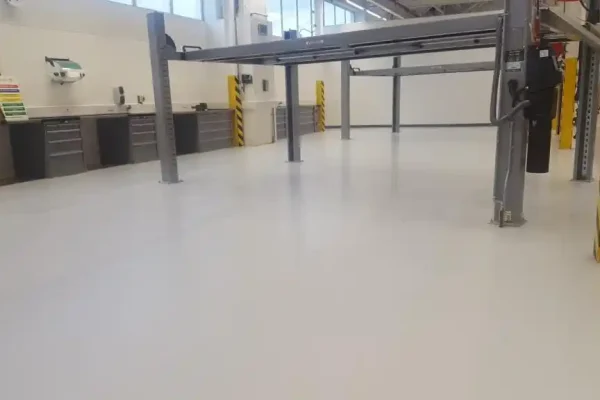
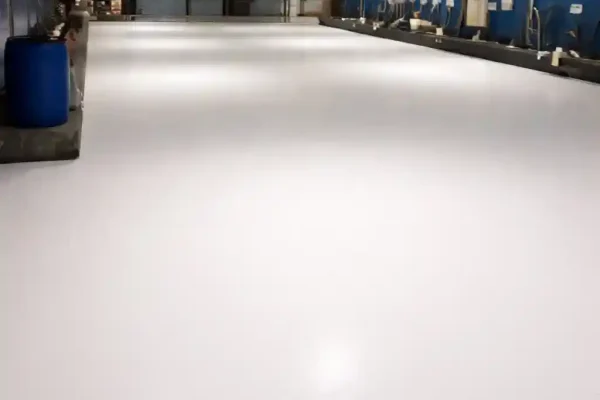
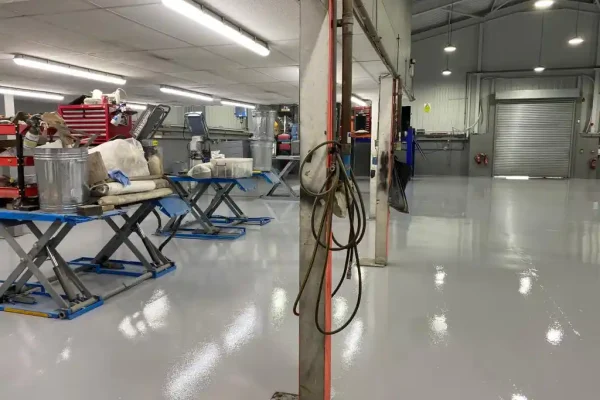
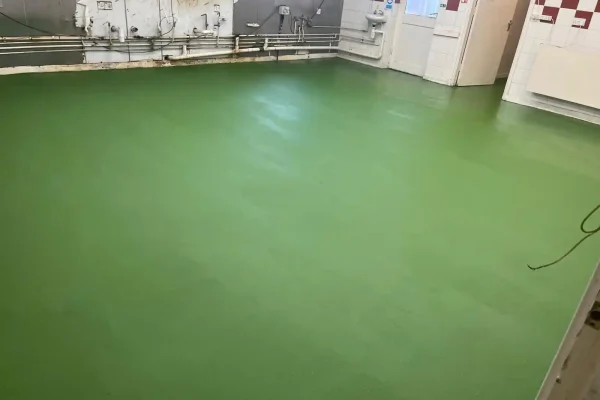
Resin flooring contractors Rotherham metals, engineering and advanced manufacturing operators rely on for floors that take impact before abrasion. Supporting facilities from the Templeborough and Aldwarke corridor to the Advanced Manufacturing Park at Waverley and the units at Hellaby.
Working for national manufacturers, logistics operators and public sector estates since 1999.
As resin flooring contractors Rotherham operators call on regularly, we specify against two contradictory briefs a few kilometres apart. The borough wraps around the metals corridor running from Templeborough through Aldwarke and out along the Sheffield Road, framed by Junctions 33 and 34 of the M1 and Junction 1 of the M18.
Along the Don Valley the floors carry forging, rolling and fabrication: heavy static machine loads, dropped sections, hot swarf, cutting fluids and abrasive scale. The damage is impact cratering and chemical staining rather than gradual wear.
At the Advanced Manufacturing Park the same borough asks the opposite. Precision machining, composites and test facilities where dust generation, static control and cleanability decide the specification. Treating Rotherham as a warehousing town misses both.
Precision, research-linked and high-specification manufacturing at Waverley and Catcliffe.
The working metals belt running along the Don between Rotherham and Tinsley.
Heavy engineering, steel processing and fabrication premises north-east of the centre.
Established industrial, storage and trade units sitting close to the town centre.
Manufacturing and distribution units along the northern approach into the borough.
Warehousing, distribution and industrial units at Junction 1 of the M18 east of town.
Impact resistance, very high static loads, heat exposure and abrasive scale underfoot.
Dropped tooling, oil and coolant exposure and concentrated wear around machine bases.
Non-dusting, chemically resistant and dimensionally stable finishes for critical work.
Seamless, coved and, where genuinely required, electrostatically controlled floors.
Acid and alkali resistance with bunded containment detailing around the tank lines.
Abrasion resistance, joint protection and racking point-load tolerance at Hellaby.
Abrasion is gradual and predictable. A dropped billet, section or tool is neither. It craters the surface in one event, and an abrasion-rated coating chosen on wear figures alone will not survive the first time it happens.
BS 8204-6 with FeRFA Types 5 to 8 and EN 13813 is the framework for why forging floors need a build-up, not a film.
Cutting oils, coolants, quench media and degreasers stain, soften and undermine an inadequately specified system.
Steam cleaning and heat-adjacent process areas justify polyurethane screeds where epoxy would crack at the bond.
Neither end of the borough stops easily. A rolling or forging line runs continuously and a precision facility cannot admit dust, so the sequence is agreed before a system is chosen rather than after.
Work is taken bay by bay or into planned shutdowns, with detailing formed up to machine bases and plinths rather than stopping short of them. Where polyurethane screeds are specified, and near heat and washdown they usually are, ISOPA and ALIPA diisocyanate training records apply and every operative holds current REACH certification.
Preparation runs under H-class extraction with shared areas screened. At the precision end that is a quality requirement as much as a health one, because dust reaching a machining or test area is a production problem.
BS 8204-6 with FeRFA Types 5 to 8 and EN 13813 covering the screed for forging and fabrication.
Protecting concrete exposed to oils, coolants, quench fluids and degreasers along the corridor.
EN 1081 resistance testing, cited for genuinely sensitive precision areas rather than site wide.
Bunding to 110% of capacity around process chemical, maintenance and fuel storage areas.
FeRFA classifies resin flooring into eight types by build-up and thickness, and BS 8204-6 governs which one a floor actually needs, with EN 13813 for the screed and EN 1504-2 where the concrete is being protected. Polyaspartic and MMA sit outside that classification because they describe the resin chemistry rather than the build-up. In Rotherham the answer differs sharply between the Don Valley and the precision end.
FeRFA Type 1. Two or more coats up to 150 microns, binding a dusting substrate and giving a cleanable surface. From £8 per square metre.
FeRFA Type 2. Dual component to 300 microns, solvent free, in gloss, matt or silk. Chemical resistance with a decorative finish.
FeRFA Type 3. Up to 1000 microns over prepared concrete and the system specified on most industrial jobs. Takes colour well for demarcation.
FeRFA Type 4. Multi-coat build at 1 to 3mm with aggregate broadcast between coats, for impact and constant wear.
FeRFA Type 5. Flow-applied at 2 to 3mm for a seamless finish where hygiene and cleaning matter more than impact resistance.
FeRFA Type 7. Three part filled system at 4 to 6mm thickness, giving a self-smoothing finish for heavy and very heavy duty areas.
FeRFA Types 7 and 8. Trowel-applied at 6 to 9mm to take thermal shock, steam cleaning and constant heavy forklift traffic.
Cures at temperatures down to −5°C and is ready in around two hours. Installed overnight or at a weekend it can remove the need to shutdown entirely.
Cures in hours, but the odour can taint food, fabrics and stock and the area must be cleared and ventilated. Better suited to new build and refurbishment projects.
Rates run from £8 per square metre for a floor seal to £45 for MMA, inclusive of preparation, labour and materials. Forging and precision areas both sit at the upper end, for entirely different reasons, and are priced separately.
| System | FeRFA | Thickness | Per m² |
|---|---|---|---|
| Floor Seal | Type 1 | Up to 150µm | From £8 |
| Epoxy and PU Coating | Type 2 | 150 – 300µm | £8 – £12 |
| High Build Coating | Type 3 | 300 – 1000µm | £8 – £12 |
| Multi-Layer Flooring | Type 4 | 1 – 3mm | £12 – £16 |
| Self-Smoothing | Type 5 | 2 – 4mm | £20 – £30 |
| Heavy Duty Flowable | Type 7 | 4 – 6mm | £25 – £35 |
| Heavy Duty PU Screed | Type 8 | 6 – 9mm | £30 – £40 |
| Polyaspartic | Chemistry | 300 – 500µm | £38 |
| MMA | Chemistry | 2 – 6mm | £45 |
Inclusive of preparation, labour and materials. Rates assume a sound, accessible substrate and are indicative until the floor has been surveyed. Polyaspartic and MMA sit outside the FeRFA type classification because they describe the resin chemistry rather than the build-up.
A three day shutdown at a plant turning over £2,000 an hour is £120,000 of lost output. On most sites that is several times the price of the floor.
Five contractors quoted one timber processing plant. All five proposed the same system and a three to four day closure. None of them costed the closure.
We proposed a faster-curing system installed across a weekend. A higher rate per square metre, and no shutdown at all. On the client’s own figures the avoided losses exceeded the price of the floor.
We install evenings, weekends and one bay at a time.
Whether a shutdown costs you thousands an hour or simply gets in the way, you do not always have to close your site for a resin flooring installation.
Making good cratering, crack stitching and rebuilding around machine bases and plinths.
Vehicle routes, walkways and crane zones applied in resin rather than painted on top.
Damp proof membrane where a substrate fails moisture testing, as a standalone package.
Heavy-duty screeds where dropped sections and hot swarf would defeat any coating.
Non-dusting, dimensionally stable finishes phased so machining and test work continue.
Abrasion resistant floors and joint repairs across the Hellaby and M18 units.
We work across the borough regularly, from the Templeborough and Aldwarke corridor through to the Advanced Manufacturing Park at Waverley and Catcliffe, Eastwood, Barbot Hall and the Hellaby and Thurcroft units. We are Cheshire based, so a survey usually happens within days and there is no mobilisation charge for attending.

A build-up rather than a film. Abrasion figures describe gradual wear, and a dropped billet or section is a single event that punches through a coating regardless of how hard-wearing it is. BS 8204-6 and FeRFA Types 5 to 8 exist to make that judgement properly.
Because chemical resistance is a property of the individual system rather than of resin flooring generally. Cutting oils, coolants, quench media and degreasers each behave differently, so we ask what is actually in use and specify against it rather than making a blanket claim.
Only if the process genuinely requires it. EN 1081 provides the test basis for electrical resistance, and where it applies we specify and evidence it. We would rather tell you an area does not need ESD than sell it across a whole building, because it is expensive and frequently unnecessary.
Yes, and dust control is treated as a quality issue rather than only a health one there. Preparation runs under H-class extraction with areas screened, because dust reaching a machining or test cell is a production problem before it is anything else.
From £8 per square metre for a floor seal up to £45 for MMA, inclusive of preparation, labour and materials. Heavy-duty screeds and precision finishes both sit at the upper end and are priced separately. The full table by system is on the cost page.
Sheffield · Barnsley · Doncaster · Mexborough · Worksop · Thorne · Chesterfield
Tell us what lands on the floor, what is spilled on it and when the bay can be released. We attend, test the substrate, and put a written specification and a fixed price in front of you at no cost.