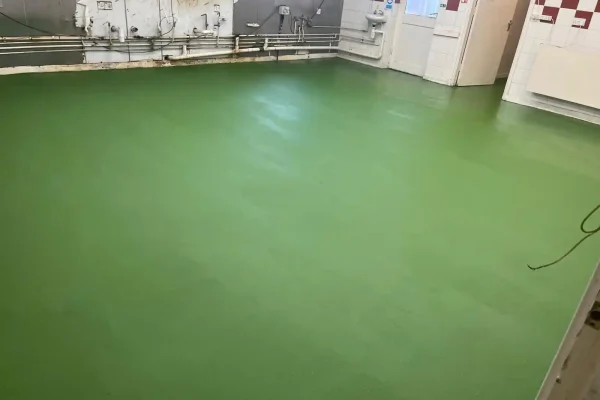
Resin flooring contractors Chesterfield fabrication shops, machining halls and distribution operators rely on for floors that take impact. Supporting engineering and warehousing facilities from Sheepbridge and Dunston to Markham Vale and the Junction 29a corridor.
Working for national manufacturers, logistics operators and public sector estates since 1999.
As resin flooring contractors Chesterfield operators call on regularly, we work across two kinds of building that share a town and nothing else. Heavy engineering never left here, and it now sits beside modern distribution on regenerated ground, with the A61, A619 and A617 tying the town to Sheffield and the coalfield.
In the fabrication and machining halls at Sheepbridge and Dunston the concrete carries decades of history: oil ingress, previous coating layers and historic patch repairs that dictate the preparation before anything else is decided.
At Markham Vale and the Junction 29a and 30 parks the buildings are new and the plates are large. Different problem, same town, and impact rather than abrasion is what leads the conversation in both.
Long-established heavy engineering, fabrication and manufacturing north-west of town.
Industrial units mixing older and refurbished floor stock across the employment area.
Regenerated former colliery site with large manufacturing and distribution buildings.
Established industrial and distribution estate south-east of town near Junction 29.
General industrial, trade and storage units to the south of the town centre.
Trade counters, motor factors and vehicle service units along the A61 corridor.
Dropped-load impact, weld spatter and mobile plant needing screed-grade build-ups.
Cutting oils, coolant spillage and swarf with cleanability driving the selection.
Thermal exposure and abrasion favouring polyurethane screeds with proven tolerance.
Aisle abrasion, racking point loads and dock-edge impact on large new plates.
Fuel and oil resistance, wet-wheel slip risk and inspection pit edge detailing.
Abrasive contamination, shovel and grab loader traffic and washdown regimes.
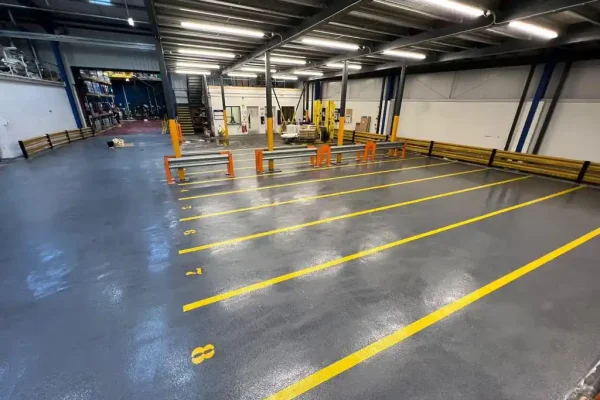
A warehouse aisle is easy to mark. A fabrication hall with cranes, stillages, mobile plant and hot work going on around fixed machines is where segregation actually gets difficult, and it is a duty under the 1992 Regulations rather than good practice.
Traffic-route organisation designed around gantries, stillage areas and machine bases.
On Sheepbridge and Dunston concrete, oil ingress and old coatings govern what can be laid.
EN 13501-1 with the fl classification where welding and heat processes are operating.
The two halves of the town constrain the work differently. In an engineering hall the plant is bolted down and the crane still runs, so floors are taken bay by bay with detailing formed up to machine bases and plinths.
In the distribution buildings the constraint is throughput, so work is sequenced aisle by aisle or door by door with racking left loaded where possible.
Where polyurethane screeds are specified, and around heat and impact they usually are, ISOPA and ALIPA diisocyanate training records apply and every operative handling them holds current REACH certification.
Traffic routes and demarcation in mixed-traffic engineering halls, where it is hardest.
BS 8204-6, where oil ingress, previous coatings and patch repairs govern preparation.
EN 13501-1 with the fl suffix where hot work, welding and heat processes are present.
BS 7976 pendulum values in washdown and workshop areas rather than a general claim.
FeRFA classifies resin flooring into eight types by build-up and thickness, and BS 8204-6 governs which one a floor actually needs, with EN 13813 for the screed. Polyaspartic and MMA sit outside that classification because they describe the resin chemistry rather than the build-up. In Chesterfield the impact duty decides the type in the halls and the traffic decides it in the sheds.
FeRFA Type 1. Two or more coats up to 150 microns, binding a dusting substrate and giving a cleanable surface. From £8 per square metre.
FeRFA Type 2. Dual component to 300 microns, solvent free, in gloss, matt or silk. Chemical resistance with a decorative finish.
FeRFA Type 3. Up to 1000 microns over prepared concrete and the system specified on most industrial jobs. Takes colour well for demarcation.
FeRFA Type 4. Multi-coat build at 1 to 3mm with aggregate broadcast between coats, for impact and constant wear.
FeRFA Type 5. Flow-applied at 2 to 3mm for a seamless finish where hygiene and cleaning matter more than impact resistance.
FeRFA Type 7. Three part filled system at 4 to 6mm thickness, giving a self-smoothing finish for heavy and very heavy duty areas.
FeRFA Types 7 and 8. Trowel-applied at 6 to 9mm to take thermal shock, steam cleaning and constant heavy forklift traffic.
Cures at temperatures down to −5°C and is ready in around two hours. Installed overnight or at a weekend it can remove the need to shutdown entirely.
Cures in hours, but the odour can taint food, fabrics and stock and the area must be cleared and ventilated. Better suited to new build and refurbishment projects.
Rates run from £8 per square metre for a floor seal to £45 for MMA, inclusive of preparation, labour and materials. Fabrication bays sit at the upper end, and preparation on legacy concrete is priced separately because it is the real variable.
| System | FeRFA | Thickness | Per m² |
|---|---|---|---|
| Floor Seal | Type 1 | Up to 150µm | From £8 |
| Epoxy and PU Coating | Type 2 | 150 – 300µm | £8 – £12 |
| High Build Coating | Type 3 | 300 – 1000µm | £8 – £12 |
| Multi-Layer Flooring | Type 4 | 1 – 3mm | £12 – £16 |
| Self-Smoothing | Type 5 | 2 – 4mm | £20 – £30 |
| Heavy Duty Flowable | Type 7 | 4 – 6mm | £25 – £35 |
| Heavy Duty PU Screed | Type 8 | 6 – 9mm | £30 – £40 |
| Polyaspartic | Chemistry | 300 – 500µm | £38 |
| MMA | Chemistry | 2 – 6mm | £45 |
Inclusive of preparation, labour and materials. Rates assume a sound, accessible substrate and are indicative until the floor has been surveyed. Polyaspartic and MMA sit outside the FeRFA type classification because they describe the resin chemistry rather than the build-up.
A three day shutdown at a plant turning over £2,000 an hour is £120,000 of lost output. On most sites that is several times the price of the floor.
Five contractors quoted one timber processing plant. All five proposed the same system and a three to four day closure. None of them costed the closure.
We proposed a faster-curing system installed across a weekend. A higher rate per square metre, and no shutdown at all. On the client’s own figures the avoided losses exceeded the price of the floor.
We install evenings, weekends and one bay at a time.
Whether a shutdown costs you thousands an hour or simply gets in the way, you do not always have to close your site for a resin flooring installation.
Grinding out oil-ingressed concrete and removing previous coatings back to a sound base.
Routes, crossings and exclusion zones designed around fixed plant and laid in resin.
Damp proof membrane where a substrate fails moisture testing, as a standalone package.
Screed-grade build-ups where dropped sections and stillages defeat any coating.
Coolant and oil resistant systems detailed around machine bases and swarf areas.
Joint repairs and duty-rated floors installed aisle by aisle around throughput.
We work across the area regularly, from Sheepbridge and Dunston through to Markham Vale at Junction 29a, Holmewood, Barlborough Links, Storforth Lane at Hasland and the Whittington Moor trade corridor. We are Cheshire based, so a survey usually happens within days and there is no mobilisation charge for attending.

Because impact is the failure mode here rather than abrasion. A dropped section or a stillage set down hard is a single high-energy event that punches through a thin system regardless of its wear figures, so the answer is a screed-grade build-up specified under BS 8204-6 rather than a coating.
Usually, but only after the contamination is dealt with. On this stock oil ingress, previous coating layers and historic patch repairs decide what will bond, so preparation strategy is established at survey and priced separately. It is the variable, not the resin.
By designing them rather than painting lines. Gantries, stillage areas and machine bases make segregation genuinely difficult, and the 1992 Workplace Regulations and HSE guidance L24 make it a duty. The scheme is set out around what is bolted down and laid in resin so it survives the traffic.
Where hot work, welding or heat processes run, it is a legitimate requirement. EN 13501-1 with the fl classification lets the finish be stated properly rather than described loosely, and we give the classification instead of calling a system fire resistant.
From £8 per square metre for a floor seal up to £45 for MMA, inclusive of preparation, labour and materials. Heavy-duty screeds for fabrication bays sit at the upper end, with preparation on legacy concrete priced separately. The full table by system is on the cost page.
Tell us what lands on the floor, what has soaked into it and where people cross the plant. We attend, test the substrate, and put a written specification and a fixed price in front of you at no cost.