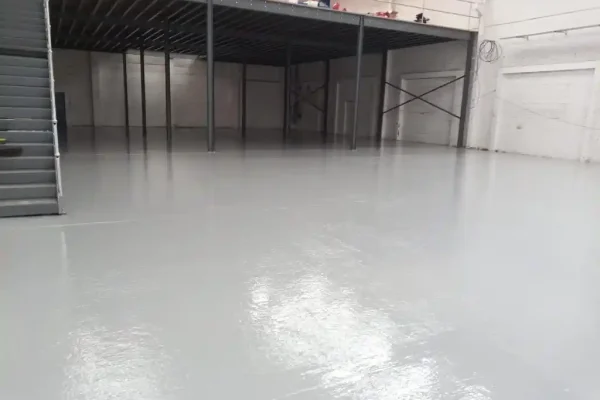
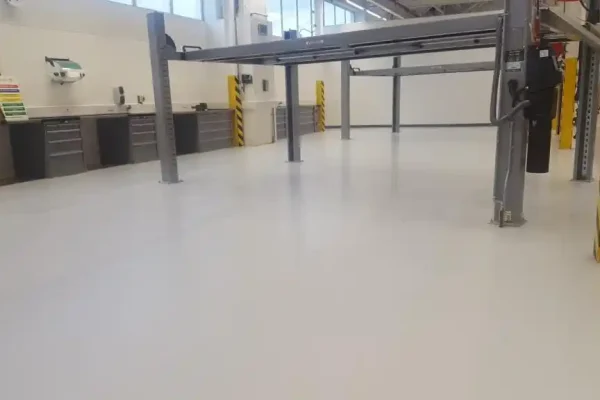
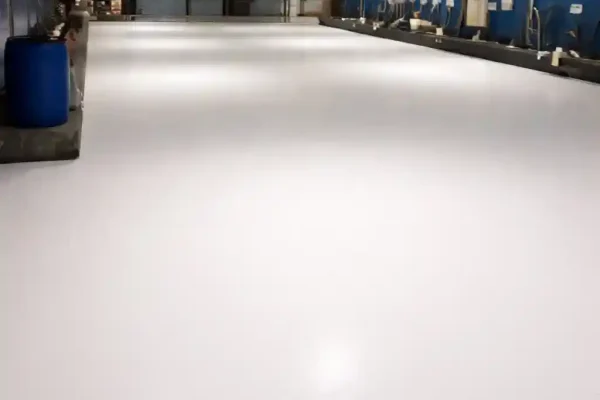
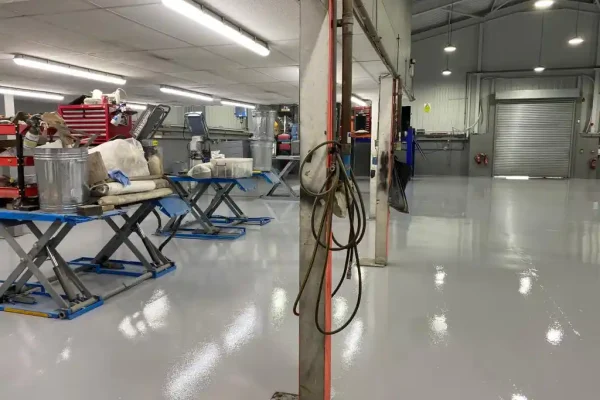
Resin flooring contractors Derby precision manufacturers, aerospace and rail supply chains rely on for floors that hold a quality standard. Supporting engineering and logistics facilities across Derby Commercial Park, Sinfin, Raynesway, Ascot Drive and Litchurch Lane.
Working for national manufacturers, logistics operators and public sector estates since 1999.
As resin flooring contractors Derby manufacturers call on regularly, we answer to audit expectations rather than to wear figures alone. The city is the East Midlands’ deepest advanced manufacturing cluster, connected by the M1, A38, A50 and A52, with rail vehicle engineering, aerospace supply and automotive tiering alongside a substantial warehousing function.
That base is more exacting than its neighbours rather than simply heavier. Process control, contamination limits and audit expectations apply to the floor as much as to the process standing on it.
So the headline failure here is contamination-driven. A dusting, porous floor absorbs oils and coolants and undermines quality control long before it presents as a structural problem.
Manufacturing, engineering and logistics facilities with high operational throughput.
Established industrial area supporting manufacturing, storage and distribution.
Engineering and manufacturing facilities with heavy machinery and technical processes.
Warehousing, trade and industrial support units on the southern industrial belt.
Long-standing rail-related engineering and manufacturing floorspace near the centre.
Advanced manufacturing and technology-led employment land on the southern fringe.
Point loading from machine tools, coolant exposure and non-dusting surfaces.
Contamination control, dimensional stability and hydraulic fluid resistance.
Conductive or dissipative systems with earthing detail and verified resistance.
Forklift abrasion, racking point loads, joint wear and loading bay impact.
Washdown, thermal shock and hygienic detailing with coving and drainage falls.
Fuel, oil and chemical resistance with bunding and dropped tooling impact.
In a precision environment a friable floor does two things at once. It puts respirable crystalline silica into the air, limited under EH40 to 0.1 mg per cubic metre over eight hours, and it releases particles into a process built to exclude them. The exposure argument and the quality argument reinforce each other.
Cleanability is a quality control requirement here rather than an appearance one.
Where electronics, test or sensitive assembly runs, EN 1081 governs the floor resistance.
BS 8204-6 and EN 13813 give classified build-ups an audited specifier can accept.
Production plans, calibration schedules and customer audits decide when an area can be released, so the sequence is agreed against those rather than proposed around our availability.
Work is taken cell by cell or bay by bay, with detailing formed up to machine bases and equipment plinths rather than stopping short of them.
Preparation runs under H-class extraction with areas screened. In a controlled environment dust control is a quality requirement as much as a health one, because particles reaching an assembly or test area are a production problem first.
Electrostatic control specified, installed and verified rather than assumed on a quote.
The EH40 limit at 0.1 mg per cubic metre, reinforced by the quality case in precision.
BS 8204-6 with EN 13813, because audited specifiers accept classifications not claims.
BS 7976 pendulum values in production and goods-in areas, not only at entrances.
FeRFA classifies resin flooring into eight types by build-up and thickness, and BS 8204-6 governs which one a floor actually needs, with EN 13813 for the screed and EN 1081 where electrical resistance is required. Polyaspartic and MMA sit outside that classification because they describe the resin chemistry rather than the build-up. In Derby the process standard decides the type before the traffic does.
FeRFA Type 1. Two or more coats up to 150 microns, binding a dusting substrate and giving a cleanable surface. From £8 per square metre.
FeRFA Type 2. Dual component to 300 microns, solvent free, in gloss, matt or silk. Chemical resistance with a decorative finish.
FeRFA Type 3. Up to 1000 microns over prepared concrete and the system specified on most industrial jobs. Takes colour well for demarcation.
FeRFA Type 4. Multi-coat build at 1 to 3mm with aggregate broadcast between coats, for impact and constant wear.
FeRFA Type 5. Flow-applied at 2 to 3mm for a seamless finish where hygiene and cleaning matter more than impact resistance.
FeRFA Type 7. Three part filled system at 4 to 6mm thickness, giving a self-smoothing finish for heavy and very heavy duty areas.
FeRFA Types 7 and 8. Trowel-applied at 6 to 9mm to take thermal shock, steam cleaning and constant heavy forklift traffic.
Cures at temperatures down to −5°C and is ready in around two hours. Installed overnight or at a weekend it can remove the need to shutdown entirely.
Cures in hours, but the odour can taint food, fabrics and stock and the area must be cleared and ventilated. Better suited to new build and refurbishment projects.
Rates run from £8 per square metre for a floor seal to £45 for MMA, inclusive of preparation, labour and materials. Static-controlled and precision finishes sit at the upper end, and are specified only where the process genuinely requires them.
| System | FeRFA | Thickness | Per m² |
|---|---|---|---|
| Floor Seal | Type 1 | Up to 150µm | From £8 |
| Epoxy and PU Coating | Type 2 | 150 – 300µm | £8 – £12 |
| High Build Coating | Type 3 | 300 – 1000µm | £8 – £12 |
| Multi-Layer Flooring | Type 4 | 1 – 3mm | £12 – £16 |
| Self-Smoothing | Type 5 | 2 – 4mm | £20 – £30 |
| Heavy Duty Flowable | Type 7 | 4 – 6mm | £25 – £35 |
| Heavy Duty PU Screed | Type 8 | 6 – 9mm | £30 – £40 |
| Polyaspartic | Chemistry | 300 – 500µm | £38 |
| MMA | Chemistry | 2 – 6mm | £45 |
Inclusive of preparation, labour and materials. Rates assume a sound, accessible substrate and are indicative until the floor has been surveyed. Polyaspartic and MMA sit outside the FeRFA type classification because they describe the resin chemistry rather than the build-up.
A three day shutdown at a plant turning over £2,000 an hour is £120,000 of lost output. On most sites that is several times the price of the floor.
Five contractors quoted one timber processing plant. All five proposed the same system and a three to four day closure. None of them costed the closure.
We proposed a faster-curing system installed across a weekend. A higher rate per square metre, and no shutdown at all. On the client’s own figures the avoided losses exceeded the price of the floor.
We install evenings, weekends and one bay at a time.
Whether a shutdown costs you thousands an hour or simply gets in the way, you do not always have to close your site for a resin flooring installation.
Copper strip, connection points and continuity installed as part of a dissipative system.
Vehicle routes, walkways and restricted zones designed and applied in resin, not paint.
Damp proof membrane where a substrate fails moisture testing, as a standalone package.
Non-dusting seamless finishes with resistance values recorded for the specification.
Coolant and oil resistant systems detailed around machine bases and test bays.
Abrasion resistant floors and coved, falled systems in chilled and food areas.
We work across the city regularly, from Derby Commercial Park and Sinfin through to Raynesway, Ascot Drive, Osmaston Park, the Litchurch Lane corridor, Spondon and Infinity Park. We are Cheshire based rather than Derby based, so a survey usually happens within days and there is no mobilisation charge for attending.
Because it is an exposure problem and a quality problem at the same time. Respirable crystalline silica is limited under EH40 to 0.1 mg per cubic metre over eight hours, and the same particles land on components and equipment in a process built to exclude them. Sealing the floor answers both.
A measured resistance and an earth. EN 1081 provides the basis, and a conductive or dissipative floor is a system including copper strip, connection points and continuity, verified after installation rather than claimed beforehand. Anti-static without a value is not a specification.
Because chemical resistance belongs to the individual system rather than to resin flooring generally. Cutting oils, coolants, hydraulic fluids and solvents each behave differently, so we ask what is actually in use and specify against that profile rather than making a blanket claim.
Classified systems rather than descriptions. BS 8204-6 and EN 13813 let the build-up and screed performance be stated properly, and where relevant we record resistance values, preparation method and system detail so the floor is evidenced rather than described.
From £8 per square metre for a floor seal up to £45 for MMA, inclusive of preparation, labour and materials. Static-controlled and precision finishes sit at the upper end and are specified only where the process needs them. The full table by system is on the cost page.
Ilkeston · Swadlincote · Nottingham · Alfreton · Chesterfield · Loughborough · Leicester
Tell us what the area produces, what it must do electrically and what your audits look for. We attend, test the substrate, and put a written specification and a fixed price in front of you at no cost.