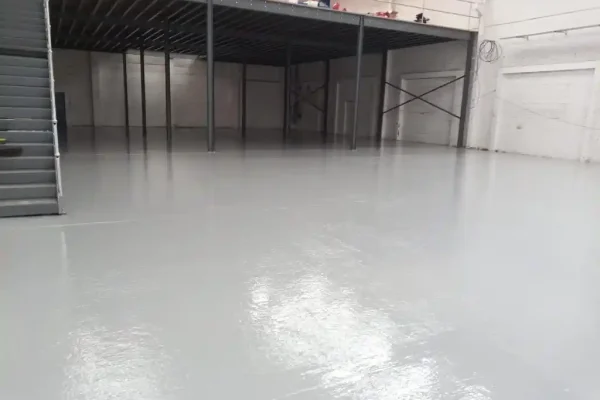
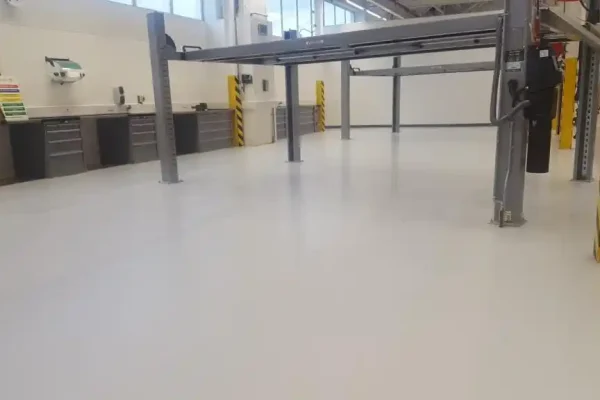
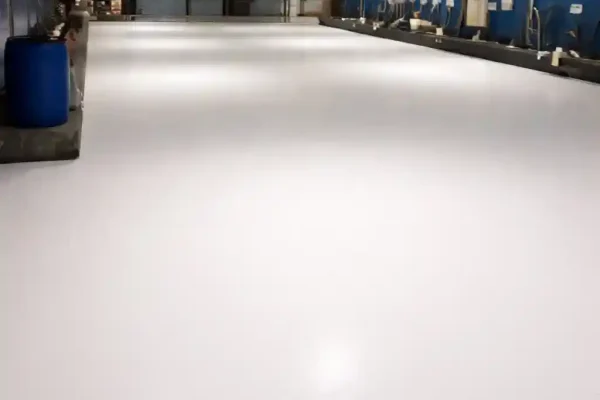
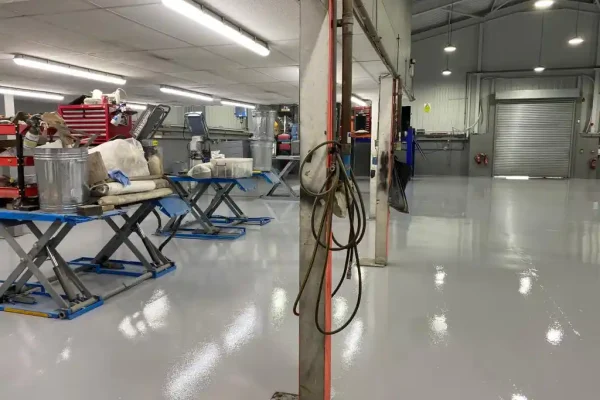
Resin flooring contractors Swadlincote ceramics, process and manufacturing operators rely on for heavy-duty screeds rather than coatings. Supporting facilities across Cadley Hill, Tetron Point, Coppice Side, the William Nadin Way corridor and the Woodville ceramics belt.
Working for national manufacturers, logistics operators and public sector estates since 1999.
As resin flooring contractors Swadlincote operators call on regularly, we specify for conditions no other Derbyshire town shares. The industrial inheritance here is thermal and abrasive: coal, clay, ceramics and pipe manufacture built a culture around heat, dust and heavy materials handling, and much of it survives.
That gives the town a failure profile of its own. Thermal shock and cycling lead, abrasive erosion from mineral dust and slurries follows, and ponding appears wherever falls were never set correctly in the first place.
A real distribution function sits alongside it. The A511 links to the A38 at Burton and the A42 and M42 south, and the A50 brings national freight within reach, so conventional aisle and dock demands run beside the process work.
Established manufacturing and distribution estate on the western side of the town.
Business and industrial park on former colliery land with modern manufacturing units.
General industrial, workshop and storage units close to the town centre itself.
The principal industrial artery, carrying distribution, manufacturing and trade units.
The historic ceramics and pipe-making area retaining heavy manufacturing character.
Purpose-built distribution and manufacturing on the South Derbyshire freight route.
Abrasive dust, wet slurry, heat and heavy handling needing thick screeds with falls.
Thermal cycling and radiant heat where polyurethane outperforms epoxy decisively.
Mechanical loading, oil and coolant exposure and demarcated production zones.
Aisle abrasion, racking point loads and loading bay impact on modern plates.
Washdown at temperature, steam cleaning and hygienic coved detailing throughout.
Abrasive contamination with grab and shovel loader traffic, the worst case here.
Kiln-adjacent areas, drying rooms and heat-process zones put the floor through constant movement, and a rigid thin system cannot absorb it. Add mineral dust acting as a grinding paste under wheeled traffic and the answer is build-up depth rather than surface hardness.
Declared screed performance gives specifiers a classification rather than a description of durability.
Clay, ceramic and mineral dust behaves like a paste under wheels and erodes thin systems quickly.
Slurry, process water and washdown make gullies, channels and falls part of the floor design.
Process plant does not stop on request and kiln areas cannot simply be handed over cold, so the sequence is agreed against your production and maintenance calendar before a system is chosen.
Work is taken bay by bay or into planned shutdowns, with detailing formed up to plant bases, channels and gully surrounds rather than stopping short of them.
Where polyurethane screeds are specified, which across this town is most of the time, ISOPA and ALIPA diisocyanate training records apply and every operative handling them holds current REACH certification.
Declared screed performance, the language specifiers use where screeds beat coatings.
ISOPA and ALIPA competence for the polyurethane systems these conditions require.
BS 8204-6 assessment covering cycling, existing falls and drainage layout as well.
BS 7976 pendulum testing where slurry, process water and washdown are continuous.
FeRFA classifies resin flooring into eight types by build-up and thickness, and BS 8204-6 governs which one a floor actually needs, with EN 13813 covering declared screed performance. Polyaspartic and MMA sit outside that classification because they describe the resin chemistry rather than the build-up. In Swadlincote the heavy-duty screeds lead, and coatings are the exception.
FeRFA Type 1. Two or more coats up to 150 microns, binding a dusting substrate and giving a cleanable surface. From £8 per square metre.
FeRFA Type 2. Dual component to 300 microns, solvent free, in gloss, matt or silk. Chemical resistance with a decorative finish.
FeRFA Type 3. Up to 1000 microns over prepared concrete and the system specified on most industrial jobs. Takes colour well for demarcation.
FeRFA Type 4. Multi-coat build at 1 to 3mm with aggregate broadcast between coats, for impact and constant wear.
FeRFA Type 5. Flow-applied at 2 to 3mm for a seamless finish where hygiene and cleaning matter more than impact resistance.
FeRFA Type 7. Three part filled system at 4 to 6mm thickness, giving a self-smoothing finish for heavy and very heavy duty areas.
FeRFA Types 7 and 8. Trowel-applied at 6 to 9mm to take thermal shock, steam cleaning and constant heavy forklift traffic.
Cures at temperatures down to −5°C and is ready in around two hours. Installed overnight or at a weekend it can remove the need to shutdown entirely.
Cures in hours, but the odour can taint food, fabrics and stock and the area must be cleared and ventilated. Better suited to new build and refurbishment projects.
Rates run from £8 per square metre for a floor seal to £45 for MMA, inclusive of preparation, labour and materials. Heat and abrasion areas sit at the upper end because thickness is what is being paid for, and falls correction is priced separately.
| System | FeRFA | Thickness | Per m² |
|---|---|---|---|
| Floor Seal | Type 1 | Up to 150µm | From £8 |
| Epoxy and PU Coating | Type 2 | 150 – 300µm | £8 – £12 |
| High Build Coating | Type 3 | 300 – 1000µm | £8 – £12 |
| Multi-Layer Flooring | Type 4 | 1 – 3mm | £12 – £16 |
| Self-Smoothing | Type 5 | 2 – 4mm | £20 – £30 |
| Heavy Duty Flowable | Type 7 | 4 – 6mm | £25 – £35 |
| Heavy Duty PU Screed | Type 8 | 6 – 9mm | £30 – £40 |
| Polyaspartic | Chemistry | 300 – 500µm | £38 |
| MMA | Chemistry | 2 – 6mm | £45 |
Inclusive of preparation, labour and materials. Rates assume a sound, accessible substrate and are indicative until the floor has been surveyed. Polyaspartic and MMA sit outside the FeRFA type classification because they describe the resin chemistry rather than the build-up.
A three day shutdown at a plant turning over £2,000 an hour is £120,000 of lost output. On most sites that is several times the price of the floor.
Five contractors quoted one timber processing plant. All five proposed the same system and a three to four day closure. None of them costed the closure.
We proposed a faster-curing system installed across a weekend. A higher rate per square metre, and no shutdown at all. On the client’s own figures the avoided losses exceeded the price of the floor.
We install evenings, weekends and one bay at a time.
Whether a shutdown costs you thousands an hour or simply gets in the way, you do not always have to close your site for a resin flooring installation.
Forming falls, channels and gully detail so wet process areas drain rather than pond.
Bunds and upstands at 110% of capacity around fuel and chemical storage points.
Damp proof membrane where a substrate fails moisture testing, as a standalone package.
Heavy-duty screeds with corrected falls where heat, slurry and abrasion combine.
Polyurethane systems selected for thermal cycling rather than wear figures alone.
Abrasion resistant floors and joint repairs across the modern corridor stock.
We work across South Derbyshire regularly, from Cadley Hill and Tetron Point through to Coppice Side, Hearthcote Road, the William Nadin Way corridor, Woodville, Church Gresley and Newhall. We are Cheshire based, so a survey usually happens within days and there is no mobilisation charge for attending.
Because heat moves the floor. Thermal cycling in kiln surrounds and drying areas produces continuous movement that a rigid thin system cannot absorb, so it crazes and debonds. Heavy-duty polyurethane screeds are formulated for that cycling, which is why they lead in these areas.
Build-up depth rather than surface hardness. Clay, ceramic and mineral dust behaves like a grinding paste under wheeled traffic, so a thin system erodes quickly regardless of its stated wear figures. EN 13813 lets the screed performance be declared rather than described.
Yes, but it is falls work rather than a finish. Slurry, process water and washdown make gullies, channels and correct falls part of the floor design, and where they were never set properly they have to be formed. We price that separately so the cost of solving it is visible.
Because the systems these conditions need are polyurethane, and diisocyanate training under ISOPA and ALIPA is mandatory for operatives handling them. It is a competence question rather than a formality, and every operative on our sites holds current REACH certification.
From £8 per square metre for a floor seal up to £45 for MMA, inclusive of preparation, labour and materials. Heavy-duty screeds for heat and abrasion sit at the upper end, with falls correction priced separately. The full table by system is on the cost page.
Derby · Ilkeston · Leicester · Loughborough · Alfreton · Chesterfield · Nottingham
Tell us how hot the area runs, what is carried across it and where the water goes. We attend, test the substrate, and put a written specification and a fixed price in front of you at no cost.