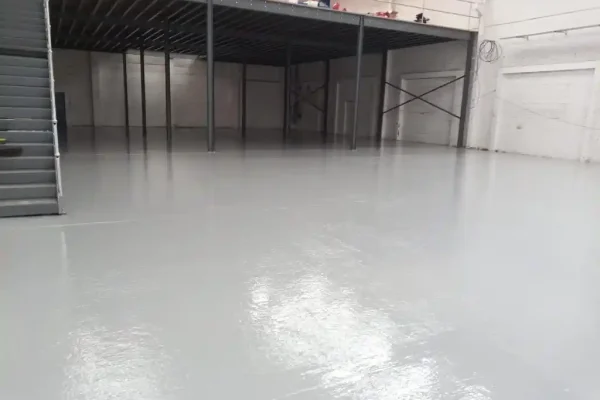
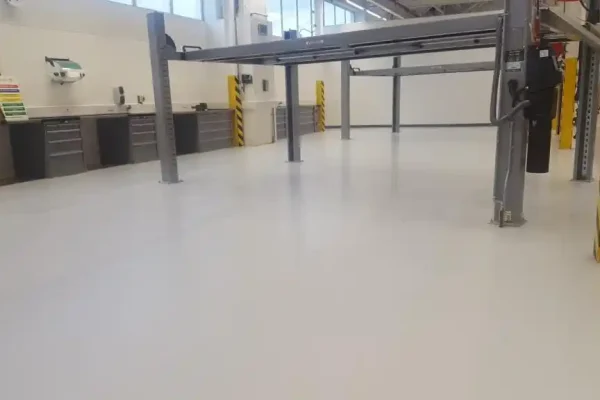
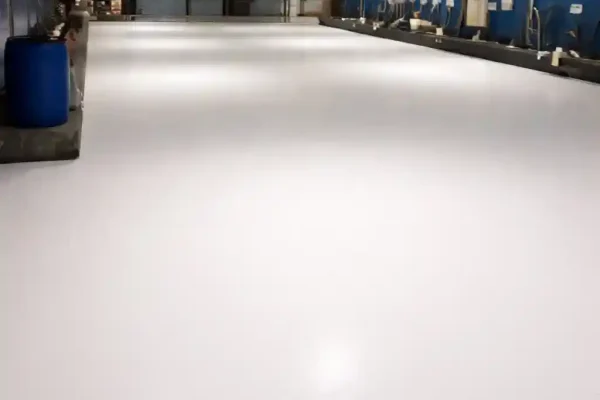
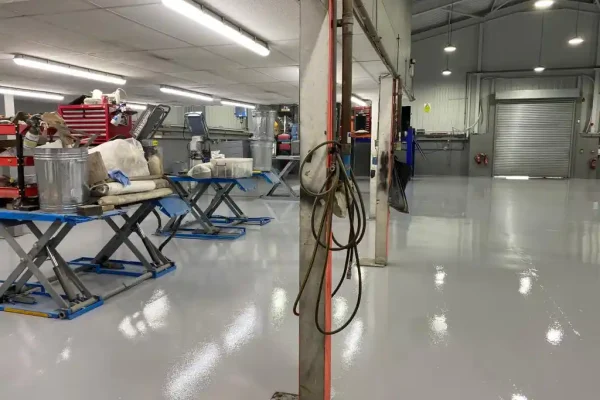
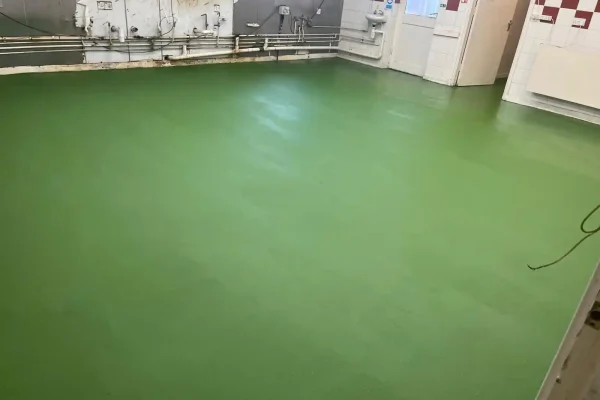
Resin flooring contractors Ilkeston small operators and trade units rely on when the existing floor is the problem. Supporting light industrial, workshop and storage premises across Quarry Hill, Manners, Cossall and the Erewash Valley corridor.
Working for national manufacturers, logistics operators and public sector estates since 1999.
As resin flooring contractors Ilkeston businesses call on regularly, we answer a refurbishment question rather than a specification one. The town sits in the Erewash Valley between Derby and Nottingham, on the A6007 and A609 with the canal running through it, and its industry lives in small and mid-size units.
Those estates were largely built between the 1960s and 1980s and have been refitted repeatedly since. Layers of previous flooring, adhesive residue, patch repairs, oil contamination and power-floated laitance are the normal starting condition rather than the exception.
So substrate condition is the first technical question on almost every enquiry here. Which resin comes second, and it comes after testing.
The principal industrial estate, with manufacturing, storage and trade units of mixed age.
Established estate off Manners Avenue with light industrial and service occupancy.
Smaller industrial and workshop units on the western side of the town at Soloman Road.
General industrial and workshop stock near the northern edge of the town itself.
Industrial and commercial land on the southern approach to the Erewash corridor.
Trade counters, vehicle service units and commercial premises on the approach.
Mixed loading and occasional spillage needing a durable, cleanable surface at sensible cost.
Pallet-truck traffic, threshold wear and a floor that has to present well between lets.
Fuel, oil, brake fluid and de-icer resistance with tyre scuffing and pit edges.
Dropped material impact, hot particle exposure and abrasion at cutting positions.
Washdown, hygienic coving, drainage falls and a seamless surface without harbourage.
Seamlessness and disinfectant resistance for disease control in small premises.
Old concrete with historic coatings, oil contamination and power-floated laitance rejects resin unless the preparation is mechanical and matched to what is actually there. That is the headline failure in this stock, and no product choice gets around it.
Substrate suitability, preparation method and moisture are established before any system is recommended.
Buildings predating modern damp-proof membrane practice need moisture assessment before a coating decision.
EN 1504-2 gives refurbishment a technical footing where the aim is extending the existing concrete.
Small operators here do not have a spare bay or a second site, so downtime and cost predictability are the buying concerns rather than specification depth.
Floors are taken sectionally or over a weekend, and rapid-cure polyaspartic and MMA options are offered where the shutdown window genuinely demands them rather than as a universally better answer. They cost more and they carry compromises, and we say so.
Preparation runs under H-class extraction with areas screened. Grinding old concrete in an occupied multi-tenant estate raises real dust obligations, with the EH40 silica limit of 0.1 mg per cubic metre over eight hours as the reference.
BS 8204-6 on substrate suitability, preparation and moisture, which is where this stock starts.
Surface protection of concrete where the aim is extending a tired floor rather than replacing it.
BS 7976 pendulum values where wet-wheel and rainwater carry-in concentrate at one doorway.
COSHH duties during preparation, with on-tool extraction expected in occupied buildings.
FeRFA classifies resin flooring into eight types by build-up and thickness, and BS 8204-6 governs which one a floor actually needs, with EN 13813 for the screed and EN 1504-2 where existing concrete is being protected. Polyaspartic and MMA sit outside that classification because they describe the resin chemistry rather than the build-up. In Ilkeston the prepared substrate decides the type.
FeRFA Type 1. Two or more coats up to 150 microns, binding a dusting substrate and giving a cleanable surface. From £8 per square metre.
FeRFA Type 2. Dual component to 300 microns, solvent free, in gloss, matt or silk. Chemical resistance with a decorative finish.
FeRFA Type 3. Up to 1000 microns over prepared concrete and the system specified on most industrial jobs. Takes colour well for demarcation.
FeRFA Type 4. Multi-coat build at 1 to 3mm with aggregate broadcast between coats, for impact and constant wear.
FeRFA Type 5. Flow-applied at 2 to 3mm for a seamless finish where hygiene and cleaning matter more than impact resistance.
FeRFA Type 7. Three part filled system at 4 to 6mm thickness, giving a self-smoothing finish for heavy and very heavy duty areas.
FeRFA Types 7 and 8. Trowel-applied at 6 to 9mm to take thermal shock, steam cleaning and constant heavy forklift traffic.
Cures at temperatures down to −5°C and is ready in around two hours. Installed overnight or at a weekend it can remove the need to shutdown entirely.
Cures in hours, but the odour can taint food, fabrics and stock and the area must be cleared and ventilated. Better suited to new build and refurbishment projects.
Rates run from £8 per square metre for a floor seal to £45 for MMA, inclusive of preparation, labour and materials. Most work here sits in the lower half, with preparation priced separately so the cost is predictable once the floor has been tested.
| System | FeRFA | Thickness | Per m² |
|---|---|---|---|
| Floor Seal | Type 1 | Up to 150µm | From £8 |
| Epoxy and PU Coating | Type 2 | 150 – 300µm | £8 – £12 |
| High Build Coating | Type 3 | 300 – 1000µm | £8 – £12 |
| Multi-Layer Flooring | Type 4 | 1 – 3mm | £12 – £16 |
| Self-Smoothing | Type 5 | 2 – 4mm | £20 – £30 |
| Heavy Duty Flowable | Type 7 | 4 – 6mm | £25 – £35 |
| Heavy Duty PU Screed | Type 8 | 6 – 9mm | £30 – £40 |
| Polyaspartic | Chemistry | 300 – 500µm | £38 |
| MMA | Chemistry | 2 – 6mm | £45 |
Inclusive of preparation, labour and materials. Rates assume a sound, accessible substrate and are indicative until the floor has been surveyed. Polyaspartic and MMA sit outside the FeRFA type classification because they describe the resin chemistry rather than the build-up.
A three day shutdown at a plant turning over £2,000 an hour is £120,000 of lost output. On most sites that is several times the price of the floor.
Five contractors quoted one timber processing plant. All five proposed the same system and a three to four day closure. None of them costed the closure.
We proposed a faster-curing system installed across a weekend. A higher rate per square metre, and no shutdown at all. On the client’s own figures the avoided losses exceeded the price of the floor.
We install evenings, weekends and one bay at a time.
Whether a shutdown costs you thousands an hour or simply gets in the way, you do not always have to close your site for a resin flooring installation.
Mechanical removal of old coverings, adhesive residue and laitance back to sound concrete.
Treating historic patch repairs and joints that were never designed for current handling.
Damp proof membrane where a substrate fails moisture testing, as a standalone package.
Layered and contaminated concrete assessed, prepared and overlaid rather than replaced.
Vacant units returned to a clean, lettable standard before a new occupier moves in.
Fuel and oil resistant systems with grip at pit edges and inspection areas.
We work across the Erewash Valley regularly, from Quarry Hill and Manners through to Cossall, Soloman Road, Larklands, Hallam Fields and the Nottingham Road trade corridor. We are Cheshire based, so a survey usually happens within days and there is no mobilisation charge for attending.

Almost certainly not. Delamination in this stock is a preparation failure, because old concrete with historic coatings, oil contamination and laitance rejects resin unless preparation is mechanical and matched to the substrate. We test adhesion and moisture before recommending anything.
If it predates modern damp-proof membrane practice, yes, and much of this stock does. Vapour rising through a ground-bearing floor lifts whatever is bonded to it, so the assessment comes before the coating decision rather than after a failure.
Only if your downtime justifies it. Polyaspartic and MMA return a unit to use quickly, but they cost more and carry compromises in odour and temperature sensitivity. For a small operator that cannot close for a week the maths often works, and where it does not we will say so.
The best time you will get. An empty unit removes every access constraint, preparation and finish can be done in one visit, and the floor presents properly to an incoming occupier rather than becoming their problem six months in.
From £8 per square metre for a floor seal up to £45 for MMA, inclusive of preparation, labour and materials. Most work here sits at the lower end, with preparation priced separately once the floor has been surveyed. The full table by system is on the cost page.
Tell us what is on the floor now, how the unit is used and how long you can close for. We attend, test the substrate, and put a written specification and a fixed price in front of you at no cost.