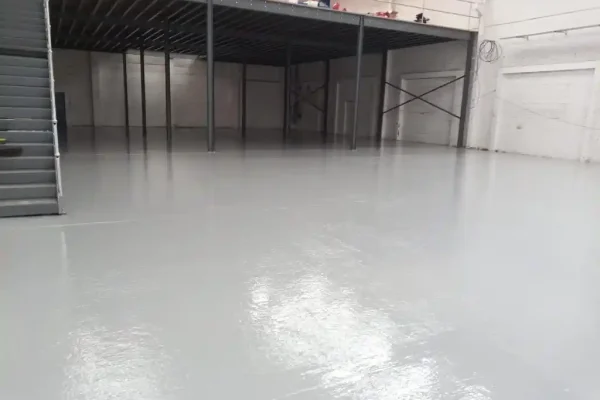
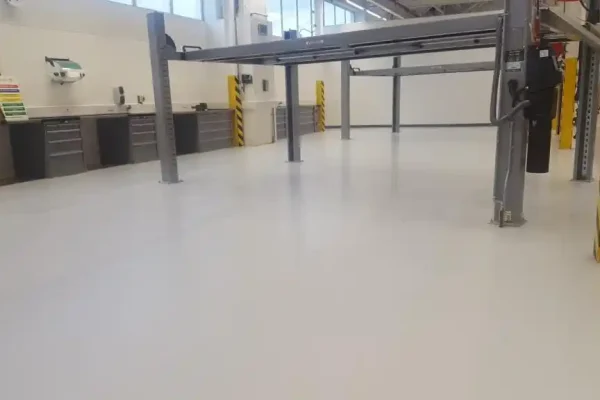
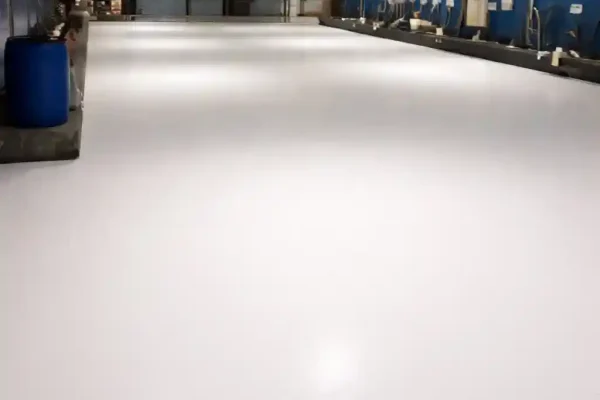
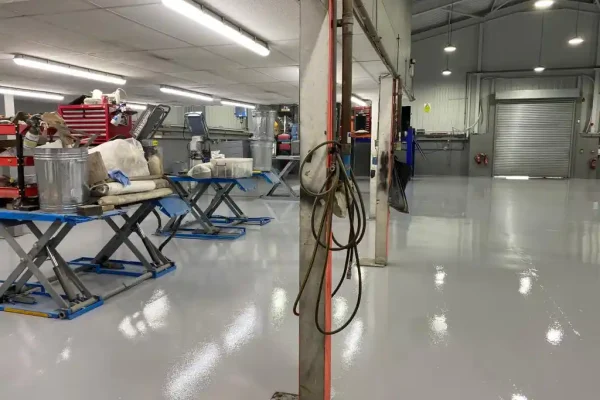
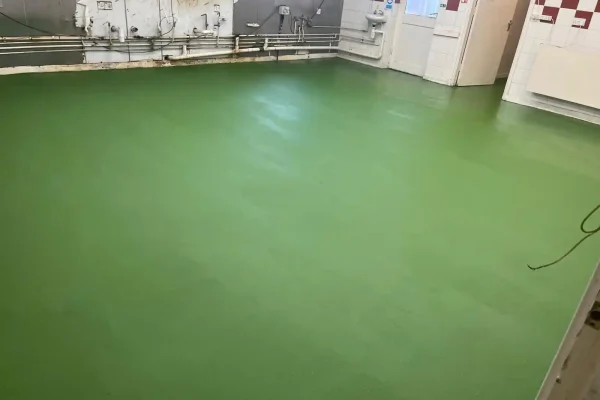
Resin flooring contractors Sutton engineering shops and distribution operators rely on for floors that resist what is spilled on them. Serving manufacturing, process and warehousing facilities across Sutton-in-Ashfield, from Fulwood and Huthwaite to Castlewood Business Park beside Junction 28.
Working for national manufacturers, logistics operators and public sector estates since 1999.
As resin flooring contractors Sutton operators call on regularly, we specify around chemistry before we specify around traffic. The town sits immediately east of Junction 28 of the M1, where a hosiery, knitwear and precision engineering heritage meets modern industrial parks along the A38.
In the older stock, cutting fluids, coolants, hydraulic oils, solvents and process liquids go onto the floor as a matter of routine. They penetrate unsealed or thin-film systems and undermine adhesion from underneath, which is what ends the life of most floors here rather than abrasion.
The Junction 28 parks then ask an entirely different question. Joint protection, racking point loads, dock-edge impact and demarcation across large open floors. Two building generations, and honestly two different specifications.
A principal industrial and manufacturing location on the western side of the town.
Industrial and storage premises sitting close to Junction 28 of the motorway.
Modern large-format industrial and distribution units at the Junction 28 interchange.
Established industrial, workshop and storage capacity on the eastern side of the district.
A major business and logistics park at Junction 27, serving the wider Ashfield area.
A continuous run of industrial, trade and storage premises between the motorway and Mansfield.
Cutting fluid, coolant and swarf exposure with impact beneath the machine bases.
Process liquids, dye and chemical spillage over older and frequently contaminated concrete.
Aggressive chemical exposure needing resistant systems and containment detailing.
Abrasion resistance, joint protection, point-load tolerance and integral demarcation.
Fuel, oil and hydraulic resistance with pit surrounds and concentrated jacking points.
Seamless, disinfectant-resistant finishes under continuous trolley and castor traffic.
An engineering floor here has usually absorbed decades of oil before anyone thinks about resurfacing it. No system overcomes that, and applying one over contaminated concrete makes delamination the predictable outcome rather than the unlucky one.
Oil ingress is found and dealt with before specification, because adhesion is decided by what is already in the concrete.
EN 1504-2 and the FeRFA range explain why routine chemical exposure pushes past a seal into higher-build systems.
Presses, lathes and finishing plant concentrate loading, vibration and dropped-tool impact into small areas.
The two halves of the town constrain the programme differently. In an engineering shop the plant is bolted down and cannot be relocated, so work is taken bay by bay around fixed machines rather than in one clear sweep.
In the Junction 28 units the constraint is shift patterns instead, so floors are sequenced aisle by aisle or into weekend windows with racking left loaded wherever possible.
Preparation runs under H-class extraction in both. That controls respirable crystalline silica, limited under EH40 to 0.1 mg per cubic metre over eight hours, and it also stops contaminated grindings being spread through a working building.
Protecting the concrete substrate where process chemistry reaches it, not simply covering the surface.
Bunding to 110% of container capacity, with the floor and upstands forming part of the containment.
COSHH covers the process chemicals in use and the silica generated when the floor is prepared.
In the Junction 28 stock, wide aisles and mixed traffic make integral demarcation the compliant answer.
FeRFA classifies resin flooring into eight types by build-up and thickness, and BS 8204-6 governs which one a floor actually needs, with EN 13813 for the screed and EN 1504-2 where the concrete itself is being protected. Polyaspartic and MMA sit outside that classification because they describe the resin chemistry rather than the build-up. In Sutton the exposure decides the type before the traffic does.
FeRFA Type 1. Two or more coats up to 150 microns, binding a dusting substrate and giving a cleanable surface. From £8 per square metre.
FeRFA Type 2. Dual component to 300 microns, solvent free, in gloss, matt or silk. Chemical resistance with a decorative finish.
FeRFA Type 3. Up to 1000 microns over prepared concrete and the system specified on most industrial jobs. Takes colour well for demarcation.
FeRFA Type 4. Multi-coat build at 1 to 3mm with aggregate broadcast between coats, for impact and constant wear.
FeRFA Type 5. Flow-applied at 2 to 3mm for a seamless finish where hygiene and cleaning matter more than impact resistance.
FeRFA Type 7. Three part filled system at 4 to 6mm thickness, giving a self-smoothing finish for heavy and very heavy duty areas.
FeRFA Types 7 and 8. Trowel-applied at 6 to 9mm to take thermal shock, steam cleaning and constant heavy forklift traffic.
Cures at temperatures down to −5°C and is ready in around two hours. Installed overnight or at a weekend it can remove the need to shutdown entirely.
Cures in hours, but the odour can taint food, fabrics and stock and the area must be cleared and ventilated. Better suited to new build and refurbishment projects.
Rates run from £8 per square metre for a floor seal to £45 for MMA, inclusive of preparation, labour and materials. On contaminated engineering concrete the preparation is priced separately, because that is where the variable sits.
| System | FeRFA | Thickness | Per m² |
|---|---|---|---|
| Floor Seal | Type 1 | Up to 150µm | From £8 |
| Epoxy and PU Coating | Type 2 | 150 – 300µm | £8 – £12 |
| High Build Coating | Type 3 | 300 – 1000µm | £8 – £12 |
| Multi-Layer Flooring | Type 4 | 1 – 3mm | £12 – £16 |
| Self-Smoothing | Type 5 | 2 – 4mm | £20 – £30 |
| Heavy Duty Flowable | Type 7 | 4 – 6mm | £25 – £35 |
| Heavy Duty PU Screed | Type 8 | 6 – 9mm | £30 – £40 |
| Polyaspartic | Chemistry | 300 – 500µm | £38 |
| MMA | Chemistry | 2 – 6mm | £45 |
Inclusive of preparation, labour and materials. Rates assume a sound, accessible substrate and are indicative until the floor has been surveyed. Polyaspartic and MMA sit outside the FeRFA type classification because they describe the resin chemistry rather than the build-up.
A three day shutdown at a plant turning over £2,000 an hour is £120,000 of lost output. On most sites that is several times the price of the floor.
Five contractors quoted one timber processing plant. All five proposed the same system and a three to four day closure. None of them costed the closure.
We proposed a faster-curing system installed across a weekend. A higher rate per square metre, and no shutdown at all. On the client’s own figures the avoided losses exceeded the price of the floor.
We install evenings, weekends and one bay at a time.
Whether a shutdown costs you thousands an hour or simply gets in the way, you do not always have to close your site for a resin flooring installation.
Grinding out oil-ingressed concrete and repairing around machine bases before anything goes down.
Vehicle routes, walkways and exclusion zones applied in resin rather than painted on top.
Damp proof membrane where a substrate fails moisture testing, as a standalone package.
Chemically resistant build-ups laid on decontaminated concrete around fixed plant.
Resistant systems with containment detailing where spillage is part of the operation.
Joint protection, abrasion resistant floors and demarcation across new-build units.
We work across the district regularly, from Fulwood and the Huthwaite estates through to Castlewood at Junction 28, Lowmoor Road at Kirkby and the A38 corridor towards Mansfield. We are Cheshire based, so a survey usually happens within days and there is no mobilisation charge for attending.
Almost certainly contamination rather than the product. Decades of cutting fluid and hydraulic oil soak into an engineering floor, and a system applied over that has nothing sound to bond to. The oil-ingressed concrete has to be ground out and made good first, or the same thing happens again.
Usually not. Where process liquids, dyes or plating chemistry reach the floor routinely, EN 1504-2 and the FeRFA range push the answer past a seal into a higher-build epoxy or polyurethane system. A seal is the right answer in a dry storage bay, not in a chemical exposure area.
Yes, and it is normal here. Plant is bolted down and cannot be relocated, so work is taken bay by bay around it, with detailing formed up to machine bases and plinths rather than stopping short of them. Vibration and dropped-tool impact are specified for at the same time.
The question changes entirely. New-build concrete in a distribution shed is sound, so the argument becomes joint protection, racking point loads, dock-edge impact and demarcation across a large open floor. We would rather give you two specifications than average them into one that fits neither.

From £8 per square metre for a floor seal up to £45 for MMA, inclusive of preparation, labour and materials. Chemically resistant systems sit at the upper end, with contamination removal priced separately. The full table by system is on the cost page.
Mansfield · Alfreton · Nottingham · Chesterfield · Worksop · Ilkeston · Newark-on-Trent
Tell us what reaches the floor, how old the building is and which bays can be released. We attend, test the substrate, and put a written specification and a fixed price in front of you at no cost.