Safe & Durable: Epoxy Resin Flooring for Schools
Educational facilities require robust surfaces that withstand relentless daily wear whilst maintaining rigorous safety benchmarks. Epoxy resin flooring in schools balances mechanical strength, chemical resilience and hygienic performance. Estates teams face mounting pressure to eliminate trip hazards and simplify cleaning regimes. They must also satisfy statutory accessibility standards. Vinyl and linoleum frequently fail under heavy localised stress. Torn welded seams and moisture entrapment then compromise hygiene across busy school sites.
Specifying the right surface demands careful evaluation of mechanical loading, pupil circulation patterns and installation timetables. School business leaders must balance slip resistance against daily cleanability. They must also work strictly within rigid academic shutdowns. How can specifiers select and install high-performance resin systems that deliver full regulatory compliance without disrupting term dates?
Key Takeaways
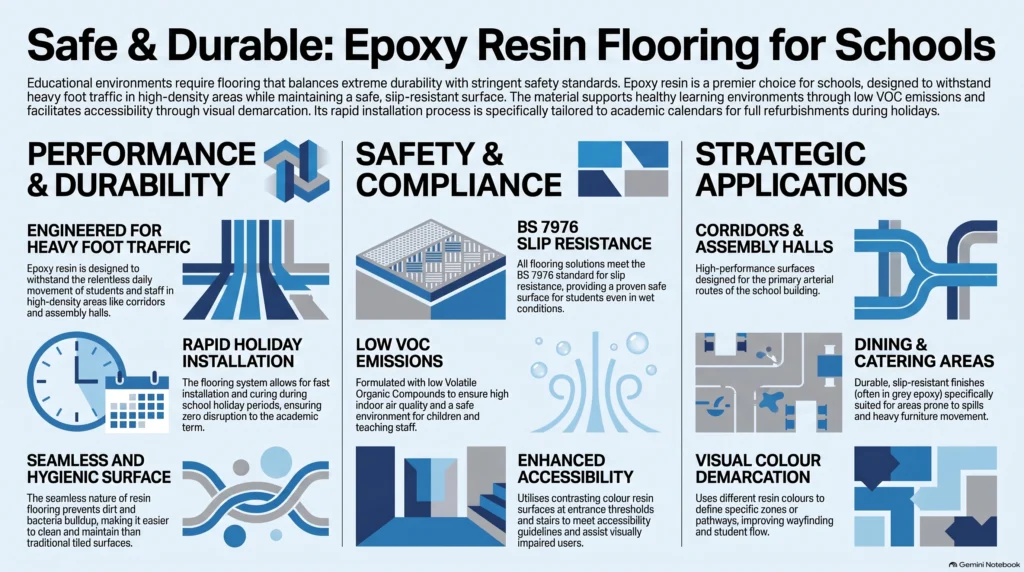
- Multi-layer epoxy systems withstand continuous corridor footfall and provide seamless surfaces that eliminate dirt traps across active school campuses.
- Fast-curing polyaspartic resin cures down to minus five degrees Celsius and accepts foot traffic within two hours.
- Wet pendulum testing to BS 7976 keeps pupils safe in dining halls and entrance foyers under surface contamination.
- Seamless resin finishes let caretaking teams mop floors clean with neutral detergents, ending specialist stripping and buffing regimes.
- Contrasting resin colours at thresholds and stair transitions satisfy Equality Act duties and provide clear wayfinding for pupils.
System Specifications for Educational Environments
Selecting an appropriate resin system requires aligning the functional demands of each school area with proven chemical and mechanical characteristics. The table below maps standard industrial resin systems directly to educational zones. Specifiers must evaluate resin thickness, typical return-to-service windows and slip ratings. Those three factors govern long-term performance across demanding school settings.
These benchmark figures assist facilities managers in planning capital budgets and calculating realistic shutdown durations. Every system must sit over a properly prepared concrete substrate to ensure durable adhesion. In practice, we find substrate moisture dictates the programme more often than the resin itself. Review the core technical metrics before finalising tender documentation.
| School Location | System Classification | Typical Thickness | Return to Service |
|---|---|---|---|
| Main Corridors and Halls | FeRFA Type 5 Self-Smoothing Resin | 2 mm to 4 mm | 24 to 48 hours |
| Dining Areas and Canteens | FeRFA Type 4 Multi-Layer System | 1 mm to 3 mm | 24 to 48 hours |
| Commercial School Kitchens | FeRFA Type 8 Heavy-Duty PU Screed | 6 mm to 9 mm | 24 to 48 hours |
| Entrance Lobbies and Foyers | Fast-Cure Polyaspartic System | 300 to 500 microns | Approx. 2 hours |
| Science Labs and Prep Rooms | FeRFA Type 3 High Build Coating | Up to 1000 microns | 24 to 48 hours |
Summer Holiday Installation Schedules and Project Feasibility
Standard Epoxy Curing Constraints
Standard epoxy systems require ambient temperatures above fifteen degrees Celsius and forty-eight hours to achieve initial mechanical cure. This rigid curing profile limits the total floor area installers can complete during brief academic half-term breaks. School specifiers must consequently restrict standard epoxy refurbishments to longer summer holidays to ensure systems reach full chemical maturity.
Standard epoxies reach full chemical cure within five to seven days. Commissioning the floor too early risks surface staining and premature wear. When contract teams refurbish large assembly halls or long corridor networks, curing times dictate site logistics. Contractors must phase the work carefully around other trades on site.
Rapid Turnaround Using Polyaspartic Technology
Polyaspartic resin technology provides an accelerated curing mechanism that transforms tight school refurbishment schedules. The system accepts pedestrian traffic approximately two hours after application and achieves full chemical cure within twenty-four hours. This rapid reactivity allows contractors to complete expansive communal areas over single weekends without risking handover delays before term starts.
Polyaspartic systems also cure reliably down to minus five degrees Celsius. Local authority estates teams can therefore schedule critical corridor repairs during cold winter breaks. Because the chemistry develops rapid structural strength, multiple coats can proceed on the same working day. Caretakers reopen facilities swiftly without compromising long-term resilience.
Slip Resistance Standards in Corridors and Dining Halls
Pendulum Test Values and BS 7976 Compliance
Floor surfaces in educational buildings must satisfy rigorous UK Health and Safety Executive slip guidelines. Testing under BS 7976 using the Stanley Pendulum test measures slip potential accurately across wet and dry conditions. Safe educational installations require a minimum Pendulum Test Value of 36 in wet conditions to confirm low slip potential.
Water carried into building entrances creates significant slip hazards during rainy school mornings. Dining areas experience liquid spills, dropped food and condensation. An anti-slip system achieving a PTV of 36 or greater provides vital legal protection for education authorities. It also keeps pupils, teaching staff and visitors safe throughout high-risk transit corridors.
Texture Selection and Cleaning Trade-offs
Specifying anti-slip aggregate requires balancing pedestrian traction with daily cleaning efficiency. Coarser aggregates increase surface friction effectively but collect dirt particles within surface valleys. Specifiers should select the finest aggregate grade that satisfies the site risk assessment. Caretaking teams can then sanitise the floor easily using conventional mopping equipment.
School dining halls require careful texture calibration. Food grease and drink spillages lower surface friction rapidly during lunch hours. A medium-grade quartz aggregate beneath an impervious resin seal provides grip whilst preventing grease staining. Maintenance staff sweep away debris smoothly without fibres snagging on the floor texture.
Did You Know?
Health and Safety Executive guidance on the BS 7976 pendulum test rates a Pendulum Test Value of 36 or above as a slip risk of one in one million. A value of 24 raises that statistical risk to one in twenty.
System Selection for High-Traffic Educational Circulation
Multi-Layer Resin for Heavy Impact Resistance
Multi-layer resin systems, classified as FeRFA Type 4, provide dependable impact tolerance across punishing circulation zones. Applied at thicknesses between one and three millimetres, these systems sandwich graded aggregates between durable resin body coats. They withstand dropped bags, rolling equipment and pupil footfall without cracking or delaminating from the concrete substrate.
The textured profile of multi-layer systems resists abrasive wear from playground grit. Thin-film coatings wear through around entrance transitions, whereas Type 4 systems retain their structural body. The multi-coat build distributes point loading across the underlying substrate. That mechanism sustains adhesion through decades of demanding educational terms.
Self-Smoothing Systems for Corridors and Communal Halls
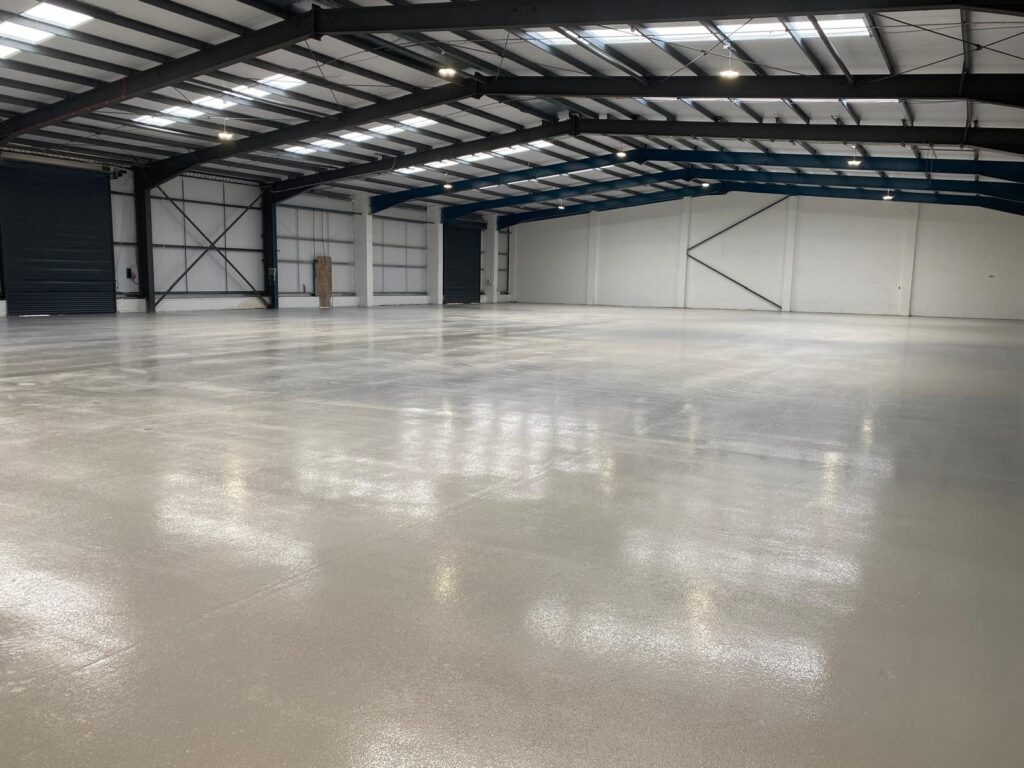
Flow-applied self-smoothing resin floors, categorised as FeRFA Type 5, deliver a level and seamless surface across shared school facilities. Applied at two to four millimetres, these formulations flow out to conceal minor imperfections in the prepared substrate. They produce an ultra-hygienic, impervious floor that prevents bacteria and moisture from penetrating the finish.
Communal spaces benefit from the clean aesthetics and acoustic uniformity of self-smoothing installations. The absence of dirt-retaining joints simplifies daily hygiene routines. Trolleys, musical instruments and staging equipment roll smoothly across the non-porous surface. The robust resin matrix absorbs rolling traffic and prevents scuffing in assembly halls.
Need a Resin Flooring Site Visit and Quote?
Indoor Air Quality and Low-VOC Formulations
Solvent-Free Chemistry for Occupied Campuses
Modern educational specifications require solvent-free, low-VOC resin formulations to preserve indoor air quality. Traditional solvent-borne systems release noxious vapours that migrate through ventilation ducts into active classrooms. Advanced solvent-free epoxy and polyaspartic coatings eliminate airborne contaminants. They protect staff and pupils from respiratory irritation during localised maintenance works on occupied campuses.
Environmental standards in education require compliance with strict indoor air limits. Solvent-free resins meet recognised environmental ratings and support sustainable campus management. Technicians apply these non-taint materials safely alongside ongoing administrative operations. This non-hazardous profile avoids the disruptive evacuations associated with older solvent-based coatings.
Ventilation and Odour Management Near Term Dates
Planning resin installation close to academic start dates requires disciplined ventilation and airflow management. High-performance air extraction units equipped with HEPA filters remove lingering atmospheric fumes rapidly during application. Installers must establish controlled air movement paths away from sensitive teaching departments, dining halls and adjoining staff facilities during work.
Methyl methacrylate chemistries cure rapidly but release strong acrylic odours that linger in enclosed rooms. Modern solvent-free epoxies and polyaspartic systems generate minimal odour during application. Estates managers can therefore schedule handovers days before pupils return. From experience across the sector, odour complaints almost always trace back to poor extraction rather than the resin.
Case Studies
Our case studies cover – Printing & Packaging, Warehousing & Logistics, Pharma & Healthcare, Automotive & Engineering, Aviation & Aerospace, Food & Drink, Printing & Packaging, Warehousing & Logistics, Pharma & Healthcare
Accessibility Compliance and Visual Contrast Requirements
Equality Act Standards at Thresholds and Steps
The Equality Act 2010 mandates accessible built environments that support pupils and visitors with visual impairments. Building regulations require distinct visual contrast at doorways, changes in direction and level changes. Specifiers use contrasting resin shades to highlight openings, ramps and stair nosings. That approach meets mandatory Light Reflectance Value thresholds.
A thirty-point difference in Light Reflectance Value between adjoining surfaces guarantees sufficient visual clarity. Deliberate resin colour bands at primary thresholds guide partially sighted pupils safely through complex facilities. Because the contrasting resin bonds chemically into the floor structure, the markers remain permanent. They will not peel away under footfall.
Level Transitions Between Distinct Floor Finishes
Managing junctions between disparate flooring materials prevents hazardous trip points along high-volume pupil routes. Resin systems can finish flush against carpet tiles or safety vinyl by using recessed transition trims anchored into the substrate. Maintaining perfectly flush thresholds accommodates wheelchair access and heavy lunch trolley movement without damaging the resin edge.
Substrate preparation dictates the success of level transitions. Installers chase neat terminating rebates into the concrete base along boundary perimeters. The liquid resin finishes neatly within the metal profile and forms a robust mechanical anchor. This locked perimeter detail prevents edge spalling between distinct educational zones.
“JD Flooring did an excellent job installing a resin floor in our food production facility. The floor is durable, hygienic, and meets all safety regulations. The team was knowledgeable and professional, and the project was completed within the agreed-upon timeframe. I highly recommend JD Flooring for food industry flooring needs.”
Alex Martinez
Colour Demarcation for Wayfinding and Departmental Zoning
Departmental Identity and Circulation Routing
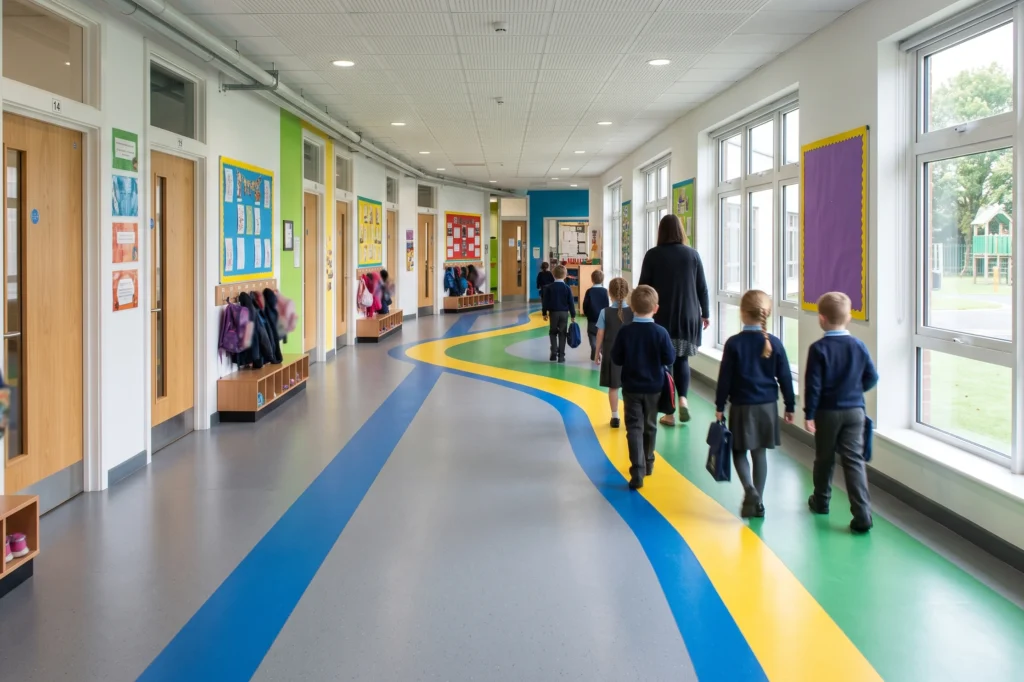
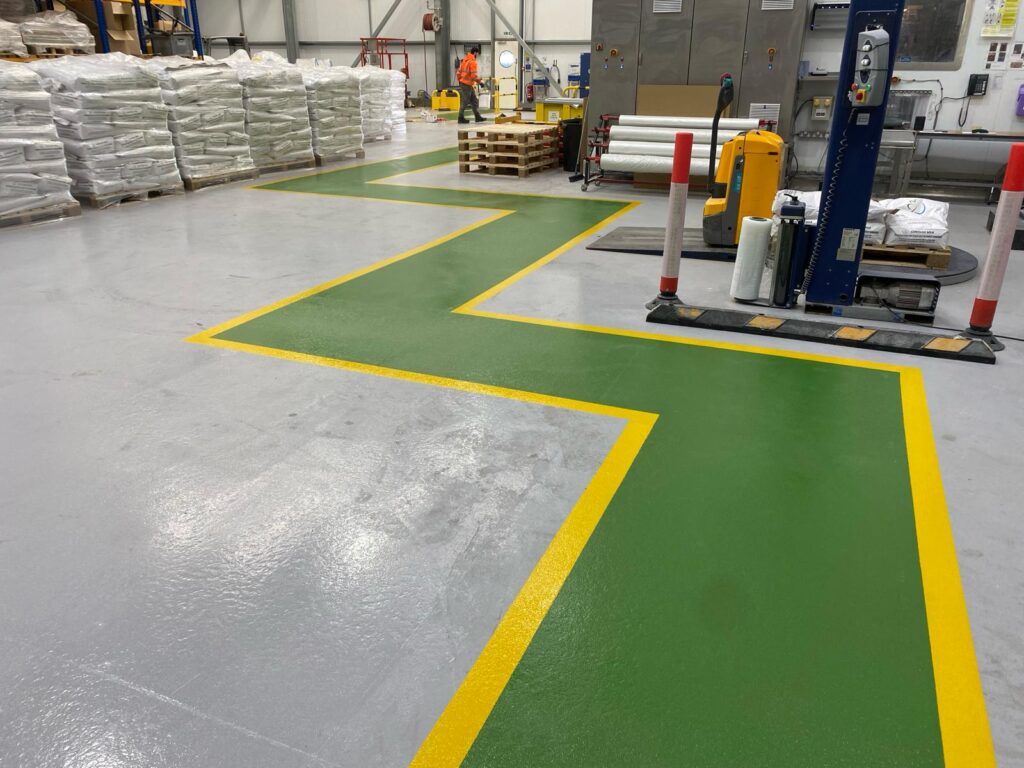
Colour-zoned resin flooring provides intuitive navigational cues across modern educational layouts. Large secondary schools and colleges use distinct floor colours to identify science corridors, humanities wings and administrative zones. Vibrant pigments blended into high-build epoxy establish spatial boundaries that assist pupil navigation throughout hectic class changeover periods.
Demarcated routes maintain orderly pedestrian circulation across sprawling communal atriums. Clear contrasting lines separate primary footpaths from locker clusters and queuing zones. Because the pigment permeates the resin matrix, visual guides never fade like surface tape. Staff direct visitors and emergency services efficiently using floor-based cues.
Safety Demarcation Around Science and Workshop Areas
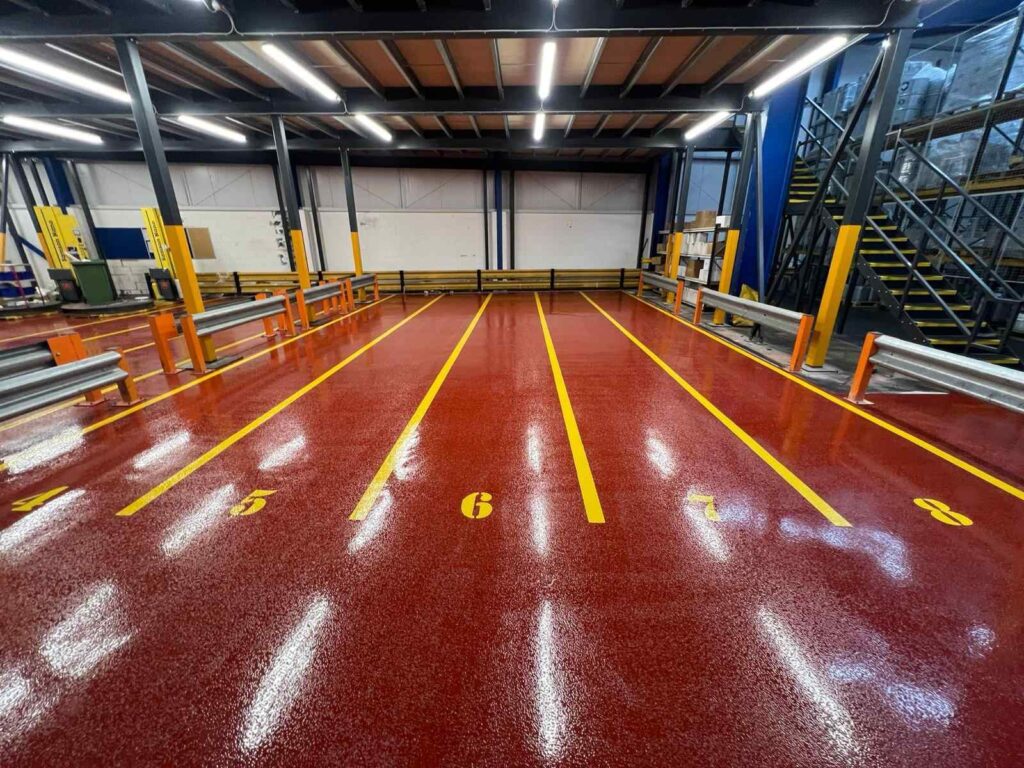
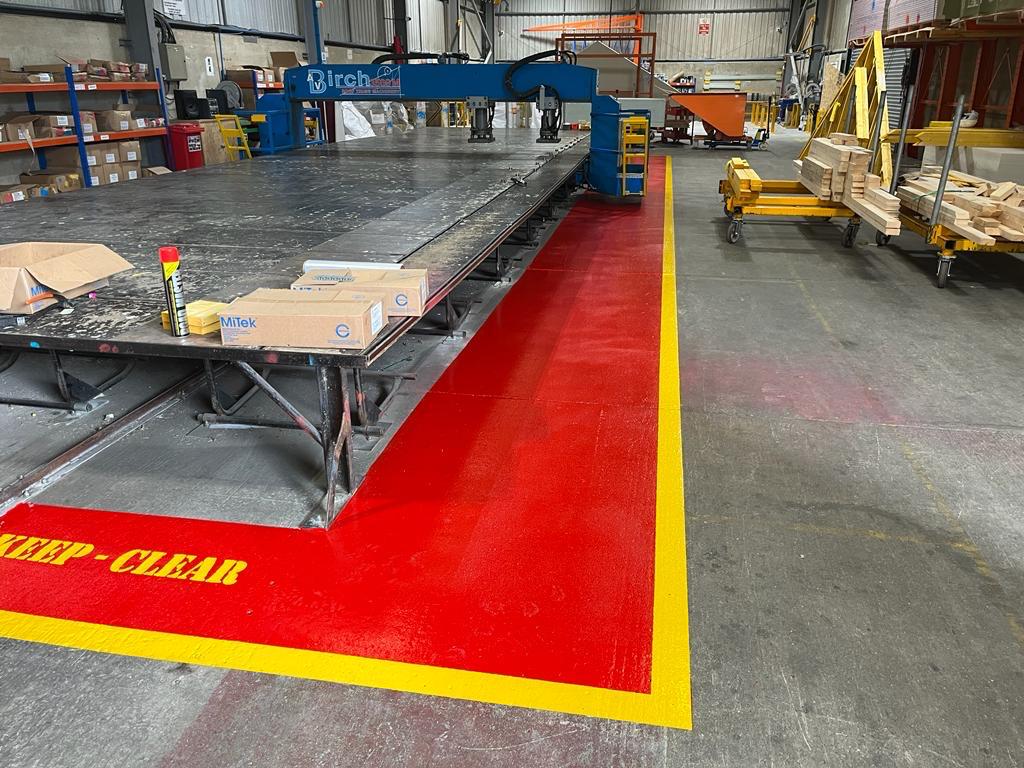
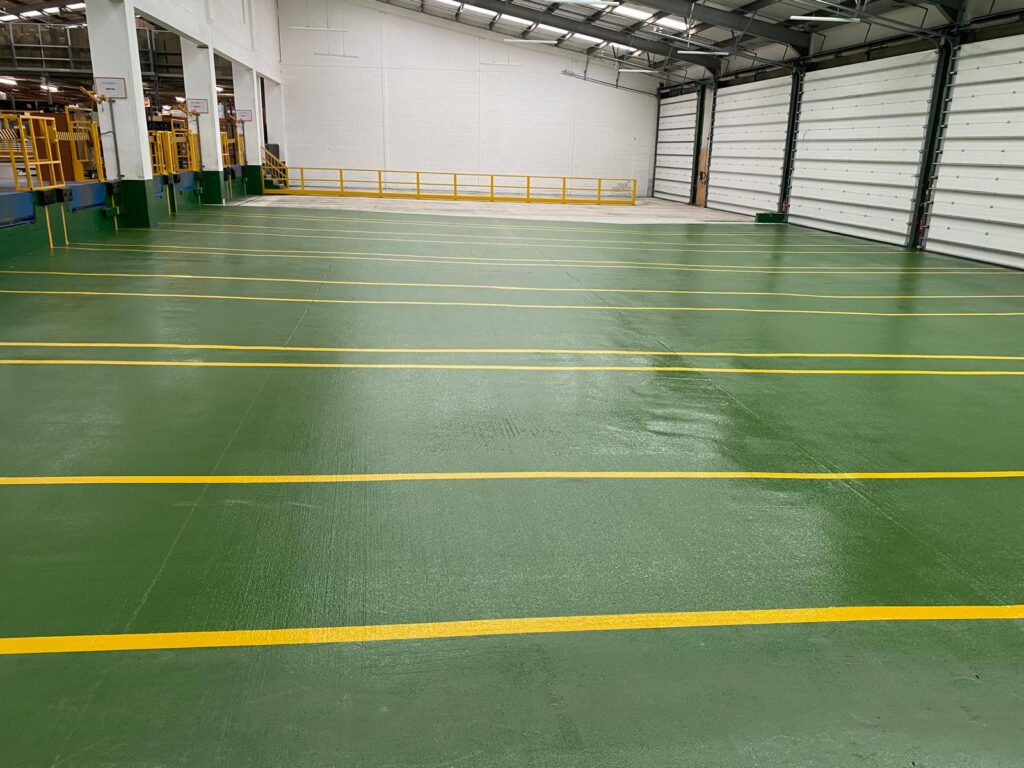
Designated safety zoning is essential in school design technology workshops, engineering suites and science laboratories. The Workplace (Health, Safety and Welfare) Regulations 1992 require explicit hazard identification around dangerous machinery. Contrasting safety-red and yellow resin line markings establish mandatory operator zones around pillar drills, lathes and chemical preparation benches.
Durable line marking resins bond directly to the base layer. They resist oil contamination and heat from hot apparatus. Clean boundary lines remind pupils to keep clear of operating machinery during practical demonstrations. Integrating eye-wash borders and fire exit routes into the floor design strengthens safety compliance.
Lifecycle Maintenance and School Budget Economics
Routine Mop Cleaning Without Specialist Equipment
Seamless resin floors lower ongoing operational costs by simplifying daily cleaning regimes across educational premises. Traditional vinyl requires periodic stripping, chemical polishing and specialist buffing machines to maintain appearance. Impervious resin systems need only flat-mop sweeping and washing with mild, pH-neutral detergents. That regime removes tracked mud and everyday spills.
School caretaking teams clean expansive assembly halls and long corridors in a fraction of the time. Eliminating seams removes recessed crevices where grime and moisture settle. The non-porous resin repels water and dirty cleaning solutions. Floors dry rapidly after morning cleaning, which reduces slip incidents when pupils arrive.
Long-Term Surface Protection and Refurbishment
Investing in a high-grade resin floor delivers superior lifecycle economics over a twenty-year operational horizon. A correctly specified multi-layer or self-smoothing installation provides fifteen to twenty years of service life. Dividing initial capital expenditure over those decades proves far more economical than replacing failed sheet coverings repeatedly across a school estate.
Where high-traffic doorways suffer localised abrasion, facilities managers can refurbish the top seal cost-effectively. Contractors lightly abrade the aged surface and apply a fresh seal coat. Hacking out the entire system is unnecessary. This straightforward refresh avoids disruptive demolition and preserves budgets for core academic priorities.
Final Thoughts
Specifying epoxy resin flooring in schools resolves the conflicting demands of pupil safety, mechanical durability and stringent maintenance budgets. Continuous multi-layer and self-smoothing systems eradicate hazardous joint failures. They also simplify daily caretaking routines across high-traffic zones. Tested slip resistance to BS 7976 satisfies workplace safety duties in wet entryways and busy dining halls. Rapid-curing chemistries remove historical downtime concerns, so extensive refurbishments now conclude safely within scheduled holiday periods.
Estates managers should evaluate existing substrates, traffic patterns and lighting requirements early in project planning. Professional relative humidity testing and mechanical diamond-grind preparation ensure new installations bond permanently to concrete subfloors. Blistering risk falls sharply as a result. Compliant colour demarcation and robust low-VOC formulations together create inclusive, durable learning environments engineered to perform for decades.
Arrange a Free Site Survey
If you are thinking about upgrading the flooring in your commercial or industrial space then we would love to hear from you. Our team of experts will conduct a free onsite survey and then guide you through the process of product selection and project planning, whilst remaining mindful of your budgetary restraints.
Frequently Asked Questions
A:
Standard epoxy installations typically require twenty-four to forty-eight hours before accepting light foot traffic. Full chemical and mechanical cure follows in two to five days above fifteen degrees Celsius. Where access windows are extremely tight, such as half-term breaks or single weekends, estates teams can specify fast-curing polyaspartic systems. Polyaspartic resin permits foot traffic in roughly two hours and cures fully within twenty-four hours, even at minus five degrees Celsius.
A:
School floors should achieve a minimum Pendulum Test Value of 36 in wet conditions. Testing must follow BS 7976. That benchmark equates to a low slip potential under Health and Safety Executive criteria. Some areas face constant surface contamination, including commercial kitchens, dining halls and entrance lobbies exposed to tracked rainwater. Graded anti-slip aggregate within the resin seal coat provides the necessary traction in those zones.
A:
Sheet vinyl relies on welded seams and adhesive bonds. Those seams frequently split, curl and lift under continuous pupil traffic and rolling equipment. Resin flooring forms an unbroken bond directly to the prepared concrete substrate. No joints exist to trap dirt or tear under dynamic loads. Resin systems therefore withstand intensive corridor abrasion and heavy impact, delivering an operational lifespan of fifteen to twenty years.
A:
Yes. Specifiers can select solvent-free, ultra-low-VOC epoxy and polyaspartic formulations engineered for occupied buildings. These materials produce negligible odour during application and emit no hazardous volatile organic compounds. Indoor air quality is therefore preserved. Provided adequate extraction and ventilation run throughout installation, the systems can be applied in phased sections beside active academic areas without evacuations.
A:
Routine maintenance is straightforward and needs no specialist buffing machines or chemical stripping agents. Caretaking teams sweep away loose grit with soft brooms or vacuum cleaners. They then wash the seamless surface using a flat mop and a mild, pH-neutral detergent. Aggressive caustic cleaners, acidic solutions and abrasive scouring pads should be avoided. Those products gradually dull the protective clear seal coat.
