
How to Vet Certified Industrial Resin Flooring Contractors
Industrial flooring projects demand rigorous technical competence, strict safety management, and dependable material chemistry. Facilities managers who hire certified industrial resin flooring contractors protect their operational budgets. Certification guards against premature bond failure, regulatory non-compliance, and unexpected downtime. Certified installers hold verified competence in handling reactive resin polymers, testing concrete moisture, and running dust-controlled mechanical preparation. Qualified specialists deliver durable surfaces for processing halls, logistics hubs, and hygienic manufacturing units.
Unqualified contractors omit basic diagnostic assessments, underestimate substrate movement, or submit artificially low pricing. Selecting an installer means examining chemical accreditations, health documentation, and past sector performance. Broad marketing statements prove nothing. How can specifiers audit prospective contractors to ensure their facility obtains a compliant, durable installation?
Key Takeaways
- Qualified industrial flooring specialists must hold mandatory ISOPA or ALIPA certification renewed every five years for handling polyurethane diisocyanates safely on site.
- Commercial projects require verified public liability cover of at least five million pounds alongside comprehensive risk assessments and method statements before starting.
- Authoritative mechanical preparation requires industrial diamond grinding with integrated HEPA vacuum extraction rather than hazardous, unapproved chemical etching methods.
- Industrial resin quotations falling materially below eight pounds per square metre indicate compromised preparation standards, inferior thicknesses, or missing regulatory provisions.
- Specifiers must separate manufacturer material warranties from contractor installation guarantees whilst demanding referenceable work across identical operational facilities.
Contractor Competence and Document Verification Matrix
Selecting the correct specialist requires validating specific technical documentation rather than relying on promotional assertions. A competent contractor provides verifiable proof of chemical handling safety and statutory insurance. Health records and sector experience follow the same rule. Evaluating these credentials prevents operational disruption and protects installation longevity.
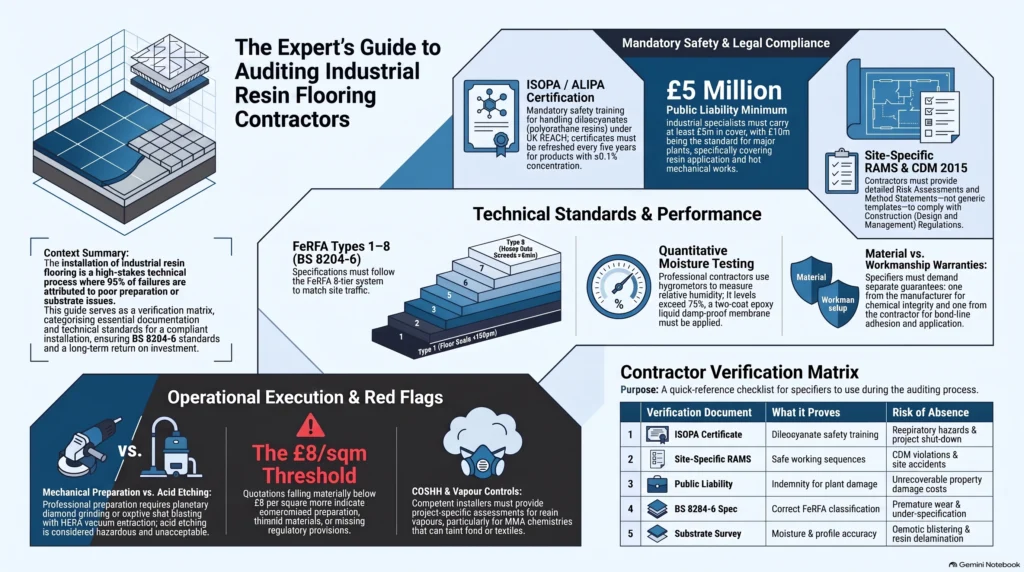
The criteria matrix below sets out the documentation specifiers must inspect when auditing prospective installers. Each row names the credential and states what it proves. It also identifies the operational risk carried by a contractor who cannot produce that paperwork. Use it as a procurement checklist across high-demand industrial facilities.
| Verification Document | What the Document Proves | Primary Operational Risk Mitigated |
|---|---|---|
| ISOPA / ALIPA Certificate | Mandatory training in handling diisocyanates safely | Workplace exposure hazards, respiratory sensitisation, and project shut-downs |
| Site-Specific RAMS | Detailed hazard analysis and safe working sequences | Uncontrolled site accidents, CDM breaches, and cross-contamination |
| Public Liability Policy | Current indemnity cover of at least five million pounds | Uninsured commercial liability and unrecoverable property damage |
| BS 8204-6 Specification | Correct FeRFA classification and depth build-up | Premature surface wear, cracking, and mechanical under-specification |
| Substrate Survey Report | Accurate moisture readings and preparation profiling | Osmotic blistering, poor adhesion, and resin delamination |
Mandatory Chemical Safety and Health Compliance Checks
Diisocyanate Safety Training Under UK REACH
Professional handlers of polyurethane resins must complete certified diisocyanate training under UK REACH restrictions. The duty applies where product concentrations equal or exceed 0.1%. Training renewed at least every five years ensures technicians understand exposure routes, sensitisation risks, and workplace controls. This statutory requirement confirms installers apply hazardous polymers responsibly.
Under UK workplace exposure limits defined in EH40, isocyanates carry a strict 8-hour time-weighted average limit of 0.02 mg/m³. The short-term exposure limit is 0.07 mg/m³. Technicians must hold training certified by industry bodies such as ISOPA or ALIPA. This covers application protocols for pouring, rolling, and trowelling polyurethane screeds. In practice, we check the safety data sheet or product label before any material reaches site. Where a product contains 0.1% or more diisocyanates, professional users must complete the training first. Refresher training is legally required at least every five years.
COSHH and In-Situ Resin Vapour Controls
Industrial resin liquid components require rigorous chemical evaluation before mixing and placement begin inside an active facility. Competent contractors produce project-specific COSHH assessments drawn from manufacturer safety data sheets. These detail vapour management, personal protective equipment, and ventilation protocols. The procedure protects workforce health and prevents product contamination.
Reactive resins release volatile compounds during blending and exothermic curing. A certified contractor identifies these hazards in advance. They establish forced-air extraction and designate chemical containment zones to protect building occupants. Methyl methacrylate chemistries emit pungent acrylic odours that taint sensitive foodstuffs, packaging, and textiles. Competent installers assess this risk before specifying fast-cure systems. That assessment avoids costly facility evacuations and inventory losses.
Operational Competence and Risk Documentation Standards
Site-Specific RAMS and CDM 2015 Duties
Most commercial resin flooring installations constitute construction operations governed by the Construction (Design and Management) Regulations 2015. Certified contractors supply detailed, site-specific Risk Assessments and Method Statements rather than generic paperwork. This documentation proves operational competence. It also ensures hazardous mechanical tasks proceed under rigorous safety supervision.
CDM 2015 places statutory obligations on clients, principal designers, and contractors to plan, manage, and monitor health risks. A compliant flooring contractor evaluates site power access, ventilation paths, pedestrian segregation, and waste disposal. The method statement describes each phase sequentially, from diamond grinding to final seal coats. Reviewing these documents confirms the installer coordinates with your site operations. It also confirms appropriate safety controls are enforced.
Public Liability and Insurance Thresholds
Industrial flooring operations involve heavy planetary grinding machinery, flammable solvents, and reactive chemical components. This work happens inside high-value operational environments. Professional contractors carry public liability cover of at least five million pounds. Ten million pounds is standard on major industrial facilities. Verifying current certificates protects clients against catastrophic plant damage.
Substandard contractors frequently operate with residential-grade policies or lapse into uninsured trading. Before granting site access, ask for a current broker verification letter. It must confirm the policy explicitly covers synthetic resin application and hot mechanical preparation. Legitimate contractors provide these indemnity documents willingly. From experience across the sector, that willingness is itself a reliable competence signal.
Did You Know?
UK REACH restrictions have applied since 24 August 2023. Professional and industrial users handling products with diisocyanate concentrations of 0.1% or greater must complete certified safety training. That training must be refreshed at least every five years.
Substrate Assessment and Mechanical Preparation Verification
Mechanical Preparation Methods and Dust Extraction
Approximately ninety-five percent of resin flooring failures result from inadequate mechanical preparation or contaminated concrete surfaces. Competent specialists use enclosed captive shot blasting or planetary diamond grinding with HEPA-filtered vacuum extraction. This sequence eliminates surface laitance, opens concrete pores, and creates a reliable anchor profile for the resin.
A contractor must state their preparation method clearly within the written proposal. Acid etching is unacceptable in modern industrial environments. It saturates concrete with water and leaves corrosive chemical residues. Mechanical diamond grinding removes aged coatings, oil contamination, and weak surface layers safely. Connecting grinding machinery to certified HEPA extraction also controls respirable crystalline silica dust. Airborne particulates then stay well below statutory workplace limits.
Moisture Testing Protocols and Vapour Suppression
Applying impermeable resin systems over damp concrete guarantees eventual adhesion failure, blistering, and osmotic delamination. Professional contractors conduct quantitative hygrometer testing to measure substrate relative humidity against established British Standards. Where readings exceed system tolerances, certified installers apply a two-coat epoxy liquid damp proof membrane before the build-up starts.
Standard synthetic resin formulations tolerate concrete moisture levels up to 75% or 80% relative humidity. If a concrete base lacks an intact physical damp proof membrane, groundwater migrates upward through capillary action. An experienced contractor tests non-destructively across several points of the floor. Where hygrometer readings exceed safe parameters, they apply a specialist epoxy liquid membrane. Such systems suppress residual construction moisture up to 98% relative humidity.
Need a Resin Flooring Site Visit and Quote?
Industry Standards and Technical Compliance Benchmarks
FeRFA System Categorisation and BS 8204-6
Authoritative contractors classify resin flooring specifications using the FeRFA eight-tier system aligned with BS 8204-6. The standard categorises builds from thin floor seals up to heavy-duty trowel-applied polyurethane screeds. Thickness and duty rating drive that classification. Clear categorisation prevents underspecification under aggressive industrial traffic.
Specifying a floor simply as an epoxy coating invites severe commercial ambiguity. A FeRFA Type 1 seal measures up to 150 microns. A FeRFA Type 8 heavy-duty screed exceeds 6 millimetres. Film thickness is the primary determining variable for operational service life. Contractors must state the exact FeRFA type, dry film build, and performance standard. That detail proves the proposed system matches your traffic and impact profile.
Quality and Environmental Management Frameworks
Reliable installers manage operational consistency by working to formal frameworks such as ISO 9001 and ISO 14001. Compliant procedures govern product batch tracking, substrate preparation records, environmental containment, and waste disposal. Specifiers should confirm contractors maintain audited internal processes rather than relying on unverified claims made in marketing material.
Industrial clients must distinguish between confirmed compliance and certified status. Reputable companies ensure their products, procedures, and environmental controls comply with ISO 9001 and ISO 14001. That framework drives systematic quality checks at every stage of installation. Checks run from initial substrate moisture testing through to final surface cure inspection. Claiming compliance is not the same as holding an accredited certificate, so ask which applies.
Case Studies
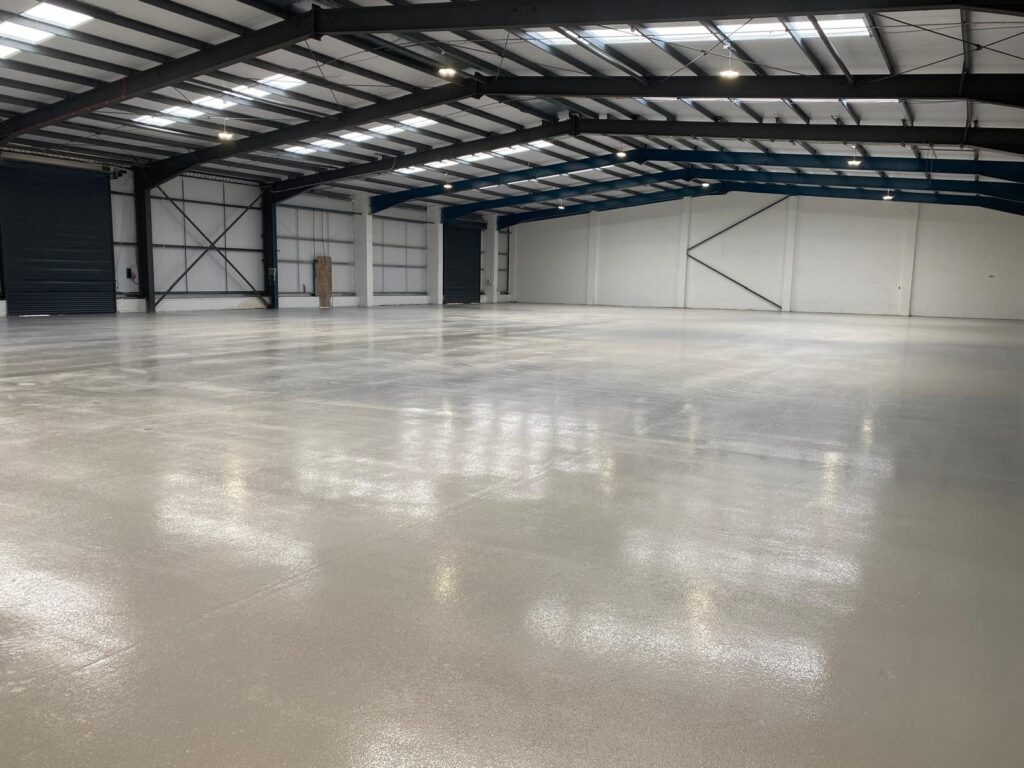
Our case studies cover – Printing & Packaging, Warehousing & Logistics, Pharma & Healthcare, Automotive & Engineering, Aviation & Aerospace, Food & Drink, Printing & Packaging, Warehousing & Logistics, Pharma & Healthcare
Sector Experience and Verifiable Contractor Evidence
Sector References and Verifiable Installations
Selecting certified industrial resin flooring contractors means testing whether a company holds a proven track record in your sector. Facilities managers should know what accreditations to ask a flooring contractor for. Case histories matter just as much. Look for documented performance under comparable chemical, thermal, and mechanical stresses.
Operational conditions vary dramatically across sectors. An engineering workshop requires heavy compressive strength and cutting-fluid resistance. A food processing plant demands thermal shock resistance against steam cleaning. A pharmaceutical cleanroom needs seamless, non-porous systems resistant to aggressive chemical disinfectants. Request anonymised references from past clients in your industry. These confirm the installer understands your hygiene, drainage, and load parameters.
Product Warranties Versus Workmanship Guarantees
Specifiers must separate resin manufacturer material warranties from the installation guarantees provided by the flooring contractor. Manufacturer documentation guarantees raw chemical integrity. Contractor warranties cover surface preparation, priming adhesion, and application workmanship. Clarifying these terms prevents costly disputes if premature debonding or cracking occurs on the finished floor.
Material warranties rarely cover application defects, moisture-induced blistering, or poor substrate preparation. The installer must provide an independent workmanship guarantee covering the bond line and mechanical profiling. Read the terms closely to understand maintenance obligations, excluded structural movement, and chemical exposure limits. A dependable contractor explains precisely where their installation liability begins and ends.
“JD Flooring did an excellent job installing a resin floor in our food production facility. The floor is durable, hygienic, and meets all safety regulations. The team was knowledgeable and professional, and the project was completed within the agreed-upon timeframe. I highly recommend JD Flooring for food industry flooring needs.”
Alex Martinez
Pricing Transparency and Quotation Scrutiny
Material and Labour Rate Thresholds
Transparent industrial resin quotations typically range between eight pounds and forty-five pounds per square metre. The specified system build drives that range. Rates incorporate mechanical preparation, specialist priming, material volume, and skilled application labour. Any industrial quote falling below eight pounds per square metre should be questioned immediately.
Basic dust-proofing seals start at eight pounds per square metre. High-build coatings cost between eight and twelve pounds. Flowable self-smoothing systems sit between twenty and thirty pounds. Heavy-duty polyurethane screeds reach thirty to forty pounds per square metre. Specialist polyaspartics average around thirty-eight pounds. When an estimate lands materially below these rates, the contractor has cut preparation or thinned the resin film.
Incomplete Quotations and Hidden Exclusions
Comprehensive estimates detail precise FeRFA system classifications, dry film thicknesses, preparation equipment, and priming formulations. Incomplete quotations omit substrate crack repairs, joint treatment, coving, or transport costs. Those omissions create unexpected variations during installation. Demanding unbundled pricing ensures fair commercial comparison between competing professional bids.
A professional quotation leaves no scope for hidden costs. It defines the preparation method, primer type, basecoat thickness, aggregate broadcast density, and topcoat chemistry. It also accounts for structural joint detailing, perimeter transitions, and waste management. Vague general allowances hide the substrate remediation steps. Specifiers then cannot verify what the contractor actually intends to carry out.
Warning Signs and Unqualified Installer Red Flags
Commercial Indicators of Substandard Contractors
Rogue tradespeople and unqualified applicators show clear commercial warnings during procurement. Common signs include refusing an on-site technical survey and demanding large cash deposits. Dramatic discounts for an immediate decision belong on the same list. Reputable industrial specialists operate transparently, with traceable registrations and verified business premises.
Never contract a company that quotes definitively over the telephone without inspecting your facility. Concrete substrates require on-site diagnosis of surface damage, relative humidity, oil ingress, and joint integrity. Professional contractors hold verifiable registered office addresses and structured invoicing schedules. Clear company registration details remove the financial risk attached to transient trade operators.
Technical Deficits and Premature Floor Failure
Incompetent installers routinely show technical deficits that end in catastrophic floor failure within months of handover. Warning signs include proposing acid etching, refusing moisture testing, or declining to state system thickness. Each shortcut lowers the headline price. The result is severe delamination, osmotic blistering, and premature surface erosion.
A contractor lacking technical competence will rarely discuss substrate temperature, dew points, or concrete moisture parameters. Applying resin over contaminated, cold, or damp surfaces traps moisture. Trapped moisture triggers osmotic blisters that ruin impermeable coatings. Failing to treat structural expansion joints with flexible polysulphide sealants causes reflective cracking. Insisting on verified compliance standards protects your business from these expensive oversights.
Final Thoughts
Specifying synthetic resin finishes across industrial environments demands technical validation, safety governance, and thorough substrate preparation. Certified industrial resin flooring contractors deliver measurable quality assurance. They work to BS 8204-6, use dust-extracted mechanical preparation, and maintain compliant health documentation. Auditing accreditations, insurance and sector case histories secures a surface built for your operational demands.
Prioritising installer competence over initial cost protects operations against bond failure, regulatory penalties, and production shutdowns. Requesting unbundled quotations and verifying chemical safety training keeps every installation stage under professional supervision. Auditing technical credentials ensures the completed resin floor performs dependably across its full design lifecycle.
Arrange a Free Site Survey
If you are thinking about upgrading the flooring in your commercial or industrial space then we would love to hear from you. Our team of experts will conduct a free onsite survey and then guide you through the process of product selection and project planning, whilst remaining mindful of your budgetary restraints.
Frequently Asked Questions
A:
Request evidence of ISOPA or ALIPA technician training for handling diisocyanates in polyurethane systems. Ask for proof that products and operational processes comply with ISO 9001 and ISO 14001. Contractors must also supply site-specific Risk Assessments and Method Statements under CDM 2015. A valid public liability certificate providing at least five million pounds of cover is essential. Finally, ask for verifiable case references from similar industrial facilities.
A:
UK REACH restrictions have applied since 24 August 2023. Professional and industrial users handling products containing 0.1% or more diisocyanates must complete certified safety training first. Polyurethane resin screeds and coatings contain diisocyanates. These present respiratory and dermal sensitisation hazards. ISOPA or ALIPA certification confirms applicators understand exposure limits, mandatory personal protective equipment, and safe application protocols. Refresher training is required at least every five years.
A:
An industrial flooring contractor should hold public liability insurance of at least five million pounds. Ten million pounds is frequently required on larger industrial plants and main contractor sites. The cover addresses third-party personal injury and property damage. Risks include heavy mechanical grinding equipment, dust extraction plant, and hazardous chemical handling. Always request a current broker verification letter confirming the policy covers commercial resin application.
A:
Request referenceable case histories from facilities operating within your specific sector. Relevant examples include food manufacturing, chemical processing, and logistics. Reviewing evidence of similar mechanical, thermal, and chemical exposures confirms the contractor understands your operating conditions. A reputable specialist provides anonymised client testimonials detailing system performance, project management standards, and operational longevity. This evidence is supplied without breaching commercial client confidentiality.
A:
A quotation below eight pounds per square metre rarely covers legitimate material volumes and skilled labour. It also fails to fund industrial-grade mechanical preparation. Professional installations require diamond grinding or captive shot blasting with HEPA vacuum extraction. Dedicated priming and specified polymer film builds add further cost. Quotes priced well below market rates signal skipped preparation, diluted materials, or omitted substrate moisture suppression.
