Industrial Resin Floor Installers Cheshire: How to Choose
Choosing industrial resin floor installers Cheshire plants can rely on demands technical vetting, not a glance at surface finish. Concrete across the county meets aggressive process chemicals every shift. It also takes constant mechanical handling traffic and sharp thermal shock cycles. An unqualified contractor invites bond failure, costly shutdowns and early delamination. Verify substrate preparation, moisture suppression and safety certification before you commit capital.
Many resin flooring companies Cheshire wide offer contrasting specifications for the same building. This guide sets out the testing protocols, preparation standards, regional demands and regulations a plant engineer must audit first. So how do you separate a technically compliant contractor from a surface painter?
Key Takeaways
- Substrate moisture testing and diamond grinding prevent osmotic blistering and early resin delamination in industrial facilities.
- Quotations must state the FeRFA classification, dry film thickness, preparation method and every warranty exclusion clause.
- Installers using diisocyanate polyurethanes need verified ISOPA or ALIPA training, refreshed at least every five years.
- Cheshire process zones need systems matched to exposure, from thermal shock screeds to chemical resistant bund linings.
- Downtime cost drives project economics, so rapid curing polyaspartic systems suit tight manufacturing shutdown windows.
Technical Evaluation Matrix for Industrial Resin Flooring Systems
Industrial resin flooring works only when the chemistry matches the operational duty. Systems range from thin dust-proofing seals to nine-millimetre screeds built for severe service. Facilities managers must weigh mechanical properties, application temperature windows and return-to-service times. Those three factors decide the specification long before appearance enters the conversation.
The matrix below sets out the main FeRFA classifications and specialist chemistries installed across the county. Indicative rates reflect a complete professional installation. They include mechanical preparation, priming and material application. Use these benchmarks to test any contractor proposal against BS 8204-6 and the wider British Standards.
| System Classification | Typical Thickness | Indicative Cost (per m²) | Primary Operational Capability |
|---|---|---|---|
| High Build Coating (FeRFA Type 3) | Up to 1000 microns | £8 – £12 | Demarcation, light MHE, general warehousing |
| Self-Smoothing Epoxy (FeRFA Type 5) | 2 – 4 mm | £20 – £30 | Cleanrooms, laboratories, hygienic production |
| Heavy Duty PU Screed (FeRFA Type 8) | 6 – 9 mm | £30 – £40 | Steam cleaning, thermal shock, aggressive wet processing |
| Polyaspartic Fast-Cure | Two coats (300–500 µm) | £38 | Rapid turnaround, low temperature curing to -5°C |
| Methyl Methacrylate (MMA) | 2 – 6 mm | £45 | Sub-zero installation, full chemical cure within 3 hours |
Pre-Qualification Checks and Statutory Contractor Compliance
Diisocyanate Training Records and RAMS Documentation
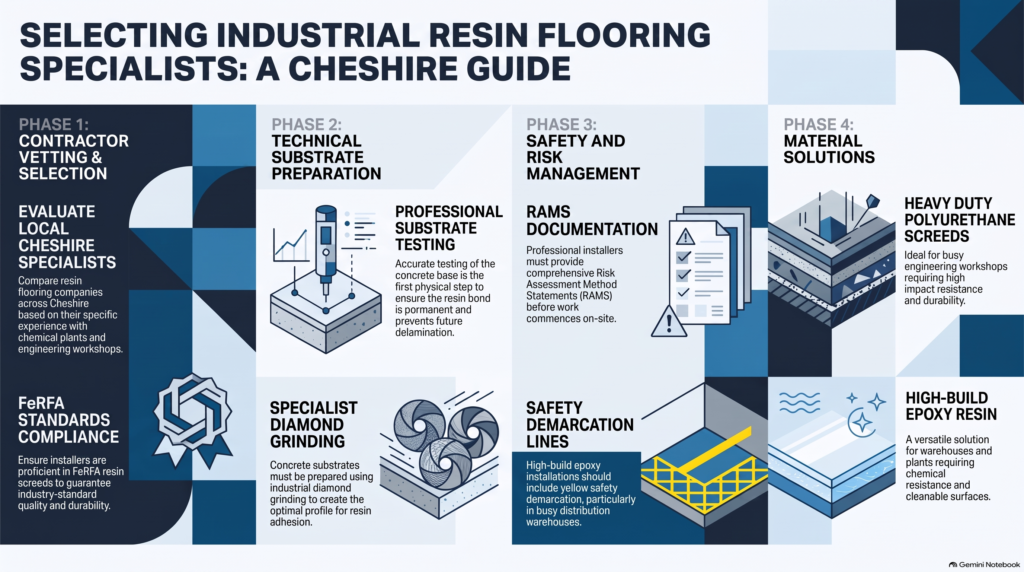
Health and safety pre-qualification is the first barrier when auditing a flooring team. Contractors must supply task-specific Risk Assessments and Method Statements. They should also evidence dust and fume controls. Where polyurethane is specified, verify technician competence under the REACH diisocyanate restriction before any work starts on site.
Check the safety data sheet and the product label first. Where a product contains 0.1 percent or more diisocyanates, professional users must complete the required training before use. Refresher training follows at least every five years. EH40 sets the isocyanate workplace exposure limit at 0.02 mg/m³ over eight hours. The short-term limit is 0.07 mg/m³. In practice, we find reliable contractors submit ISOPA or ALIPA certificates unprompted. They also issue project-specific COSHH assessments before mobilisation.
Contractor Experience and Workmanship Guarantees
Insurance cover and warranty structure separate reputable installers from trade painters. Facilities managers should require at least five million pounds of public liability cover. Higher-risk sites warrant ten million. Specifiers must also force a clear split between the manufacturer material warranty and the contractor installation guarantee.
Manufacturer warranties cover formulation consistency and chemical defects. They never cover adhesion failure caused by a contaminated or poorly prepared substrate. A workmanship warranty must guarantee bond integrity, inter-coat adhesion and curing execution. Experienced industrial resin flooring contractors work to BS 8204-6. From experience across the sector, the strongest bidders also hold ISO 9001 and ISO 14001 certification. They show a transparent trading history alongside it.
Substrate Soundness and Pre-Installation Testing Protocols
Relative Humidity and Moisture Vapour Transmission Testing
Moisture trapped beneath an impermeable resin film creates osmotic blisters and total bond failure. Reliable contractors never judge moisture by eye. They take quantitative hygrometer readings under BS 8204-6. Where relative humidity exceeds 75 percent, the installer must apply an epoxy liquid damp proof membrane before priming.
Groundwater rises through concrete by capillary action. It carries salts that break the bond between primer and substrate. Standard epoxies tolerate relative humidity of 75 to 80 percent. Above that threshold, installers apply a two-coat, solvent-free epoxy liquid DPM. The barrier suppresses moisture vapour transmission up to 98 percent relative humidity. That protects the primary floor system against osmotic failure.
Mechanical Soundness and Tensile Adhesion Pull-Off Verification
A resin floor depends entirely on the strength of the concrete beneath it. Reputable contractors test surface soundness before issuing a specification. Rebound hammers, scratch testing and compressive core samples all have a place. Tensile pull-off testing then confirms whether the prepared surface reaches adequate cohesive strength.
Industrial concrete needs a minimum tensile surface strength of 1.5 N/mm². That figure supports heavy-duty overlays under mechanical handling equipment. Weak laitance, historical oil contamination and chemical attack all reduce it. Pull-off tests bond steel dollies to the slab with high-strength resin. The dolly is then pulled to quantify substrate cohesion. If the concrete fractures below target, specify mechanical remediation or a consolidation primer.
Did You Know?
Under UK REACH, mandatory diisocyanate training took legal effect on 24 August 2023. It applies to any substance containing monomeric diisocyanates at 0.1 percent or greater. Recertification is required at least every five years.
Surface Preparation Methods and Profile Standards
Enclosed Diamond Grinding and Captive Shot Blasting
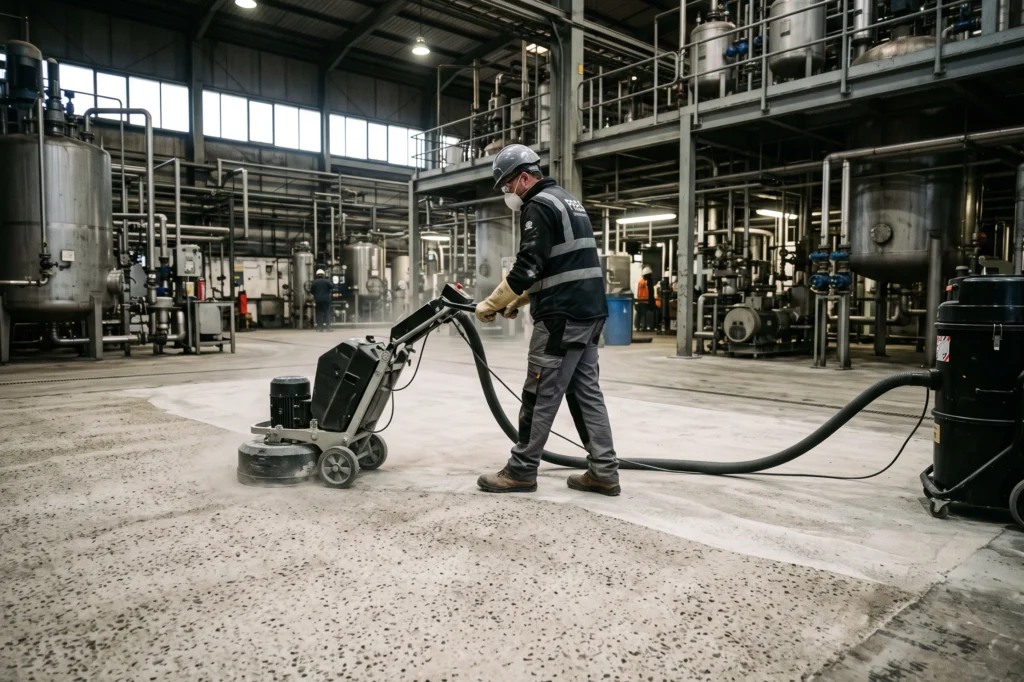
Mechanical preparation opens the pores of the slab and creates the profile adhesion depends on. Competent installers use enclosed diamond grinding with HEPA-filtered vacuum extraction. That captures hazardous dust at source. For thicker screeds, captive shot blasting gives a coarser key without releasing airborne silica.
Over 95 percent of resin floor failures trace back to poor substrate preparation. Grinding removes weak laitance, legacy paint films and contamination. It exposes sound concrete aggregate. Acid etching has no place in a modern facility. It drives liquid moisture and corrosive salts into the slab. Enclosed grinding also keeps sites within the EH40 limit for respirable crystalline silica, set at 0.1 mg/m³ over eight hours.
Joint Repair and Substrate Crack Bridging
Movement joints and structural cracks need engineering, not filler. Professional installers never seal an expansion joint with rigid resin. Thermal cycling then causes reflective cracking within months. Instead, contractors rebuild broken joint arrises with high-strength epoxy mortar. Elastomeric polysulphide sealant follows once that repair has cured fully.
Surveyors must separate static shrinkage cracks from active movement joints. Static cracks take resin injection, or raking out and filling with thixotropic epoxy mortar. Movement joints must mirror precisely through the resin build-up. Heavy forklift traffic breaks down unsupported joint edges. Contractors reform those arrises with high-compressive-strength mortar. Flexible jointing compound then absorbs the dynamic mechanical load.
Need a Resin Flooring Site Visit and Quote?
Chemical and Process Corridors of North Cheshire
Chemical Containment and Bunding on the Mersey Estuary
Plants along the Mersey estuary handle aggressive chemical media and need certified secondary containment. In Runcorn, process manufacturing demands chemical-resistant linings with integral coving across multi-building sites. Refining operations in Ellesmere Port need impervious bunded coatings. Those coatings must satisfy statutory environmental containment requirements in full.
Secondary containment bunds must hold 110 percent of the largest container capacity. That duty sits under the oil storage and environmental permitting regimes. Floor and wall junctions need seamless resin coving. Coving removes the joints that leak. Contractors must then specify resin against a documented exposure schedule. That schedule records chemical identity, concentration, contact duration and temperature.
Thermal Shock and Legacy Substrate Challenges
Steam cleaning and hot water discharge create acute thermal shock risk in processing plants. In Widnes, specialty chemical sites and washdown bays need heavy-duty polyurethane screeds. Those screeds must survive repeated thermal cycling. In Northwich, historic process buildings need contamination testing to detect residual chemical saturation first.
Polyurethane screeds under FeRFA Type 8 run at 6 mm to 9 mm. They expand and contract at rates close to the concrete beneath. That elasticity holds from -40°C to +120°C. Live steam cleaning then causes no blistering. In Northwich, legacy slabs saturated with salts or alkalis need deep grinding. Moisture-tolerant barrier primers to EN 1504-2 secure permanent adhesion.
Case Studies
Our case studies cover – Printing & Packaging, Warehousing & Logistics, Pharma & Healthcare, Automotive & Engineering, Aviation & Aerospace, Food & Drink, Printing & Packaging, Warehousing & Logistics, Pharma & Healthcare
Heavy Engineering, Rail, and Life Sciences Flooring Specifications
Point Loading and Cutting Fluid Resistance in Manufacturing
Assembly and machining workshops punish floors with point loading, dropped tooling and synthetic lubricants. In Crewe, rail engineering works and depots need high-compressive-strength screeds. Those screeds must resist cutting fluids, greases and fuels. In Macclesfield, precision engineering and life sciences sites need seamless dissipative floors compliant with EN 1081.
Rail maintenance and machining generate high static loads under machine feet and jacking points. Heavy-duty flowable systems (FeRFA Type 7) and screeds (Type 8) resist oil penetration. They also deliver superior compressive strength. In Macclesfield’s life science sector, self-smoothing floors (Type 5) give a seamless, non-porous finish. That finish inhibits microbial growth and survives harsh disinfectants. It also dissipates static safely in ATEX-rated suites.
Precision Finish and Proportionate Specifications in Mid-Cheshire
Proportionate specification protects budget without compromising performance. Light manufacturing and trade units in Knutsford suit high-build epoxy coatings. Those coatings stop concrete dusting at a fraction of screed cost. In Chester, distribution hubs and food-handling facilities need seamless slip-resistant surfaces tested to BS 7976 instead.
A 9 mm polyurethane screed in a light assembly workshop is wasted money. A FeRFA Type 3 high-build epoxy at up to 1000 microns seals dusting concrete. It resists abrasion well at £8 to £12 per m². Food preparation zones and wet delivery areas are different. Those areas need a textured, slip-resistant finish. Aim for a Pendulum Test Value of 36 or above in wet conditions.
“JD Flooring did an excellent job installing a resin floor in our food production facility. The floor is durable, hygienic, and meets all safety regulations. The team was knowledgeable and professional, and the project was completed within the agreed-upon timeframe. I highly recommend JD Flooring for food industry flooring needs.”
Alex Martinez
Logistics Hubs and High-Throughput Distribution Corridors
Material Handling Equipment Traffic Along Motorway Arteries
Logistics hubs on the motorway spine take severe mechanical wear from constant handling equipment. In Warrington, national fulfilment centres near major junctions need abrasion-resistant systems. Those systems must hold floor flatness and protect saw-cut joints. Traffic in narrow racking aisles strips sub-standard coatings and spalls joint arrises quickly.
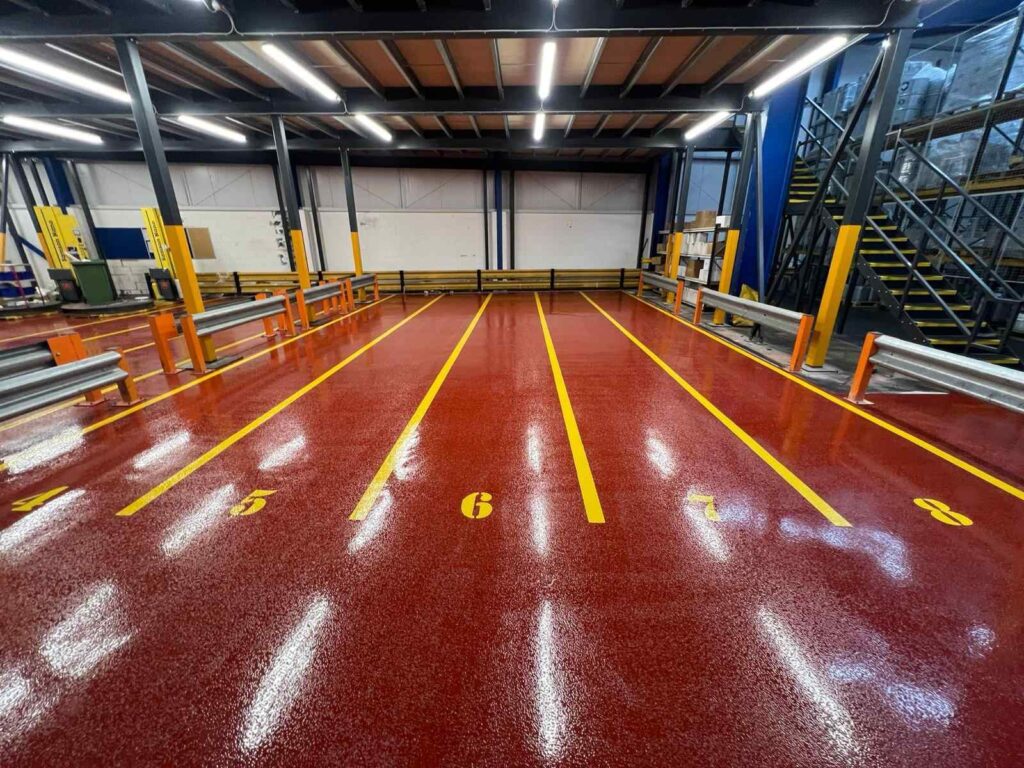
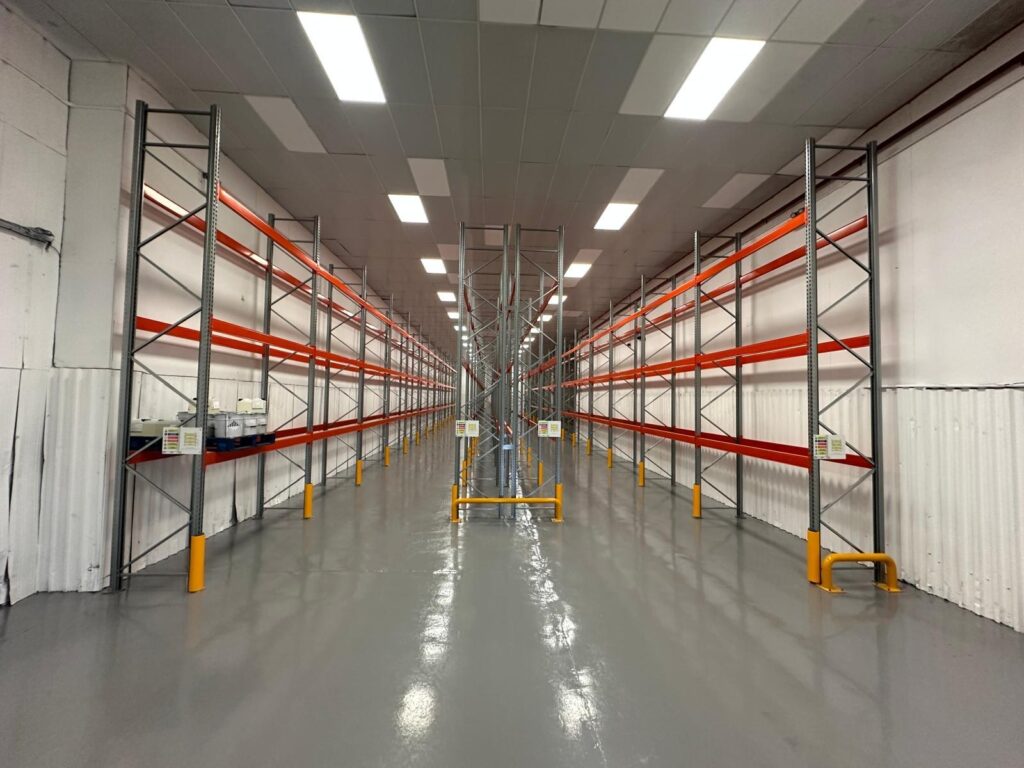
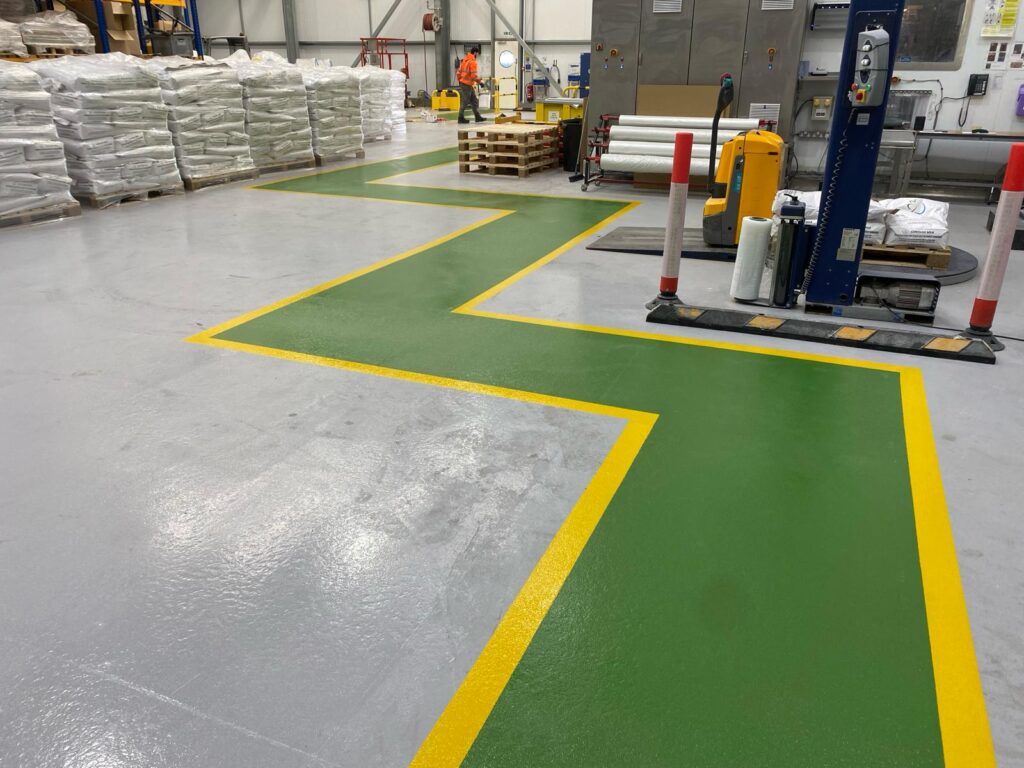
Reach trucks run the same paths all shift. That concentrates abrasion into narrow bands. Installers specify high-build epoxy or multi-layer quartz systems under FeRFA Types 3 and 4. Both protect the concrete matrix against accelerated wear. Contractors must also apply contrasting resin line markings. HSE guidance L24 and the Workplace Regulations 1992 require segregated walkways, forklift lanes and charging bays.
Loading Aprons and Upgrades for Aged Distribution Substrates
Loading docks take continuous impact at internal and external thresholds. In Middlewich, mid-box units beside motorway links need impact-resistant screeds at dock levellers and chill lobbies. Distribution estates in Winsford hold older concrete. Those slabs often need structural repair and resin re-surfacing before they carry modern storage loads.
Dock levellers take repeated impact from steel-wheeled pallet trucks and container movements. Rainwater tracking makes the problem worse. Heavy-duty polyurethane screed along dock perimeters prevents edge breakage and water ingress. Across Winsford’s older stock, installers repair worn joints and inject static cracks. High-strength flowable resins then upgrade weak substrates. Existing buildings can then support high-density racking safely.
Essential Questions to Ask an Industrial Resin Flooring Contractor in Cheshire
System Chemistry, Film Thickness and Return to Service
Precise questions to ask an industrial resin flooring contractor in Cheshire remove ambiguity before contract. Ask for the exact FeRFA classification, the total dry film thickness and the resin chemistry. Then ask for real cure schedules. Confirm the temperature thresholds needed for full chemical resistance on site.
A quotation offering a two-coat floor paint has negligible wear life under forklift traffic. An engineered 1000-micron high-build coating is a different product entirely. Plants working to tight shutdown windows should ask about polyaspartic systems. Those systems accept foot traffic within two hours, down to -5°C. If MMA is proposed, agree extraction measures first. The acrylic odour is strong and it travels.
Preparation Specifications and Warranty Exclusions
Comparing bids means dissecting preparation method and contractual exclusion, not headline rate. Confirm whether enclosed diamond grinding with HEPA extraction is included or charged as an extra. Check that the quotation names primer types and coat numbers. It should also state the moisture testing parameters applied on site.
Professional resin flooring companies Cheshire facilities employ price transparently from £8 to £45 per m². The figure tracks the system build-up. A proposal that omits mechanical preparation or moisture testing signals high failure risk. Ask for the warranty in writing. Check the exclusions covering dynamic substrate cracking, hydrostatic pressure and chemical exposure beyond the agreed schedule.
Final Thoughts
Choosing industrial resin floor installers Cheshire plants can depend on means looking past headline price. Inspect technical credentials, preparation standards and statutory compliance. A sound installation needs substrate moisture testing, enclosed diamond grinding and a resin chemistry matched to traffic and chemical exposure. Disciplined pre-qualification protects the capital you commit.
Set a clear performance brief. Demand a detailed exposure schedule. Audit technician accreditations before works are commissioned. Mechanical substrate profiling, certified diisocyanate handling and verified dry film build protect operational continuity. They also keep the facility compliant with UK workplace safety law.
Arrange a Free Site Survey
If you are thinking about upgrading the flooring in your commercial or industrial space then we would love to hear from you. Our team of experts will conduct a free onsite survey and then guide you through the process of product selection and project planning, whilst remaining mindful of your budgetary restraints.
Frequently Asked Questions
A:
Cure schedules depend on resin chemistry, ambient temperature and intended traffic. Standard epoxy and polyurethane systems usually take foot traffic within 24 to 48 hours. Full chemical and mechanical cure takes two to five days at 15°C or above. Fast-curing polyaspartic systems accept foot traffic in about two hours. They reach full cure within 24 hours, down to -5°C. MMA achieves full chemical cure in two to three hours. Lower temperatures extend every one of these figures.
A:
The difference is system build-up and dry film thickness. Industrial resin coatings under FeRFA Types 2 and 3 run from 150 to 1000 microns. They suit dustproofing, light mechanical handling and safety demarcation. Heavy-duty resin screeds under FeRFA Types 7 and 8 measure 4 mm to 9 mm. They are formulated with aggregate-filled polymers. That gives far higher compressive strength, impact resistance and tolerance to thermal shock from steam cleaning and boiling liquids.
A:
Installing resin over damp or untested concrete invites blistering and early bond failure. Standard epoxies cannot tolerate relative humidity above 75 to 80 percent. Professional contractors test with calibrated hygrometers under BS 8204-6 before starting. Where relative humidity exceeds 75 percent, a specialised two-coat, solvent-free epoxy liquid damp proof membrane is required. That barrier suppresses moisture up to 98 percent relative humidity. It secures long-term adhesion for the floor above it.
A:
UK REACH requires formal training for anyone handling polyurethane formulations containing monomeric diisocyanates at 0.1 percent or more. Diisocyanates are potent respiratory and skin sensitisers. The risk is highest during mixing and wet application. Since 24 August 2023, employers must ensure technicians complete accredited ISOPA or ALIPA training. Refresher certification follows at least every five years. Facilities managers should audit contractor training records before allowing work on site.
A:
Selection depends on mechanical duty, operating temperature and chemical exposure. Epoxy resins offer high compressive strength and rigidity. They suit dry engineering workshops, distribution aisles and heavy static racking. Polyurethane formulations are more elastomeric. They tolerate thermal shock better and resist organic acids more effectively. Heavy-duty polyurethane screeds are therefore preferred in food manufacturing, washdown zones and cold storage. Epoxy remains the standard choice for dry mechanical warehouses.
