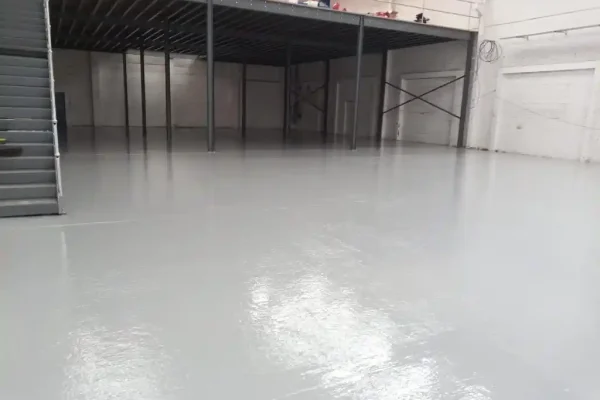
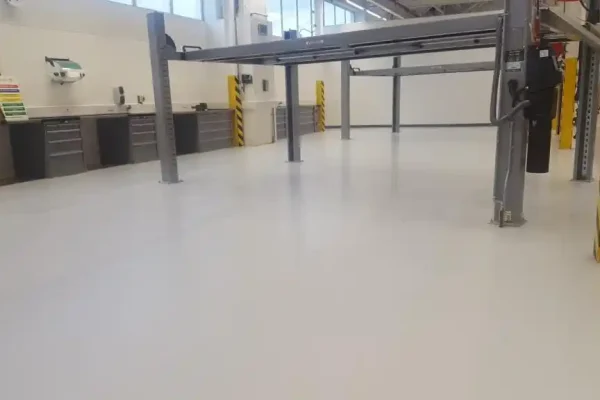
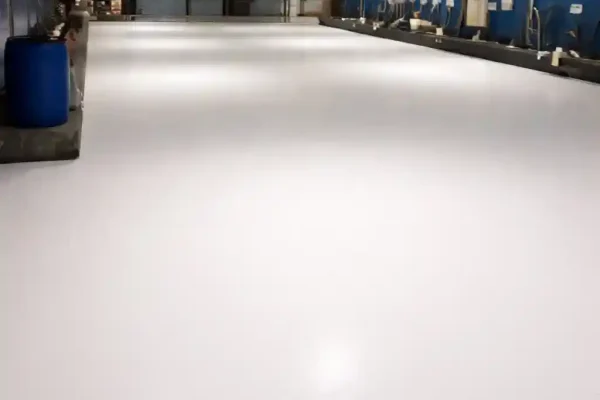
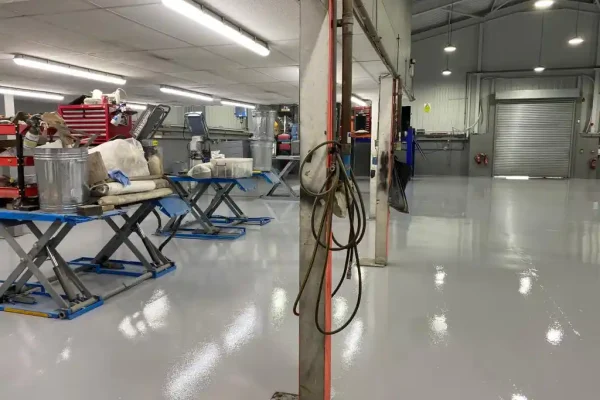
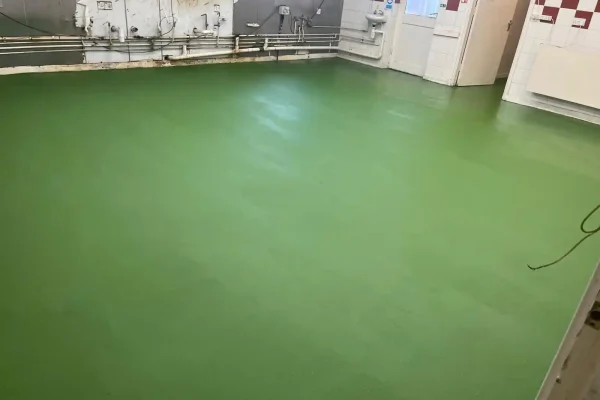
Resin flooring contractors Stockport precision manufacturers, electronics and test facilities rely on for floors specified to tolerance rather than tonnage. Supporting engineering, logistics and commercial premises across Bredbury, Adswood, Hempshaw Lane and Cheadle Royal.
Working for national manufacturers, logistics operators and public sector estates since 1999.
As resin flooring contractors Stockport operators call on regularly, we answer questions about consistency rather than load. The town sits on the M60 between Junctions 25 and 27, and a significant share of its manufacturing is precision work: machining and toolmaking, instrumentation, electronics assembly, test and calibration.
Those environments care far less about forklift tonnage than about surface consistency, particle generation, electrostatic behaviour, chemical staining from oils and solvents, and whether the floor can be kept clean enough to satisfy a customer audit.
Logistics at Bredbury and Adswood runs alongside it, and town-centre regeneration adds commercial back-of-house. But the technical centre of gravity here is precision, and the specification follows that.
A large established industrial area with logistics and manufacturing at Junction 25.
Manufacturing and engineering units with regular movement south-east of the centre.
Mixed industrial and storage facilities typical of high-wear operational environments.
Established manufacturing and storage stock on the eastern side of the borough.
High-quality commercial and specialist buildings where cleanability and appearance matter.
Office, hotel and mixed-use floorspace with parking, plant and service areas.
Cutting oils, coolants and swarf with a consistent surface around machine bases.
Dissipative flooring, particle control and defined earthing arrangements throughout.
Flat, seamless, low-particulate surfaces under castor traffic and stable conditions.
Seamless coved detailing, disinfectant resistance and chemical spill tolerance.
Forklift abrasion, racking loads and dock impact across the industrial estates.
Kitchens, cellars and service corridors delivered in phased or overnight windows.
Electrostatic performance is measured, not claimed. EN 1081 covers the measurement of electrical resistance of floor coverings, and a dissipative or conductive floor only works as a system, with earthing arrangements designed in rather than assumed.
Resistance stated as a tested range with the conditions recorded, not described as anti-static on a quotation.
Copper strip, connection points and continuity belong in the specification, because the coating alone does nothing.
Cutting oils, coolants and solvents are matched from your actual inventory rather than a generic resistance claim.
Precision environments are constrained by more than production. Calibration schedules, customer audits and controlled conditions all shape when an area can be released, so sequencing is agreed against those rather than around our diary.
Work is taken room by room or bay by bay, with detailing formed up to machine bases and equipment plinths. Dust control is a quality requirement here as much as a health one, because particles reaching a test or assembly area are a production problem first.
Where polyurethane systems are used, ISOPA and ALIPA diisocyanate training records apply and every operative handling them holds current REACH certification, which matters when a controlled environment is being worked in.
The measurement standard for floor electrical resistance, with earthing as part of it.
Specification follows the COSHH assessment rather than a general chemical resistance claim.
BS 8204-6 and EN 13813 on flatness, thickness and finish around equipment and metrology.
Coved skirtings and sealed junctions reducing harbourage and supporting quality audits.
FeRFA classifies resin flooring into eight types by build-up and thickness, and BS 8204-6 governs which one a floor actually needs, with EN 13813 for the screed and EN 1081 where electrical resistance is required. Polyaspartic and MMA sit outside that classification because they describe the resin chemistry rather than the build-up. In Stockport the environment sets the type, not the traffic.
FeRFA Type 1. Two or more coats up to 150 microns, binding a dusting substrate and giving a cleanable surface. From £8 per square metre.
FeRFA Type 2. Dual component to 300 microns, solvent free, in gloss, matt or silk. Chemical resistance with a decorative finish.
FeRFA Type 3. Up to 1000 microns over prepared concrete and the system specified on most industrial jobs. Takes colour well for demarcation.
FeRFA Type 4. Multi-coat build at 1 to 3mm with aggregate broadcast between coats, for impact and constant wear.
FeRFA Type 5. Flow-applied at 2 to 3mm for a seamless finish where hygiene and cleaning matter more than impact resistance.
FeRFA Type 7. Three part filled system at 4 to 6mm thickness, giving a self-smoothing finish for heavy and very heavy duty areas.
FeRFA Types 7 and 8. Trowel-applied at 6 to 9mm to take thermal shock, steam cleaning and constant heavy forklift traffic.
Cures at temperatures down to −5°C and is ready in around two hours. Installed overnight or at a weekend it can remove the need to shutdown entirely.
Cures in hours, but the odour can taint food, fabrics and stock and the area must be cleared and ventilated. Better suited to new build and refurbishment projects.
Rates run from £8 per square metre for a floor seal to £45 for MMA, inclusive of preparation, labour and materials. Static-controlled and laboratory finishes sit at the upper end, and are specified only where the process genuinely requires them.
| System | FeRFA | Thickness | Per m² |
|---|---|---|---|
| Floor Seal | Type 1 | Up to 150µm | From £8 |
| Epoxy and PU Coating | Type 2 | 150 – 300µm | £8 – £12 |
| High Build Coating | Type 3 | 300 – 1000µm | £8 – £12 |
| Multi-Layer Flooring | Type 4 | 1 – 3mm | £12 – £16 |
| Self-Smoothing | Type 5 | 2 – 4mm | £20 – £30 |
| Heavy Duty Flowable | Type 7 | 4 – 6mm | £25 – £35 |
| Heavy Duty PU Screed | Type 8 | 6 – 9mm | £30 – £40 |
| Polyaspartic | Chemistry | 300 – 500µm | £38 |
| MMA | Chemistry | 2 – 6mm | £45 |
Inclusive of preparation, labour and materials. Rates assume a sound, accessible substrate and are indicative until the floor has been surveyed. Polyaspartic and MMA sit outside the FeRFA type classification because they describe the resin chemistry rather than the build-up.
A three day shutdown at a plant turning over £2,000 an hour is £120,000 of lost output. On most sites that is several times the price of the floor.
Five contractors quoted one timber processing plant. All five proposed the same system and a three to four day closure. None of them costed the closure.
We proposed a faster-curing system installed across a weekend. A higher rate per square metre, and no shutdown at all. On the client’s own figures the avoided losses exceeded the price of the floor.
We install evenings, weekends and one bay at a time.
Whether a shutdown costs you thousands an hour or simply gets in the way, you do not always have to close your site for a resin flooring installation.
Copper strip, connection points and continuity installed as part of a dissipative system.
Routes, cell boundaries and inspection zones applied in resin rather than taped down.
Damp proof membrane where a substrate fails moisture testing, as a standalone package.
Dissipative systems installed with earthing and resistance values recorded for audit.
Coolant and oil resistant finishes detailed around machine bases and swarf areas.
Abrasion resistant floors and joint repairs across the logistics and storage estates.
We work across the borough regularly, from Bredbury Parkway and Hempshaw Lane through to Adswood, Woodley, Cheadle Royal and the town centre regeneration area. We are Cheshire based, so a survey usually happens within days and there is no mobilisation charge for attending.

A measured resistance and an earth. EN 1081 covers the measurement of electrical resistance of floor coverings, and a dissipative or conductive floor is a system including copper strip, connection points and continuity. The coating on its own does nothing, so anti-static without a value and an earthing detail is not a specification.
That depends entirely on what is in it. Cutting oils, coolants and cleaning solvents behave differently, so we specify against your COSHH inventory rather than making a general chemical resistance claim. Asking for the inventory is the difference between a specification and a guess.
It does where measurement and castor traffic are involved. BS 8204-6 and EN 13813 cover flatness, thickness and finish, and in metrology and test rooms surface regularity affects the work rather than just the look of the floor. It is stated rather than assumed.
That is largely a detailing question. Seamless surfaces with coved skirtings and sealed junctions reduce harbourage and are what an auditor examines, and we record the system, the resistance values where relevant and the preparation method so the floor is evidenced rather than described.
From £8 per square metre for a floor seal up to £45 for MMA, inclusive of preparation, labour and materials. Static-controlled and laboratory finishes sit at the upper end and are specified only where the process needs them. The full table by system is on the cost page.
Manchester · Denton · Hyde · Altrincham · Ashton-under-Lyne · Stretford · Macclesfield
Tell us what the area produces, what it must do electrically and what your audits look for. We attend, test the substrate, and put a written specification and a fixed price in front of you at no cost.