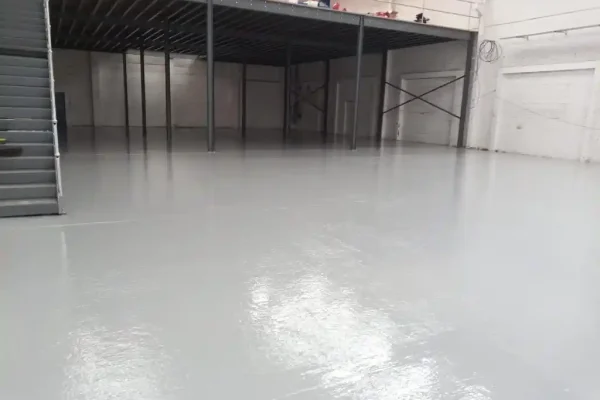
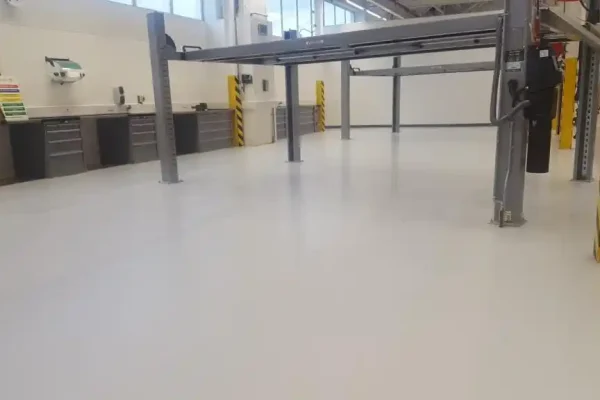
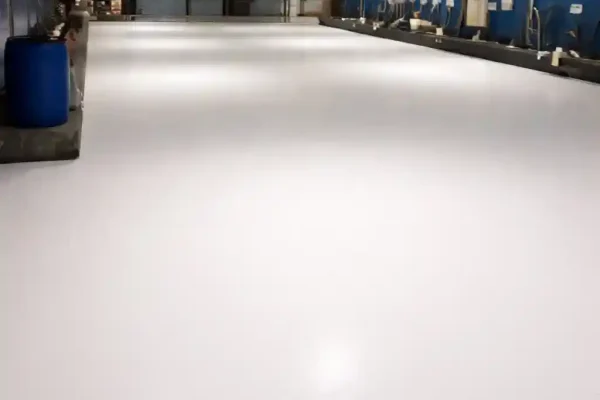
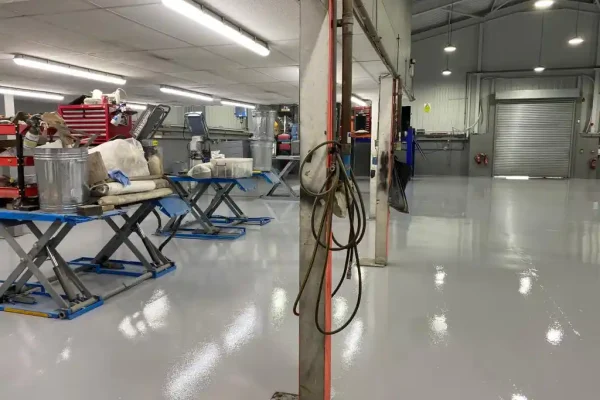
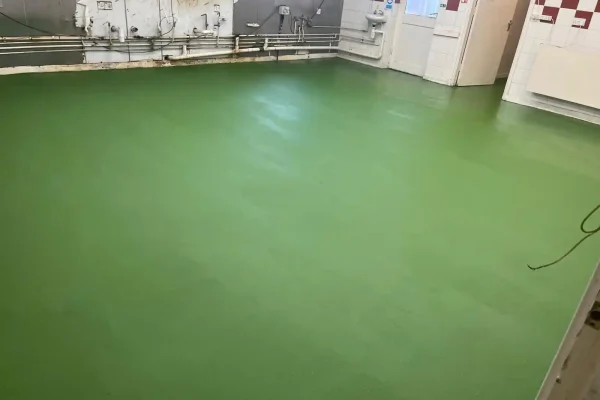
Resin flooring contractors Hyde manufacturers, storage occupiers and landlords rely on when nobody knows what is under the floor. Supporting converted mill and works premises across Bennett Street, Newton, Godley and Hattersley, and the units along the M67 corridor.
Working for national manufacturers, logistics operators and public sector estates since 1999.
As resin flooring contractors Hyde occupiers call on regularly, we survey buildings that have been adapted for a century and a half. The town sits on the M67 at Junction 3, in the Tame valley with the Peak Forest Canal running through it, and much of its industry still works out of mill and works stock.
Those buildings have been subdivided, re-roofed, re-serviced and re-let many times. The floors inside mix original power-floated and tamped concrete, later overlays, patched infills where machinery was removed, and screed of uncertain composition and thickness.
That variability is the defining characteristic here. Two bays of the same building can need completely different treatment, and a survey that assumes uniformity produces a floor that fails.
The principal concentration of mill-era premises, subdivided for light industrial use.
Adapted works and mill floorspace in mixed manufacturing, workshop and storage use.
Industrial and trade units taking direct motorway access on the western side of town.
Employment land on the eastern edge running towards the Longdendale valley.
Waterside works and conversions at Woodley with access and substrate constraints.
Trade counters, service premises and vehicle businesses on the main road corridors.
Sealing and levelling variable substrates into a serviceable, non-dusting floor.
Oil and coolant resistance on concrete never designed for the plant on it now.
Forklift routes across floors with historic joints, infills and level variation.
Hygiene detailing, coving and falls retrofitted where there was no provision.
Lightweight systems where dead load and deflection limit what can be applied.
Preparing vacant mill space so units can be marketed and let credibly.
An old mill floor can carry overlays, unknown screeds, live cracks, infills and laitance within a few metres. No resin corrects that from above, so the honest work happens before anything is mixed.
BS 8204-6 requires a sound, clean, prepared base, so overlays, contamination and level variation are identified first.
Historic cracks, joints and infills are treated for the movement actually present rather than bridged and hoped over.
Buildings before 2000 carry an asbestos duty to manage, and floor preparation is exactly the intrusive work that requires it.
Subdivided mill buildings mean the unit next door is somebody else’s business, and shared access, loading and structure all shape how the work can be done.
Floors are taken bay by bay or over a weekend, with preparation time on unknown substrates built into the programme rather than discovered halfway through. We would rather tell you at survey that a floor needs more work than find it on day two.
Preparation runs under H-class extraction with areas screened. Grinding old concrete releases respirable crystalline silica, limited under EH40 to 0.1 mg per cubic metre over eight hours, and in an occupied mill there is nowhere for it to disperse.
Identifying overlays, unknown screeds, contamination and laitance before a system is chosen.
Pre-2000 buildings require the register to be checked before intrusive floor preparation begins.
EN 13813 and FeRFA selection follow from the repaired substrate rather than the other way round.
The EH40 limit of 0.1 mg per cubic metre over eight hours governs preparation in occupied mills.
FeRFA classifies resin flooring into eight types by build-up and thickness, and BS 8204-6 governs which one a floor actually needs, with EN 13813 for the screed. Polyaspartic and MMA sit outside that classification because they describe the resin chemistry rather than the build-up. In Hyde the type follows the repaired substrate rather than leading it.
FeRFA Type 1. Two or more coats up to 150 microns, binding a dusting substrate and giving a cleanable surface. From £8 per square metre.
FeRFA Type 2. Dual component to 300 microns, solvent free, in gloss, matt or silk. Chemical resistance with a decorative finish.
FeRFA Type 3. Up to 1000 microns over prepared concrete and the system specified on most industrial jobs. Takes colour well for demarcation.
FeRFA Type 4. Multi-coat build at 1 to 3mm with aggregate broadcast between coats, for impact and constant wear.
FeRFA Type 5. Flow-applied at 2 to 3mm for a seamless finish where hygiene and cleaning matter more than impact resistance.
FeRFA Type 7. Three part filled system at 4 to 6mm thickness, giving a self-smoothing finish for heavy and very heavy duty areas.
FeRFA Types 7 and 8. Trowel-applied at 6 to 9mm to take thermal shock, steam cleaning and constant heavy forklift traffic.
Cures at temperatures down to −5°C and is ready in around two hours. Installed overnight or at a weekend it can remove the need to shutdown entirely.
Cures in hours, but the odour can taint food, fabrics and stock and the area must be cleared and ventilated. Better suited to new build and refurbishment projects.
Rates run from £8 per square metre for a floor seal to £45 for MMA, inclusive of preparation, labour and materials. On mill stock the preparation and repair are priced separately, because that is the part nobody can quote without looking.
| System | FeRFA | Thickness | Per m² |
|---|---|---|---|
| Floor Seal | Type 1 | Up to 150µm | From £8 |
| Epoxy and PU Coating | Type 2 | 150 – 300µm | £8 – £12 |
| High Build Coating | Type 3 | 300 – 1000µm | £8 – £12 |
| Multi-Layer Flooring | Type 4 | 1 – 3mm | £12 – £16 |
| Self-Smoothing | Type 5 | 2 – 4mm | £20 – £30 |
| Heavy Duty Flowable | Type 7 | 4 – 6mm | £25 – £35 |
| Heavy Duty PU Screed | Type 8 | 6 – 9mm | £30 – £40 |
| Polyaspartic | Chemistry | 300 – 500µm | £38 |
| MMA | Chemistry | 2 – 6mm | £45 |
Inclusive of preparation, labour and materials. Rates assume a sound, accessible substrate and are indicative until the floor has been surveyed. Polyaspartic and MMA sit outside the FeRFA type classification because they describe the resin chemistry rather than the build-up.
A three day shutdown at a plant turning over £2,000 an hour is £120,000 of lost output. On most sites that is several times the price of the floor.
Five contractors quoted one timber processing plant. All five proposed the same system and a three to four day closure. None of them costed the closure.
We proposed a faster-curing system installed across a weekend. A higher rate per square metre, and no shutdown at all. On the client’s own figures the avoided losses exceeded the price of the floor.
We install evenings, weekends and one bay at a time.
Whether a shutdown costs you thousands an hour or simply gets in the way, you do not always have to close your site for a resin flooring installation.
Treating live cracks, historic infills and level variation before any finish is applied.
Forming coved detail and drainage falls in buildings with no original provision.
Damp proof membrane where a substrate fails moisture testing, as a standalone package.
Variable substrates assessed, repaired and levelled into a serviceable working floor.
Coving, falls and drainage retrofitted into premises never designed to carry them.
Mill space prepared and sealed between lettings so it can be marketed properly.
We work across the area regularly, from Bennett Street and Newton through to Godley, Hattersley, the canal-side stock at Woodley and the units at Junction 3 of the M67. We are Cheshire based, so a survey usually happens within days and there is no mobilisation charge for attending.

Because the floors inside it are not the same. A converted mill can hold original concrete, later overlays, patched infills and screed of unknown composition within a few metres. Two bays genuinely can need different treatment, and assuming uniformity is how the last floor failed.
Only if they are dealt with first. Some are dormant and some are live, and a finish laid over a moving crack simply reproduces it at the surface within months. We assess the movement present and treat each accordingly before anything is applied.
It can, and it should be checked. Buildings constructed before 2000 carry a duty to manage asbestos, and grinding or blasting a floor is exactly the sort of intrusive work that requires the register to be reviewed first. We ask for it rather than assuming somebody else has.
Yes, but the hygiene detail has to be created rather than inherited. Coved skirtings, sealed junctions and correct falls to drainage were never in these buildings originally, so drainage design becomes part of the flooring conversation rather than a separate trade.
From £8 per square metre for a floor seal up to £45 for MMA, inclusive of preparation, labour and materials. On mill stock preparation and repair are priced separately once the floor has been surveyed. The full table by system is on the cost page.
Denton · Ashton-under-Lyne · Stockport · Manchester · Oldham · Middleton · Rochdale
Tell us how old the building is, what the floor has been through and what happens on it now. We attend, test the substrate, and put a written specification and a fixed price in front of you at no cost.