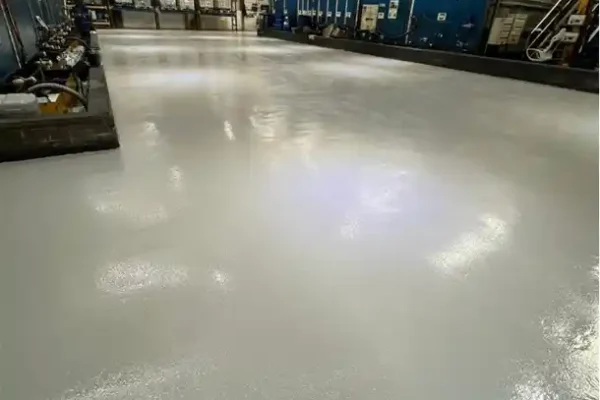
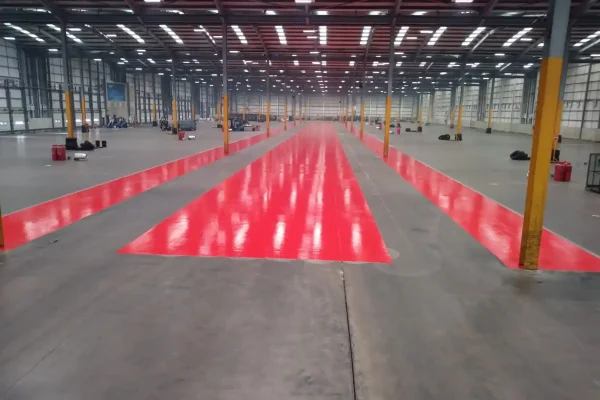
Resin flooring contractors Deeside manufacturers and logistics operators rely on for floors that carry point loads and dropped stock. Supporting large-span facilities across Deeside Industrial Park, Northern Gateway, Sandycroft, Shotton and the Broughton and Hawarden corridor.
Working for national manufacturers, logistics operators and public sector estates since 1999.
As resin flooring contractors Deeside operators call on regularly, we work at a scale nothing else in the region matches. Flintshire’s industrial core runs along the south bank of the Dee estuary between Queensferry, Connah’s Quay, Garden City, Sealand and Broughton, served by the A494, A550, A548 and A55.
What crosses these floors is not pallets. It is sub-assemblies, tooling, jigs, coil, castings and heavy plant, and that shifts the question away from abrasion, which dominates warehouse-led towns, towards impact, point loading and long-run flatness.
Scale then does the rest. Individual halls here are among the largest in the country, so one estate can present a heavy-duty screed problem and a big-box joint-protection problem within a few hundred metres, and no building can simply be closed while it is solved.
The principal large-format manufacturing, engineering and distribution site in the Enterprise Zone.
Modern large-format industrial and logistics development on the estuary corridor at Garden City.
Very large-span assembly with associated engineering, component and technical supply units.
Steel processing, coating and heavy materials handling with rail-connected stock movement.
Established manufacturing, engineering and storage units on the A548 side of the corridor.
Engineering, manufacturing and trade units on the southern side of the estuary corridor.
Long-run flatness, point-load tolerance and resistance to hydraulic fluids and sealants.
Oils, coolants, solvents and dropped tools with impact under press and machine bases.
Tracked scale, abrasive contamination and dropped stock demanding heavy-duty screeds.
Racking baseplate point loads, joint protection and demarcation over very large areas.
The highest concentration of impact damage and slip risk anywhere on these estates.
Seamless, cleanable, particle-controlled and, where specified, dissipative finishes.
A warehouse floor wears out gradually under repeated light contact. A Deeside manufacturing floor is punched. Tooling, jigs, castings and plant concentrate load into small areas, and the failure is local and sudden rather than broad and slow.
BS 8204-6 and the FeRFA range give the vocabulary for why a heavy manufacturing hall needs a screed rather than a coating.
Trailer traffic and heavy handling break down arrises and aprons before anything else, so those are detailed separately.
Across halls of this size, long-run flatness is a specification input in its own right rather than a finishing detail.
At this scale phasing is not a courtesy, it is the whole commercial conversation. A hall covering tens of thousands of square metres cannot be released in one piece, so zoning, joint strategy and cure windows are agreed before a system is chosen.
Work is taken zone by zone or into planned shutdowns, with rapid-cure systems where a bay has to be back under production quickly. Where polyurethane screeds are specified, ISOPA and ALIPA diisocyanate training records apply and every operative handling them holds current REACH certification.
Preparation runs under H-class extraction with shared areas screened, because a live assembly or technical production area cannot absorb dust drifting across tooling, stock or controlled space.
BS 8204-6 and the FeRFA range, with EN 13813 for the screed and EN 1504-2 for concrete protection.
EN 1081 electrical resistance across aerospace, electronics and technical assembly environments.
HSE L24 matters disproportionately where routes run for hundreds of metres, and marking can be bilingual.
BS 7976 pendulum values at goods-in thresholds and dock aprons exposed to estuary weather.
FeRFA classifies resin flooring into eight types by build-up and thickness, and BS 8204-6 governs which one a floor actually needs, with EN 13813 covering the screed material. Polyaspartic and MMA sit outside that classification because they describe the resin chemistry rather than the build-up. In Deeside the heavy-duty screeds lead, because point loading decides the specification.
FeRFA Type 1. Two or more coats up to 150 microns, binding a dusting substrate and giving a cleanable surface. From £8 per square metre.
FeRFA Type 2. Dual component to 300 microns, solvent free, in gloss, matt or silk. Chemical resistance with a decorative finish.
FeRFA Type 3. Up to 1000 microns over prepared concrete and the system specified on most industrial jobs. Takes colour well for demarcation.
FeRFA Type 4. Multi-coat build at 1 to 3mm with aggregate broadcast between coats, for impact and constant wear.
FeRFA Type 5. Flow-applied at 2 to 3mm for a seamless finish where hygiene and cleaning matter more than impact resistance.
FeRFA Type 7. Three part filled system at 4 to 6mm thickness, giving a self-smoothing finish for heavy and very heavy duty areas.
FeRFA Types 7 and 8. Trowel-applied at 6 to 9mm to take thermal shock, steam cleaning and constant heavy forklift traffic.
Cures at temperatures down to −5°C and is ready in around two hours. Installed overnight or at a weekend it can remove the need to shutdown entirely.
Cures in hours, but the odour can taint food, fabrics and stock and the area must be cleared and ventilated. Better suited to new build and refurbishment projects.
Rates run from £8 per square metre for a floor seal to £45 for MMA, inclusive of preparation, labour and materials. Across areas this size the phasing decides the project cost as much as the rate does.
| System | FeRFA | Thickness | Per m² |
|---|---|---|---|
| Floor Seal | Type 1 | Up to 150µm | From £8 |
| Epoxy and PU Coating | Type 2 | 150 – 300µm | £8 – £12 |
| High Build Coating | Type 3 | 300 – 1000µm | £8 – £12 |
| Multi-Layer Flooring | Type 4 | 1 – 3mm | £12 – £16 |
| Self-Smoothing | Type 5 | 2 – 4mm | £20 – £30 |
| Heavy Duty Flowable | Type 7 | 4 – 6mm | £25 – £35 |
| Heavy Duty PU Screed | Type 8 | 6 – 9mm | £30 – £40 |
| Polyaspartic | Chemistry | 300 – 500µm | £38 |
| MMA | Chemistry | 2 – 6mm | £45 |
Inclusive of preparation, labour and materials. Rates assume a sound, accessible substrate and are indicative until the floor has been surveyed. Polyaspartic and MMA sit outside the FeRFA type classification because they describe the resin chemistry rather than the build-up.
A three day shutdown at a plant turning over £2,000 an hour is £120,000 of lost output. On most sites that is several times the price of the floor.
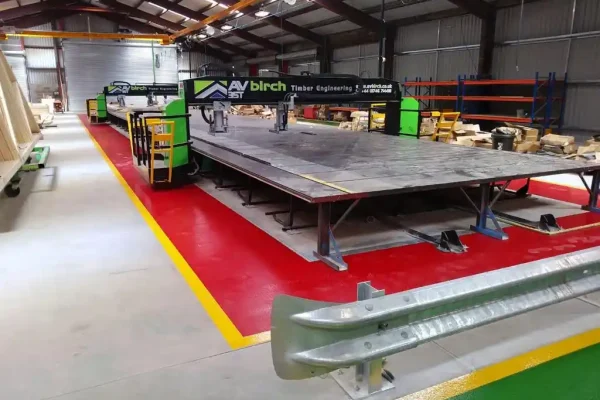
Five contractors quoted one timber processing plant. All five proposed the same system and a three to four day closure. None of them costed the closure.
We proposed a faster-curing system installed across a weekend. A higher rate per square metre, and no shutdown at all. On the client’s own figures the avoided losses exceeded the price of the floor.
We install evenings, weekends and one bay at a time.
Whether a shutdown costs you thousands an hour or simply gets in the way, you do not always have to close your site for a resin flooring installation.
Arris rebuilding, crack stitching and flexible joint sealing across aprons and leveller zones.
Vehicle routes, walkways and exclusion zones in resin, with Welsh-language marking if needed.
Damp proof membrane where a substrate fails moisture testing, as a standalone package.
Heavy-duty screeds laid zone by zone around live production and tooling movement.
Impact resistant systems where tracked scale and dropped stock defeat a coating.
Joint protection and dock-edge detailing across very large distribution floor plates.
We work across the corridor regularly, from Deeside Industrial Park and Northern Gateway through to Sandycroft, Shotton, Queensferry and the Broughton and Hawarden area. We are based in the North West of England and reach Flintshire directly via the M53, M56 and A494, so a survey usually happens within days at no mobilisation charge.

Because the loading is different in kind, not just in degree. A warehouse floor takes repeated light contact and wears gradually. A manufacturing hall takes tooling, jigs, castings and plant concentrating load into small areas, so the failure is local and sudden. BS 8204-6 and the FeRFA range exist to make that distinction properly.
It is the most common visible failure on these estates. Trailer traffic and heavy handling put every wheel across the arris, and once an edge chips the damage widens into the surrounding concrete. Aprons and leveller zones are detailed separately from the main floor rather than treated as part of it.
Yes. Those environments bring particle control and, where specified, electrical resistance to EN 1081 into the specification, and seamless cleanable finishes are used accordingly. Preparation runs under H-class extraction with areas screened so dust does not travel across tooling or controlled space.
By agreeing the zoning, the joint strategy and the cure windows before choosing a system. Work is taken zone by zone or into planned shutdowns, and rapid-cure systems are used where a bay has to be back under production quickly. At this scale the phasing is the project.
From £8 per square metre for a floor seal up to £45 for MMA, inclusive of preparation, labour and materials. Heavy-duty manufacturing screeds sit at the upper end, and across large areas the phasing affects the total as much as the rate. The full table by system is on the cost page.
Chester · Flint · Mold · Wrexham · Chirk · Ellesmere Port · Birkenhead
Tell us what the floor carries, how large the area is and which zones can be released first. We attend, test the substrate, and put a written specification and a fixed price in front of you at no cost.