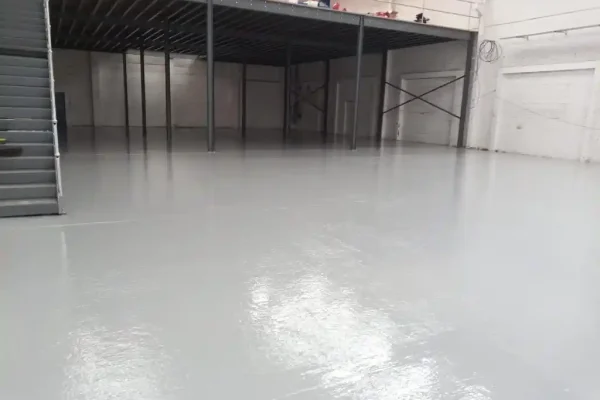
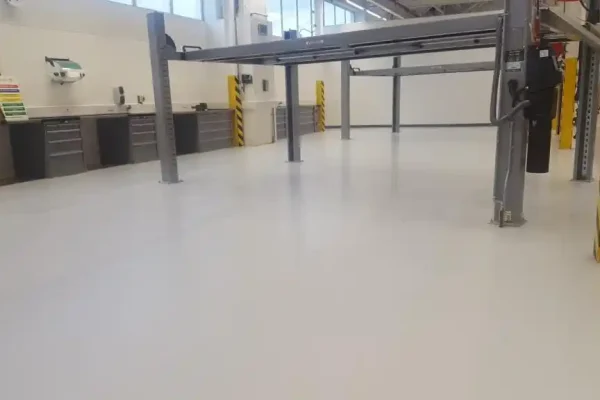
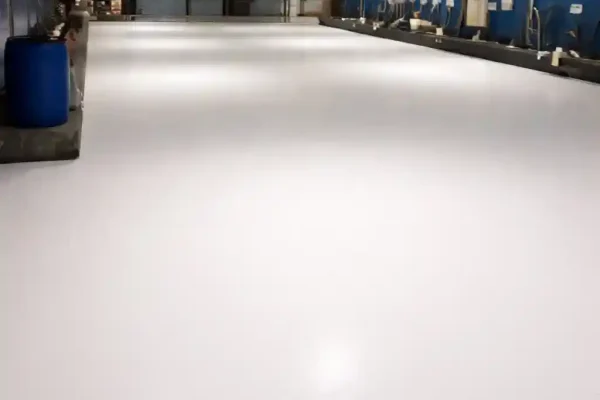
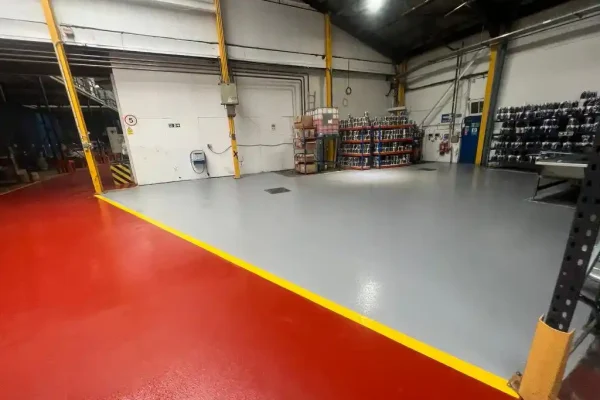
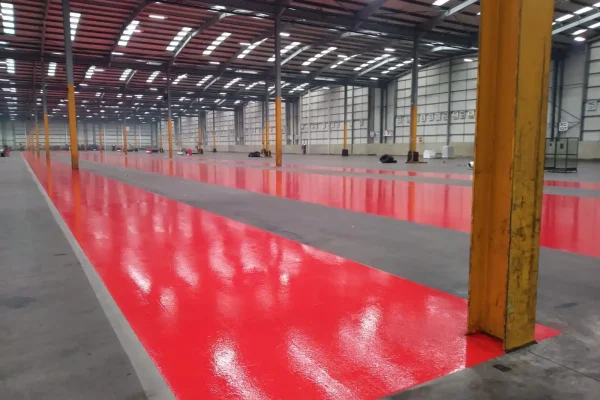
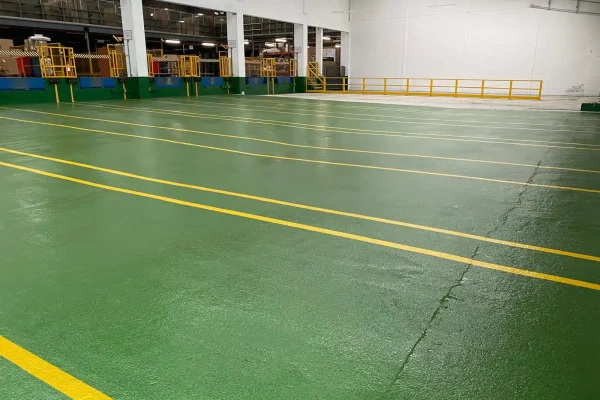
Resin flooring contractors Chirk timber, board and engineering operators rely on for floors that take dropped loads and abrasive dust. Supporting processing, manufacturing and storage facilities from the rail-served industrial area off Station Avenue to Canal Wood and the A5 corridor.
Working for national manufacturers, logistics operators and public sector estates since 1999.
As resin flooring contractors Chirk operators call on regularly, we specify against a duty that exists almost nowhere else in the region. This is a small town at the southern tip of Wrexham County Borough with a disproportionately large industrial footprint, sitting on the A5 where the Ceiriog valley meets the Shropshire border.
Where Deeside is large-span assembly and Wrexham is estate-scale mixed manufacturing, Chirk is dominated by continuous timber and board processing and the engineering and logistics around it. Panels, packs and banded stock land edge-on, and that localised impact damage spreads outward from the point it starts.
Abrasive dust is the constant underneath it. Wood and board dust behaves as a grinding medium beneath wheels and feet, taking thin-film systems apart far faster than the same traffic would on clean concrete.
The principal manufacturing and processing concentration, rail-served and connected to the A5.
Industrial and commercial units serving the town and the surrounding border area.
Trade, storage, vehicle and roadside commercial units along the A5 towards Oswestry.
Smaller industrial, workshop and yard-based operations on the western side of the town.
Industrial and storage units on the northern approach, historically a heavy industry corridor.
Visitor, hospitality and service premises with public-facing floor requirements.
Abrasive dust, dropped board impact & adhesive contact across large continuous areas.
Thermal variation, heavy dust loading and constant movement of substantial stock.
Machine-base impact with oil and coolant exposure along the main stock routes.
Point loading beneath racking legs and heavy pallet traffic over very long runs.
Dock-edge impact and slip risk where wet external surfaces meet the internal floor.
Diesel, hydraulic oil and grease exposure with pit and jacking-point detailing.
A panel or a banded pack does not land flat. It lands on a corner or an edge, concentrating the whole weight into a few square centimetres, and the damage spreads outward from that point until the surrounding surface goes with it.
BS 8204-6 and the FeRFA range explain why a dropped-load environment needs a heavy-duty screed rather than a coating.
Wood and board dust grinds between wheel and floor, so a sealed surface is part of the dust strategy.
Where combustible material and dust are handled, EN 13501-1 with the fl suffix becomes a real specification input.
Processing plants here run long shifts, and a continuous line does not stop conveniently. The sequence is agreed before anything is specified, and out-of-hours and phased working are normal rather than exceptional.
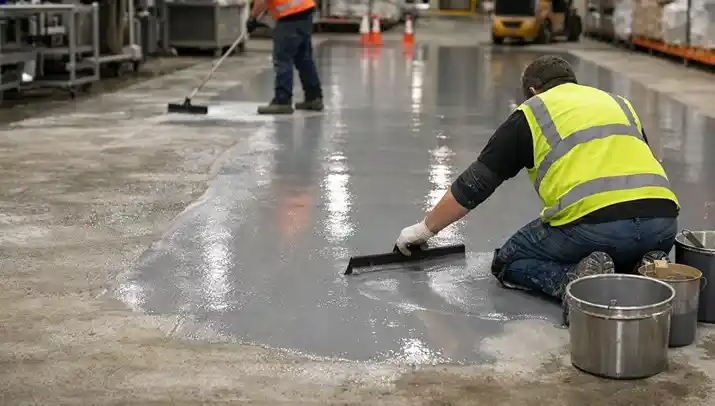
Work is taken area by area or into planned shutdowns, so stock routes, loading interfaces and machine areas are handed back as they cure rather than the plant standing idle.
Preparation runs under H-class extraction with shared areas screened. In a building already managing a wood dust exposure duty under COSHH, adding uncontrolled silica dust from grinding is not an acceptable trade, so containment is standard.
Reaction to fire with the fl suffix, a real input where combustible board and dust are handled.
COSHH and EH40 cover wood dust as well as silica, and a sealed floor supports the control strategy.
BS 8204-6 and the FeRFA range, with EN 13813 for the screed, matched to dropped-load duty.
BS 7976 pendulum values where rail aprons and A5-facing loading areas meet internal floors.
FeRFA classifies resin flooring into eight types by build-up and thickness, and BS 8204-6 governs which one a floor actually needs, with EN 13813 covering the screed material itself. Polyaspartic and MMA sit outside that classification because they describe the resin chemistry rather than the build-up. In Chirk the heavy-duty screeds lead, because dropped-load impact decides the specification.
FeRFA Type 1. Two or more coats up to 150 microns, binding a dusting substrate and giving a cleanable surface. From £8 per square metre.
FeRFA Type 2. Dual component to 300 microns, solvent free, in gloss, matt or silk. Chemical resistance with a decorative finish.
FeRFA Type 3. Up to 1000 microns over prepared concrete and the system specified on most industrial jobs. Takes colour well for demarcation.
FeRFA Type 4. Multi-coat build at 1 to 3mm with aggregate broadcast between coats, for impact and constant wear.
FeRFA Type 5. Flow-applied at 2 to 3mm for a seamless finish where hygiene and cleaning matter more than impact resistance.
FeRFA Type 7. Three part filled system at 4 to 6mm thickness, giving a self-smoothing finish for heavy and very heavy duty areas.
FeRFA Types 7 and 8. Trowel-applied at 6 to 9mm to take thermal shock, steam cleaning and constant heavy forklift traffic.
Cures at temperatures down to −5°C and is ready in around two hours. Installed overnight or at a weekend it can remove the need to shutdown entirely.
Cures in hours, but the odour can taint food, fabrics and stock and the area must be cleared and ventilated. Better suited to new build and refurbishment projects.
Rates run from £8 per square metre for a floor seal to £45 for MMA, inclusive of preparation, labour and materials. Processing and impact areas sit at the upper end, because thickness is what absorbs a dropped load.
| System | FeRFA | Thickness | Per m² |
|---|---|---|---|
| Floor Seal | Type 1 | Up to 150µm | From £8 |
| Epoxy and PU Coating | Type 2 | 150 – 300µm | £8 – £12 |
| High Build Coating | Type 3 | 300 – 1000µm | £8 – £12 |
| Multi-Layer Flooring | Type 4 | 1 – 3mm | £12 – £16 |
| Self-Smoothing | Type 5 | 2 – 4mm | £20 – £30 |
| Heavy Duty Flowable | Type 7 | 4 – 6mm | £25 – £35 |
| Heavy Duty PU Screed | Type 8 | 6 – 9mm | £30 – £40 |
| Polyaspartic | Chemistry | 300 – 500µm | £38 |
| MMA | Chemistry | 2 – 6mm | £45 |
Inclusive of preparation, labour and materials. Rates assume a sound, accessible substrate and are indicative until the floor has been surveyed. Polyaspartic and MMA sit outside the FeRFA type classification because they describe the resin chemistry rather than the build-up.
A three day shutdown at a plant turning over £2,000 an hour is £120,000 of lost output. On most sites that is several times the price of the floor.
Five contractors quoted one timber processing plant. All five proposed the same system and a three to four day closure. None of them costed the closure.
We proposed a faster-curing system installed across a weekend. A higher rate per square metre, and no shutdown at all. On the client’s own figures the avoided losses exceeded the price of the floor.
We install evenings, weekends and one bay at a time.
Whether a shutdown costs you thousands an hour or simply gets in the way, you do not always have to close your site for a resin flooring installation.
Impact damage repair, crack stitching and joint sealing across processing and storage areas.
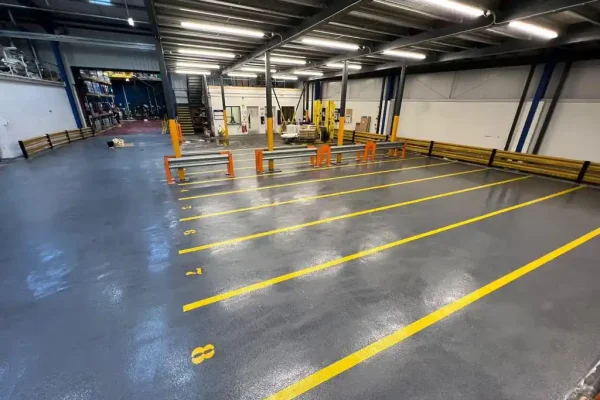
Traffic routes, walkways and exclusion zones in resin, with Welsh-language marking where required.
Damp proof membrane where a substrate fails moisture testing, as a standalone package.
Heavy-duty screeds where dropped panels and abrasive dust would take a coating apart.
Impact resistant floors and joint repairs sequenced around continuous stock movement.
Dock-edge detailing with measured slip performance at the yard-to-building threshold.
We work across the town and the surrounding border area regularly, from the industrial area off Station Avenue and Canal Wood through to Chirk Bank, Gledrid and the A483 frontage. We are based in the North West of England and cover Chirk in both directions along the A5, so a survey usually happens within days at no mobilisation charge.
Because a panel or a banded pack lands on an edge or a corner, not flat, and the whole weight concentrates into a few square centimetres. That produces localised failure that then spreads. It is an impact problem rather than a wear problem, and it needs a screed thickness rather than a tougher coating.
Yes, considerably. Board and wood dust behaves as a grinding medium between wheel and floor, so a system wears through far faster than the same traffic on clean concrete would suggest. A sealed, cleanable floor is part of the dust control strategy rather than something separate from it.
In a building processing or storing combustible material, yes. EN 13501-1 with the fl suffix classifies the reaction to fire of the floor finish, and it is a legitimate specification input here in a way it is not on most industrial sites. We will state the classification rather than leave it unanswered.
Yes. Traffic routes, walkways and exclusion zones are applied in resin rather than tape, and Welsh-language marking and bilingual wayfinding can be included where the site requires it.
From £8 per square metre for a floor seal up to £45 for MMA, inclusive of preparation, labour and materials. Processing and impact areas sit at the upper end. The full table by system is on the cost page.
Wrexham · Mold · Flint · Chester · Ellesmere Port
Tell us what lands on the floor, how much dust the area carries and when the line can be released. We attend, test the substrate, and put a written specification and a fixed price in front of you at no cost.