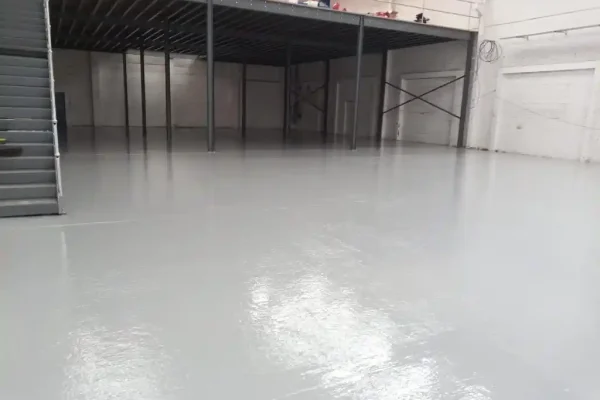
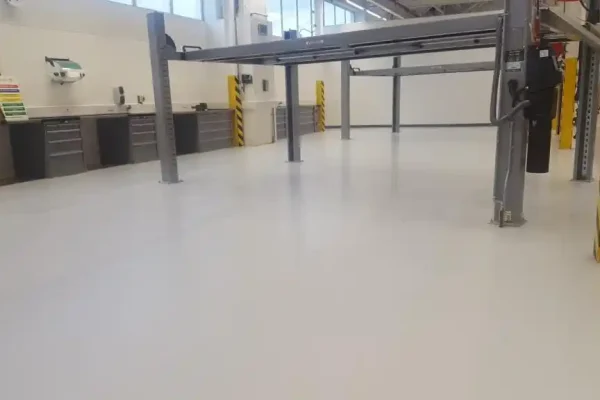
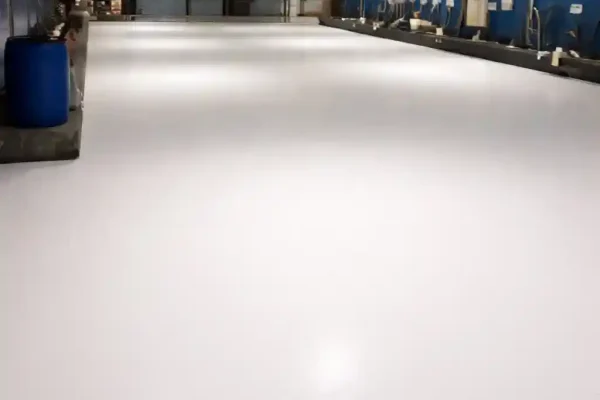
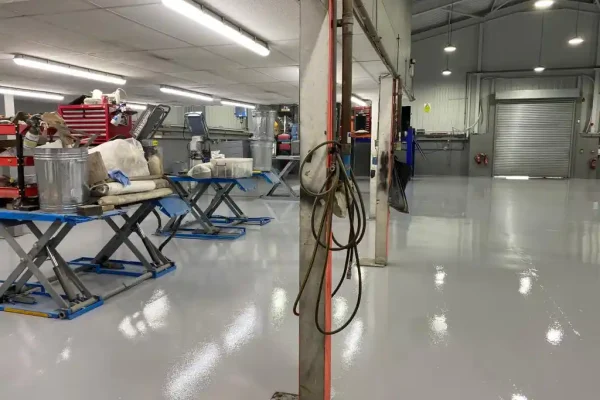
Resin flooring contractors Salford industrial operators and building managers rely on for two very different briefs. Supporting distribution and manufacturing along the Trafford Road corridor and at Agecroft, and commercial back-of-house across Salford Quays and the Chapel Street corridor.
Working for national manufacturers, logistics operators and public sector estates since 1999.
As resin flooring contractors Salford occupiers call on regularly, we switch between two briefs that have almost nothing in common. Where the Ship Canal turns inland the city has rebuilt itself around the water, with converted dock basins carrying office, media, hotel and leisure floorspace.
Behind that sits a substantial back-of-house estate: goods-in routes, kitchens, plant rooms, car park decks, cycle stores, service corridors and refuse areas. Public-adjacent floors where appearance, colour contrast and slip performance matter as much as durability.
Alongside it, the Trafford Road and dockside corridor, Agecroft to the north and the Eccles and Irlam belt carry real logistics and manufacturing capacity. Both are Salford, and they are not specified the same way.
Working industrial and distribution premises on the dockside adjacent to the Quays.
An established industrial and commercial park north of the city, with manufacturing.
Converted dock basins with office, media, hotel and leisure floorspace and services.
Mixed-use commercial conversion with associated plant, parking and service areas.
Smaller multi-occupancy industrial pockets running along the M602 corridor.
Older canal-side commercial premises and small workshop stock to the west.
Cleanability and colour contrast at transitions, installed around occupied buildings.
Grease, hot liquids and wet cleaning needing polyurethane with coving and falls.
Trafficked coatings, waterproofing and thermal movement across exposed structure.
Forklift abrasion, dock impact and racking loads along the Ship Canal corridor.
Impact, staining and heavy cleaning regimes in semi-external conditions.
Oils, coolants and mechanical impact across the Agecroft and western estates.
The commercial half of Salford brings work that is not internal industrial flooring at all. A car park or podium deck is exposed, moves thermally and has to keep water and chlorides out of the structure, which makes it a waterproofing job that happens to be walked on.
Surface protection of concrete against water, chlorides and carbonation, the real purpose of a deck coating.
Equality Act contrast at level changes and EN 13501-1 fire classification in shared circulation.
ISOPA and ALIPA training matters because polyurethane in a live commercial building is a controlled operation.
Most commercial work here happens in occupied buildings, so phasing, noise, odour and access are agreed before a system is selected rather than raised once we are on site.
Back-of-house areas are taken overnight or zone by zone, decks bay by bay with parking relocated, and industrial units aisle by aisle or into weekends. Rapid-cure options are used where an area has to reopen the next morning.
Preparation runs under H-class extraction with areas screened. In a multi-tenant building the floor above and the unit next door are somebody else’s premises, and dust and odour control are part of the method statement.
Equality Act contrast at level changes, thresholds, ramps and stair nosings in public areas.
EN 13501-1 with the fl suffix across escape routes and shared circulation in let buildings.
EN 1504-2 protecting car park and podium decks against water, chlorides and carbonation.
BS 7976 pendulum values where wind-driven rain off the water reaches internal floors.
FeRFA classifies resin flooring into eight types by build-up and thickness, and BS 8204-6 governs which one a floor actually needs, with EN 13813 for the screed and EN 1504-2 for deck and concrete protection. Polyaspartic and MMA sit outside that classification because they describe the resin chemistry rather than the build-up. In Salford the building type decides which of those standards leads.
FeRFA Type 1. Two or more coats up to 150 microns, binding a dusting substrate and giving a cleanable surface. From £8 per square metre.
FeRFA Type 2. Dual component to 300 microns, solvent free, in gloss, matt or silk. Chemical resistance with a decorative finish.
FeRFA Type 3. Up to 1000 microns over prepared concrete and the system specified on most industrial jobs. Takes colour well for demarcation.
FeRFA Type 4. Multi-coat build at 1 to 3mm with aggregate broadcast between coats, for impact and constant wear.
FeRFA Type 5. Flow-applied at 2 to 3mm for a seamless finish where hygiene and cleaning matter more than impact resistance.
FeRFA Type 7. Three part filled system at 4 to 6mm thickness, giving a self-smoothing finish for heavy and very heavy duty areas.
FeRFA Types 7 and 8. Trowel-applied at 6 to 9mm to take thermal shock, steam cleaning and constant heavy forklift traffic.
Cures at temperatures down to −5°C and is ready in around two hours. Installed overnight or at a weekend it can remove the need to shutdown entirely.
Cures in hours, but the odour can taint food, fabrics and stock and the area must be cleared and ventilated. Better suited to new build and refurbishment projects.
Rates run from £8 per square metre for a floor seal to £45 for MMA, inclusive of preparation, labour and materials. Deck coatings and occupied-building work are priced separately, because access and phasing drive them more than area does.
| System | FeRFA | Thickness | Per m² |
|---|---|---|---|
| Floor Seal | Type 1 | Up to 150µm | From £8 |
| Epoxy and PU Coating | Type 2 | 150 – 300µm | £8 – £12 |
| High Build Coating | Type 3 | 300 – 1000µm | £8 – £12 |
| Multi-Layer Flooring | Type 4 | 1 – 3mm | £12 – £16 |
| Self-Smoothing | Type 5 | 2 – 4mm | £20 – £30 |
| Heavy Duty Flowable | Type 7 | 4 – 6mm | £25 – £35 |
| Heavy Duty PU Screed | Type 8 | 6 – 9mm | £30 – £40 |
| Polyaspartic | Chemistry | 300 – 500µm | £38 |
| MMA | Chemistry | 2 – 6mm | £45 |
Inclusive of preparation, labour and materials. Rates assume a sound, accessible substrate and are indicative until the floor has been surveyed. Polyaspartic and MMA sit outside the FeRFA type classification because they describe the resin chemistry rather than the build-up.
A three day shutdown at a plant turning over £2,000 an hour is £120,000 of lost output. On most sites that is several times the price of the floor.
Five contractors quoted one timber processing plant. All five proposed the same system and a three to four day closure. None of them costed the closure.
We proposed a faster-curing system installed across a weekend. A higher rate per square metre, and no shutdown at all. On the client’s own figures the avoided losses exceeded the price of the floor.
We install evenings, weekends and one bay at a time.
Whether a shutdown costs you thousands an hour or simply gets in the way, you do not always have to close your site for a resin flooring installation.
Trafficked waterproofing, line marking and detailing across car park and podium decks.
Coved skirtings and falls formed in kitchens and wet back-of-house areas.
Damp proof membrane where a substrate fails moisture testing, as a standalone package.
Kitchens, corridors and plant rooms completed overnight around continuously trading units.
Waterproofing and trafficked coatings phased bay by bay with parking kept in use.
Abrasion resistant floors and dock detailing along the Trafford Road corridor.
We work across the city regularly, from Salford Quays and the Chapel Street corridor through to Trafford Road, Agecroft Commerce Park, Weaste and the industrial areas towards Eccles and Irlam. We are Cheshire based rather than Salford based, so a survey usually happens within days and there is no mobilisation charge for attending.
No, and treating it as one is a common and expensive mistake. A deck is exposed, moves thermally and has to keep water and chlorides out of the structure, so it is a waterproofing system that happens to be trafficked. EN 1504-2 frames it, and the build-up differs from anything used internally.
Yes, and it is the normal condition here. Back-of-house is taken overnight or zone by zone, decks bay by bay with parking relocated, and the phasing, noise, odour and access constraints are agreed before a system is chosen rather than raised afterwards.

In public-adjacent areas it does. Equality Act considerations cover contrast at level changes, thresholds, ramps and stair nosings, and a resin system can build that in integrally rather than having strips applied over it later. It is a design decision made at specification.
That threshold is treated separately. Wind-driven rain off the Quays reaches internal floors, so pendulum values to BS 7976 in the wet state govern the finish at those doors rather than the value used across the rest of the building.
From £8 per square metre for a floor seal up to £45 for MMA, inclusive of preparation, labour and materials. Deck coatings and occupied-building work are priced separately because access and phasing drive them. The full table by system is on the cost page.
Tell us whether the area is industrial or public-facing, who is in the building and when it can be released. We attend, test the substrate, and put a written specification and a fixed price in front of you at no cost.