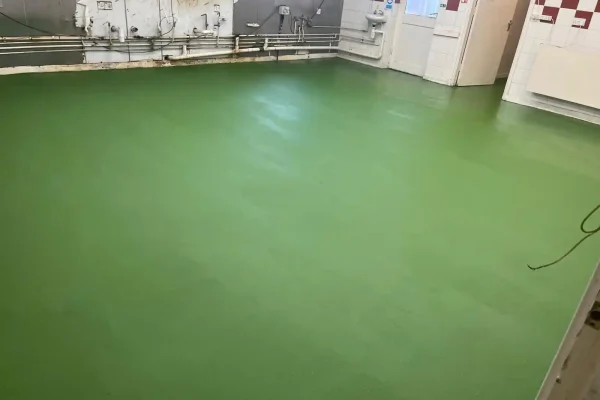
Resin flooring contractors Swinton small unit occupiers, workshops and trade businesses rely on when all the wear lands in one place. Supporting multi-occupancy estates across Clifton, Agecroft and Wardley in north Salford, between the A580, the A666 and the M60.
Working for national manufacturers, logistics operators and public sector estates since 1999.
As resin flooring contractors Swinton occupiers call on regularly, we work on floors where the damage is concentrated rather than spread. Swinton and neighbouring Clifton form a compact industrial belt in the north of Salford, and the stock is small and medium units rather than large sheds.
That shapes everything. Shared yards, tight turning circles, roller shutter access and usually a single owner-manager making the decision, with works measured in days rather than weeks.
The compensating factor is intensity. Everything comes in and goes out through one shutter, forklifts turn in a fraction of the space, and the same three metres of floor takes all the impact. A small unit can genuinely justify a heavier system than a warehouse.
An established multi-unit industrial estate with manufacturing, storage and trade units.
Industrial and commercial units on the Agecroft side, close to the canal corridor.
Multi-occupancy industrial and trade units on the A580 East Lancashire Road corridor.
Smaller terraced workshop and storage premises along Bolton Road serving trade.
Vehicle workshops, MOT bays, tyre premises and small trade counters on Manchester Road.
Older canal-side industrial land and small workshop stock along the corridor.
Concentrated wear at shutter thresholds and the forklift turning points inside.
Hot-work resistance, dropped material impact and swarf abrasion at the benches.
Oils, fuels, hydraulic fluid, wet bays and pit or vehicle lift surrounds.
Trolley and pallet truck traffic with a customer-facing appearance requirement.
Tracked and wheeled plant loading producing severe, localised point impact.
Washdown, drainage and hygiene detailing retrofitted into general industrial space.
It sounds counterintuitive, but a small unit often warrants a heavier duty than a large warehouse. The floor area is smaller, so every movement crosses the same ground, and the shutter line takes every delivery, every despatch and every turn.
BS 8204-6 and EN 13813 justify a heavier build-up because the loading has nowhere to spread.
Danger peaks where reversing vehicles pass personnel doors, and demarcation is the control.
The EH40 silica limit bites harder in a small workshop, where a confined space concentrates dust.
Works here are measured in days, and the occupier usually has nowhere else to go. Access and material handling are constrained, so plant and material storage are planned around what will physically fit rather than what we would prefer.
Floors are taken zone by zone or over a weekend, and where a unit is between tenancies the work is far simpler and cheaper. Dilapidations and lease reinstatement are a common and entirely sensible reason to do it then.
Preparation runs under H-class extraction with areas screened. In a small unit on a shared estate there is nowhere for dust to disperse and the neighbouring unit is somebody else’s business.
HSE L24 traffic routes and segregation where reversing vehicles pass personnel doors.
BS 7976 pendulum values concentrated where rain comes in through the single main opening.
BS 8204-6 and EN 13813, where concentrated loading justifies a heavier build-up than expected.
Bunding at 110% of capacity where oils and fuels are stored in vehicle and plant premises.
FeRFA classifies resin flooring into eight types by build-up and thickness, and BS 8204-6 governs which one a floor actually needs, with EN 13813 for the screed. Polyaspartic and MMA sit outside that classification because they describe the resin chemistry rather than the build-up. In Swinton the answer often varies within a single small unit.
FeRFA Type 1. Two or more coats up to 150 microns, binding a dusting substrate and giving a cleanable surface. From £8 per square metre.
FeRFA Type 2. Dual component to 300 microns, solvent free, in gloss, matt or silk. Chemical resistance with a decorative finish.
FeRFA Type 3. Up to 1000 microns over prepared concrete and the system specified on most industrial jobs. Takes colour well for demarcation.
FeRFA Type 4. Multi-coat build at 1 to 3mm with aggregate broadcast between coats, for impact and constant wear.
FeRFA Type 5. Flow-applied at 2 to 3mm for a seamless finish where hygiene and cleaning matter more than impact resistance.
FeRFA Type 7. Three part filled system at 4 to 6mm thickness, giving a self-smoothing finish for heavy and very heavy duty areas.
FeRFA Types 7 and 8. Trowel-applied at 6 to 9mm to take thermal shock, steam cleaning and constant heavy forklift traffic.
Cures at temperatures down to −5°C and is ready in around two hours. Installed overnight or at a weekend it can remove the need to shutdown entirely.
Cures in hours, but the odour can taint food, fabrics and stock and the area must be cleared and ventilated. Better suited to new build and refurbishment projects.
Rates run from £8 per square metre for a floor seal to £45 for MMA, inclusive of preparation, labour and materials. In a small unit it is frequently worth putting the heavier system only in the shutter and turning zone, and a lighter one elsewhere.
| System | FeRFA | Thickness | Per m² |
|---|---|---|---|
| Floor Seal | Type 1 | Up to 150µm | From £8 |
| Epoxy and PU Coating | Type 2 | 150 – 300µm | £8 – £12 |
| High Build Coating | Type 3 | 300 – 1000µm | £8 – £12 |
| Multi-Layer Flooring | Type 4 | 1 – 3mm | £12 – £16 |
| Self-Smoothing | Type 5 | 2 – 4mm | £20 – £30 |
| Heavy Duty Flowable | Type 7 | 4 – 6mm | £25 – £35 |
| Heavy Duty PU Screed | Type 8 | 6 – 9mm | £30 – £40 |
| Polyaspartic | Chemistry | 300 – 500µm | £38 |
| MMA | Chemistry | 2 – 6mm | £45 |
Inclusive of preparation, labour and materials. Rates assume a sound, accessible substrate and are indicative until the floor has been surveyed. Polyaspartic and MMA sit outside the FeRFA type classification because they describe the resin chemistry rather than the build-up.
A three day shutdown at a plant turning over £2,000 an hour is £120,000 of lost output. On most sites that is several times the price of the floor.
Five contractors quoted one timber processing plant. All five proposed the same system and a three to four day closure. None of them costed the closure.
We proposed a faster-curing system installed across a weekend. A higher rate per square metre, and no shutdown at all. On the client’s own figures the avoided losses exceeded the price of the floor.
We install evenings, weekends and one bay at a time.
Whether a shutdown costs you thousands an hour or simply gets in the way, you do not always have to close your site for a resin flooring installation.
Heavier build-up and arris detailing at the shutter line where every movement crosses.
Yard routes, crossings and pedestrian door protection applied in resin rather than paint.
Damp proof membrane where a substrate fails moisture testing, as a standalone package.
Concentrated wear zones rebuilt and the rest of the unit sealed proportionately.
Oil resistant floors with bunded detailing and grip around wet and pit areas.
Units returned to a lettable standard between tenancies at dilapidations stage.
We work across north Salford regularly, from Clifton Industrial Estate and Agecroft Commerce Park through to Wardley on the A580, the Pendlebury pockets and the vehicle premises along the A666. We are Cheshire based, so a survey usually happens within days and there is no mobilisation charge for attending.

Salford. This page covers Swinton and Clifton in the north of the City of Salford, between the A580 East Lancashire Road and the M60. There is a separate Swinton near Rotherham in South Yorkshire, so it is worth confirming which one you mean when you call.
In the wear zone, quite possibly. A small unit concentrates every movement into the same ground, so the shutter line and turning area take far more punishment per square metre than a warehouse aisle does. Often the sensible answer is a heavier system in that zone and a lighter one elsewhere.
Because everything crosses it. Deliveries, despatch, forklift turns and tracked plant all pass through one opening, and rainwater and grit come in with them. That zone gets a heavier build-up and its own slip specification rather than being treated as part of the main floor.
Demarcation is the practical control. On a small estate the risk peaks where reversing vehicles pass personnel doors, and HSE guidance L24 supports marked routes and segregation. It is set out in resin so it survives the traffic rather than fading within a season.
From £8 per square metre for a floor seal up to £45 for MMA, inclusive of preparation, labour and materials. Zoning a small unit usually costs less than one system throughout. The full table by system is on the cost page.
Tell us the unit size, where the wear is showing and whether the yard is shared. We attend, test the substrate, and put a written specification and a fixed price in front of you at no cost.