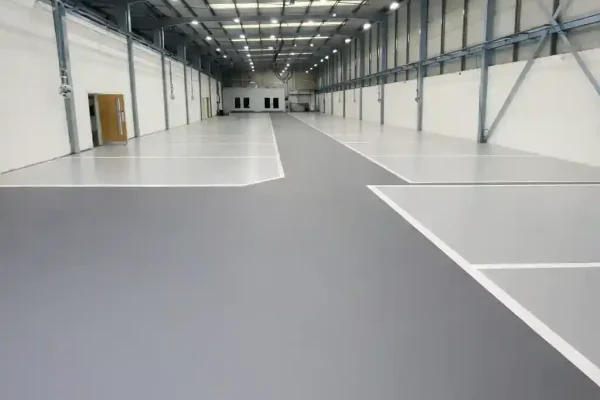
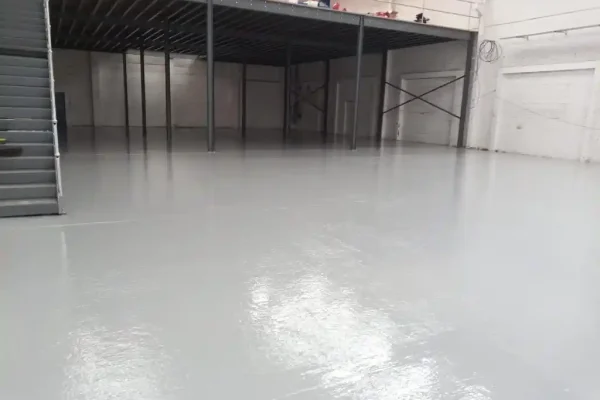
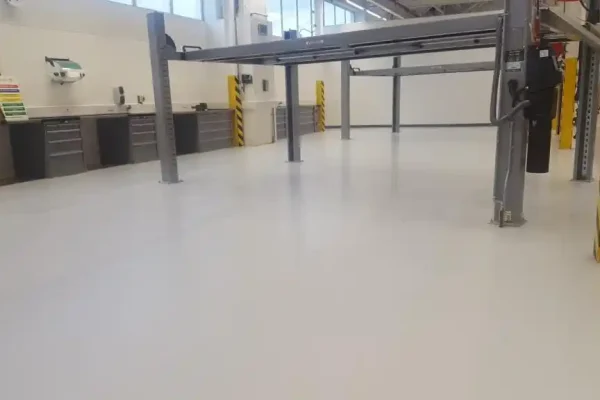
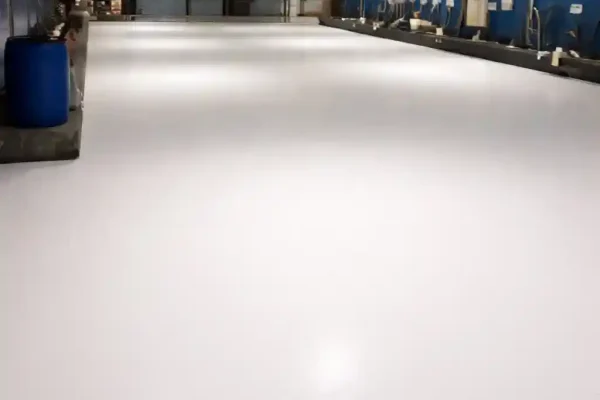
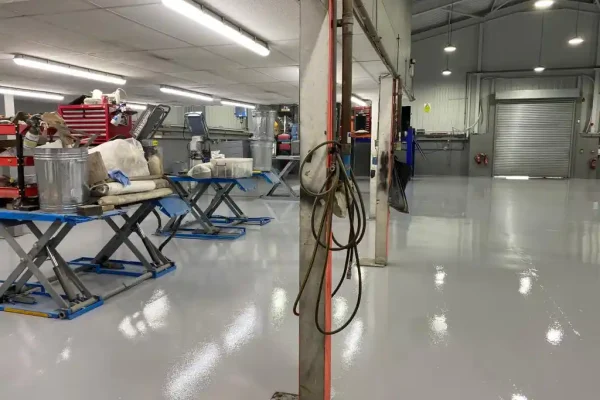
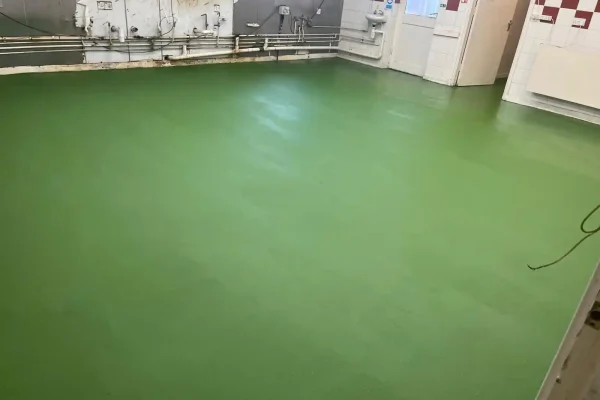
Resin flooring contractors Walsall plating, finishing and metal trades rely on for floors that survive acid and satisfy an inspector. Supporting surface treatment, manufacturing and trade distribution premises from the Aldridge estates and Darlaston to Willenhall, Bloxwich and Brownhills.
Working for national manufacturers, logistics operators and public sector estates since 1999.
As resin flooring contractors Walsall operators call on regularly, we specify against an attack profile almost no other town in the region shares. The borough sits on the M6 between Junctions 7 and 10, fed by the A34, A461 and A454, and holds one of the densest concentrations of surface treatment and metal finishing capacity in the country.
Acids, alkalis, plating solutions, degreasers, dyes and finishing chemistry reach the floor daily. They etch the surface, expose the aggregate and undermine tank bases and plinths long before any forklift wears it.
What happens to the spill is then a regulatory matter rather than a housekeeping one. Bund integrity, falls to interception and impermeable surfacing are inspected requirements, which puts the floor inside your environmental compliance rather than alongside it.
A substantial cluster of manufacturing, finishing and distribution units off Middlemore Lane.
Modern and established industrial capacity on the north-eastern side of the borough.
Metals, engineering, pressing and trade units carrying heavy vehicle movement daily.
Warehousing, manufacturing and trade premises sitting off the A5 corridor north.
Established industrial and storage units north-west of the town centre at Leamore.
Lock, pressed metal and light manufacturing premises on the Willenhall side.
Acid and alkali resistance, tank plinth detailing and falls to controlled containment.
Impermeable, jointless surfacing with containment capacity that can be verified.
Dye, solvent and finishing agent resistance with a surface that cleans down properly.
Oil and cutting fluid exposure combined with dropped-stock impact at the machines.
Sustained wet exposure, chemical attack and drainage falls that actually work.
Forklift abrasion, wet entrance slip risk and demarcation across trade premises.
Around a plating line or a chemical store the floor is not simply a surface. It is the containment, and its falls, upstands and joints are what an inspector actually examines when they ask where a spill would go.
Permitting and oil storage rules require containment at capacity, with impermeable surfacing and falls.
Standard epoxy is not a universal answer under concentrated acid, and specialist build-ups exist for it.
Where acid has attacked the substrate, EN 1504-2 reinstatement comes before any finish is chosen.
Plating and finishing lines are fixed, expensive to drain and awkward to stop, so work is planned around them rather than expecting the process to accommodate the floor.
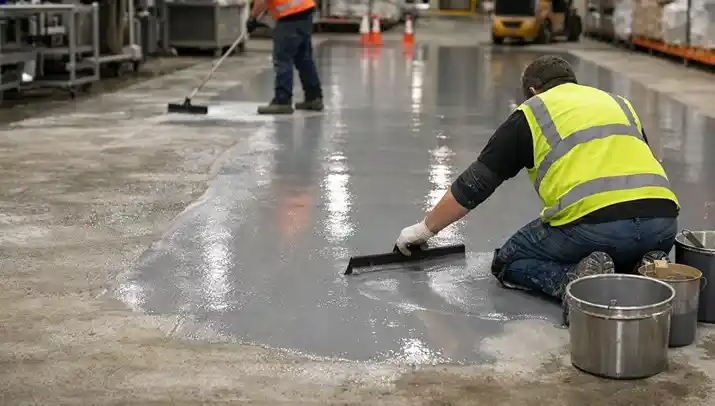
Areas are taken bay by bay or into planned shutdowns, with detailing formed up to tank plinths, upstands and channel edges rather than stopping short. Most of this stock is older and previously coated, so preparation time goes into the plan rather than being discovered during it.
Preparation runs under H-class extraction with areas screened. That controls respirable crystalline silica, limited under EH40 to 0.1 mg per cubic metre over eight hours, and keeps contaminated grindings out of the rest of a working building.
Environmental permitting and oil storage rules bring bunding, falls and impermeable surfacing into scope.
BS 8204-6 and EN 13813 frame selection, and resistance is stated against concentration and exposure.
Protecting and reinstating concrete that acid has already etched, before any finish is considered.
BS 7976 pendulum values across plating halls, wash bays and effluent areas that are rarely dry.
FeRFA classifies resin flooring into eight types by build-up and thickness, and BS 8204-6 governs which one a floor actually needs, with EN 13813 for the screed and EN 1504-2 where the concrete itself is being protected. Polyaspartic and MMA sit outside that classification because they describe the resin chemistry rather than the build-up. In Walsall the chemistry of the system matters more than its thickness.
FeRFA Type 1. Two or more coats up to 150 microns, binding a dusting substrate and giving a cleanable surface. From £8 per square metre.
FeRFA Type 2. Dual component to 300 microns, solvent free, in gloss, matt or silk. Chemical resistance with a decorative finish.
FeRFA Type 3. Up to 1000 microns over prepared concrete and the system specified on most industrial jobs. Takes colour well for demarcation.
FeRFA Type 4. Multi-coat build at 1 to 3mm with aggregate broadcast between coats, for impact and constant wear.
FeRFA Type 5. Flow-applied at 2 to 3mm for a seamless finish where hygiene and cleaning matter more than impact resistance.
FeRFA Type 7. Three part filled system at 4 to 6mm thickness, giving a self-smoothing finish for heavy and very heavy duty areas.
FeRFA Types 7 and 8. Trowel-applied at 6 to 9mm to take thermal shock, steam cleaning and constant heavy forklift traffic.
Cures at temperatures down to −5°C and is ready in around two hours. Installed overnight or at a weekend it can remove the need to shutdown entirely.
Cures in hours, but the odour can taint food, fabrics and stock and the area must be cleared and ventilated. Better suited to new build and refurbishment projects.
Rates run from £8 per square metre for a floor seal to £45 for MMA, inclusive of preparation, labour and materials. Chemically resistant build-ups sit at the upper end, and containment detailing is priced separately because it is engineering rather than area.
| System | FeRFA | Thickness | Per m² |
|---|---|---|---|
| Floor Seal | Type 1 | Up to 150µm | From £8 |
| Epoxy and PU Coating | Type 2 | 150 – 300µm | £8 – £12 |
| High Build Coating | Type 3 | 300 – 1000µm | £8 – £12 |
| Multi-Layer Flooring | Type 4 | 1 – 3mm | £12 – £16 |
| Self-Smoothing | Type 5 | 2 – 4mm | £20 – £30 |
| Heavy Duty Flowable | Type 7 | 4 – 6mm | £25 – £35 |
| Heavy Duty PU Screed | Type 8 | 6 – 9mm | £30 – £40 |
| Polyaspartic | Chemistry | 300 – 500µm | £38 |
| MMA | Chemistry | 2 – 6mm | £45 |
Inclusive of preparation, labour and materials. Rates assume a sound, accessible substrate and are indicative until the floor has been surveyed. Polyaspartic and MMA sit outside the FeRFA type classification because they describe the resin chemistry rather than the build-up.
A three day shutdown at a plant turning over £2,000 an hour is £120,000 of lost output. On most sites that is several times the price of the floor.
Five contractors quoted one timber processing plant. All five proposed the same system and a three to four day closure. None of them costed the closure.
We proposed a faster-curing system installed across a weekend. A higher rate per square metre, and no shutdown at all. On the client’s own figures the avoided losses exceeded the price of the floor.
We install evenings, weekends and one bay at a time.
Whether a shutdown costs you thousands an hour or simply gets in the way, you do not always have to close your site for a resin flooring installation.
Forming bunds, upstands, falls and channel detail so a spill is held where it lands.
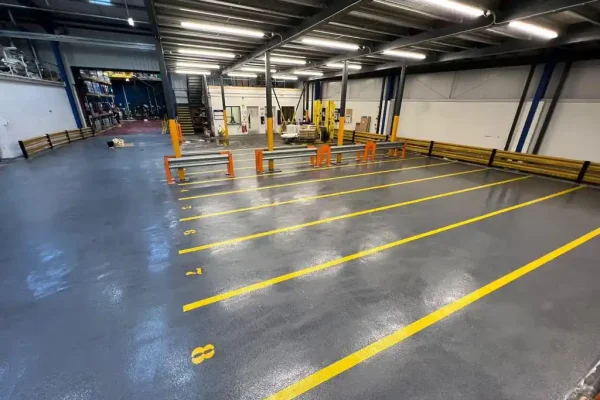
Traffic routes, drum handling zones and walkways applied in resin rather than paint.
Damp proof membrane where a substrate fails moisture testing, as a standalone package.
Acid resistant systems with tank plinth detailing and verified containment falls.
Dye and solvent resistant finishes that clean down without staining or softening.
Abrasion resistant floors and demarcation across merchant and wholesale premises.
We work across the borough regularly, from Northgate and the Aldridge estates through to Darlaston Central, Neachells Lane at Willenhall, Fryers Road at Bloxwich and Maybrook at Brownhills. We are Cheshire based, so a survey usually happens within days and there is no mobilisation charge for attending.

Not automatically, and anyone claiming resistance without asking about concentration and exposure duration is guessing. Standard epoxy handles a great deal but concentrated acid exposure often calls for vinyl ester or a specialist chemical-resistant build-up. We ask what is in the tanks and specify against it.
Usually not. Acid attack removes the cement matrix and exposes aggregate, but the substrate can generally be reinstated and protected. EN 1504-2 covers exactly that, and the repair comes before the finish rather than being hidden underneath it.
Around plating lines, tanks and chemical stores, yes. Bund integrity, impermeable surfacing and falls to interception are inspected requirements, and containment at 110 per cent of capacity applies. That makes the floor part of your environmental compliance rather than a finish applied over it.
It is specified from measured values rather than adjectives. BS 7976 pendulum testing in the wet condition is what anchors an anti-slip claim in a hall that is permanently wet, and the aggregate is graded to that requirement while keeping the surface cleanable.
From £8 per square metre for a floor seal up to £45 for MMA, inclusive of preparation, labour and materials. Chemically resistant systems sit at the upper end, with containment detailing priced separately. The full table by system is on the cost page.
West Bromwich · Wolverhampton · Dudley · Birmingham · Solihull · Coventry
Tell us what is in the tanks, where a spill would go and when the line can be released. We attend, test the substrate, and put a written specification and a fixed price in front of you at no cost.