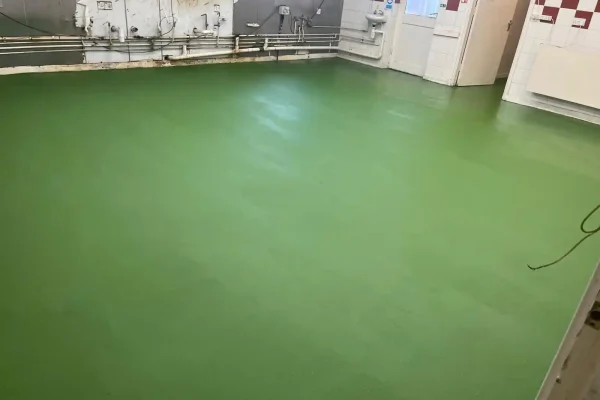
Resin flooring contractors Wolverhampton precision manufacturers and established engineering works rely on for two very different specifications. Supporting facilities from the i54 and M54 Junction 2 corridor to the works along the Stafford Road, Bilston Road and Wednesfield.
Working for national manufacturers, logistics operators and public sector estates since 1999.
As resin flooring contractors Wolverhampton operators call on regularly, we give two genuinely different answers in the same city. To the north west the M54 Junction 2 corridor carries advanced manufacturing and aerospace-facing plots where cleanliness and tolerance govern the specification.
To the south and east, the Bilston Road and Wednesfield corridors hold older engineering, lock and metal trades premises beside the Birmingham Canal Navigations and the flight of locks below Broad Street Basin.
In a precision hall a floor that dusts, chips or sheds aggregate is a debris risk before it is a wear problem. In a canal-side works the question is whether anything will bond at all. Blending those two into one message helps nobody.
A major advanced manufacturing employment site at Junction 2 on the northern edge.
Modern industrial, technical and commercial units alongside the M54 Junction 2 corridor.
Established engineering premises along the A449 Stafford Road corridor to the north.
Manufacturing, storage and trade units on the Bushbury side of the city boundary.
Engineering, fabrication and distribution capacity at Neachells Lane and Steelpark.
Victorian and early twentieth-century premises on the Birmingham Canal Navigations.
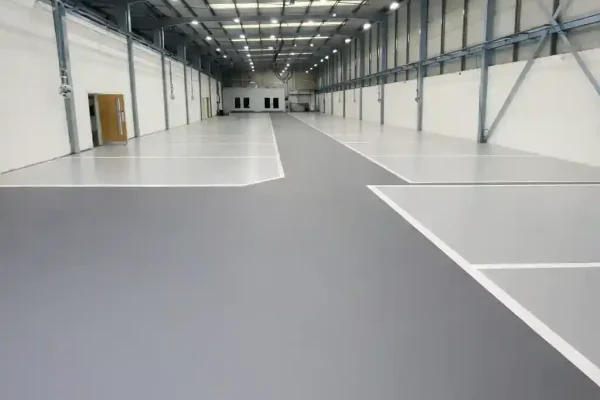
Seamless, non-dusting, flat finishes where debris control matters as much as wear.
Coolant and oil resistance with point loading and stable surface regularity.
Jointless detailing and coving where measurement depends on a stable surface.
Solvent and resin exposure with a surface that decontaminates cleanly.
Impact and abrasion over concrete already compromised by decades of use.
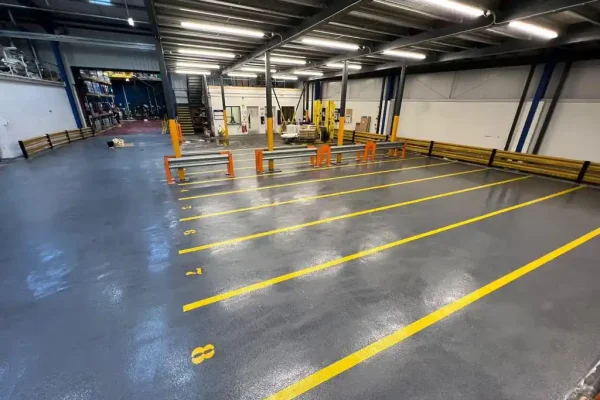
Joint protection, abrasion resistance and demarcation on distribution floors.
In an aerospace-facing or precision hall the floor is a source of foreign object debris. A finish that dusts, chips at a joint or releases aggregate puts particles into an environment built to exclude them, and that is a product risk rather than a maintenance one.
A seamless, non-dusting surface protects the product as well as the people working around it.
Surface regularity affects jigs, measurement, castor movement and inspection, so the standards apply.
On canal-side and made ground, moisture and oil assessment decide the answer before a finish is chosen.
A modern high-eaves hall and a subdivided Victorian works need different handling, and pretending otherwise wastes everyone’s time. In the precision corridor the constraint is cleanliness, so preparation is screened and extracted to protect the product as much as the operatives.
In the older stock the constraint is what is underneath. Damp, made ground, oil saturation and generations of previous coatings mean the survey does more work than the specification does, and preparation time goes into the programme rather than being discovered during it.
Where polyurethane systems are used, and in engineering and washdown areas they usually are, ISOPA and ALIPA diisocyanate training records apply and every operative holds current REACH certification.
BS 8204-6 and EN 13813 frame flatness, thickness and screed performance where tolerance matters.
The EH40 limit of 0.1 mg per cubic metre covers preparation, and non-shedding protects the product.
EN 1504-2 protection with moisture and contamination testing on canal-side and made ground.
EN 13501-1 with the fl suffix is a legitimate input for assembly halls and enclosed production.
FeRFA classifies resin flooring into eight types by build-up and thickness, and BS 8204-6 governs which one a floor actually needs, with EN 13813 for the screed and EN 1504-2 where the concrete is being protected. Polyaspartic and MMA sit outside that classification because they describe the resin chemistry rather than the build-up. In Wolverhampton the right answer changes entirely between the two corridors.
FeRFA Type 1. Two or more coats up to 150 microns, binding a dusting substrate and giving a cleanable surface. From £8 per square metre.
FeRFA Type 2. Dual component to 300 microns, solvent free, in gloss, matt or silk. Chemical resistance with a decorative finish.
FeRFA Type 3. Up to 1000 microns over prepared concrete and the system specified on most industrial jobs. Takes colour well for demarcation.
FeRFA Type 4. Multi-coat build at 1 to 3mm with aggregate broadcast between coats, for impact and constant wear.
FeRFA Type 5. Flow-applied at 2 to 3mm for a seamless finish where hygiene and cleaning matter more than impact resistance.
FeRFA Type 7. Three part filled system at 4 to 6mm thickness, giving a self-smoothing finish for heavy and very heavy duty areas.
FeRFA Types 7 and 8. Trowel-applied at 6 to 9mm to take thermal shock, steam cleaning and constant heavy forklift traffic.
Cures at temperatures down to −5°C and is ready in around two hours. Installed overnight or at a weekend it can remove the need to shutdown entirely.
Cures in hours, but the odour can taint food, fabrics and stock and the area must be cleared and ventilated. Better suited to new build and refurbishment projects.
Rates run from £8 per square metre for a floor seal to £45 for MMA, inclusive of preparation, labour and materials. Precision finishes and older-stock preparation both add cost, for opposite reasons, and are priced separately.
| System | FeRFA | Thickness | Per m² |
|---|---|---|---|
| Floor Seal | Type 1 | Up to 150µm | From £8 |
| Epoxy and PU Coating | Type 2 | 150 – 300µm | £8 – £12 |
| High Build Coating | Type 3 | 300 – 1000µm | £8 – £12 |
| Multi-Layer Flooring | Type 4 | 1 – 3mm | £12 – £16 |
| Self-Smoothing | Type 5 | 2 – 4mm | £20 – £30 |
| Heavy Duty Flowable | Type 7 | 4 – 6mm | £25 – £35 |
| Heavy Duty PU Screed | Type 8 | 6 – 9mm | £30 – £40 |
| Polyaspartic | Chemistry | 300 – 500µm | £38 |
| MMA | Chemistry | 2 – 6mm | £45 |
Inclusive of preparation, labour and materials. Rates assume a sound, accessible substrate and are indicative until the floor has been surveyed. Polyaspartic and MMA sit outside the FeRFA type classification because they describe the resin chemistry rather than the build-up.
A three day shutdown at a plant turning over £2,000 an hour is £120,000 of lost output. On most sites that is several times the price of the floor.
Five contractors quoted one timber processing plant. All five proposed the same system and a three to four day closure. None of them costed the closure.
We proposed a faster-curing system installed across a weekend. A higher rate per square metre, and no shutdown at all. On the client’s own figures the avoided losses exceeded the price of the floor.
We install evenings, weekends and one bay at a time.
Whether a shutdown costs you thousands an hour or simply gets in the way, you do not always have to close your site for a resin flooring installation.
Moisture testing, contamination removal and repair on canal-side and made-ground floors.
Walkways, routes and exclusion zones applied in resin rather than painted on top.
Damp proof membrane where a substrate fails moisture testing, as a standalone package.
Seamless non-dusting finishes laid flat where debris control governs the specification.
Coolant resistant systems detailed up to machine bases and the inspection areas.
Damp, oil-saturated concrete tested, reinstated and overlaid rather than replaced.
We work across the city regularly, from i54 and Wolverhampton Business Park at Junction 2 of the M54 through to Fordhouses, Bushbury, Park Lane, Wednesfield and the canal-side works off the Bilston Road. We are Cheshire based, so a survey usually happens within days and there is no mobilisation charge for attending.

Because it becomes a source of foreign object debris. A finish that dusts, chips at a joint or releases aggregate puts particles into an environment designed to exclude them, so a non-shedding seamless floor protects the product as much as it protects the people working on it.
It is functional here. Surface regularity affects assembly jigs, measurement, castor movement and inspection work, and BS 8204-6 and EN 13813 give the framework for specifying it. It is stated rather than assumed, because assuming it is how disputes start.
Testing before promises. Damp, made ground, oil saturation and generations of previous coatings are the normal starting condition in that stock, and they decide whether anything will bond. We establish all of it at survey and tell you plainly what the floor will and will not do.
We install seamless, jointless, coved and non-shedding systems suited to controlled environments, and we will state exactly what the system does. We do not claim classification or certification on your behalf, because that belongs to your validation process rather than to a flooring contractor.
From £8 per square metre for a floor seal up to £45 for MMA, inclusive of preparation, labour and materials. Precision finishes sit at the upper end, and preparation on older stock is priced separately. The full table by system is on the cost page.
Walsall · Dudley · West Bromwich · Birmingham · Solihull · Coventry
Tell us how clean the area must stay, how old the building is and what the floor has to hold. We attend, test the substrate, and put a written specification and a fixed price in front of you at no cost.