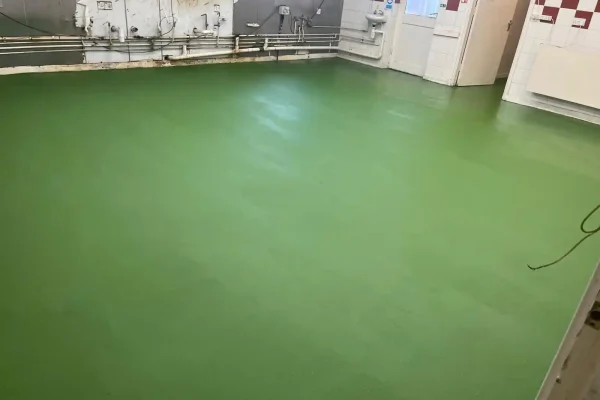
Resin flooring contractors West Bromwich manufacturers, merchants and distribution operators rely on for refurbishing floors that have carried several businesses. Supporting mixed estates from Kelvin Way and Swan Lane to the Black Country New Road and the M5 Junction 1 corridor.
Working for national manufacturers, logistics operators and public sector estates since 1999.
As resin flooring contractors West Bromwich occupiers call on regularly, we survey concrete that has already served three or four different businesses. The town sits where the M5 begins at Junction 1, with the A41 Expressway and the Black Country New Road carrying heavy commercial traffic through Hill Top and Great Bridge.
Its industrial base is deliberately mixed rather than specialised, across estates built in three different eras. Units have been re-let and re-purposed repeatedly, and each occupier has left patch repairs, fixings, contamination and another coating layer behind.
So the defining condition is worn, dusting concrete rather than any single process. A tired power-floated surface sheds fine dust continuously, into stock, into equipment and into the air people work in.
A substantial established estate with manufacturing, storage and trade units across the site.
Mixed light industrial and warehousing capacity sitting close to the town centre.
Long-standing manufacturing and fabrication premises to the north of the town.
Trade, storage and engineering units running towards Tipton on the western side.
A continuous industrial and trade frontage linking the town to Wednesbury and Bilston.
Distribution, trade and commercial units with immediate access to the motorway.
Abrasion resistance and dust suppression on tired and previously coated concrete.
Dropped-stock impact, spark exposure and oil contamination across the working bays.
Mixed public, pedestrian and forklift traffic with wet entrance slip risk at doors.
Joint protection, point loading and demarcation across the warehousing floors.
Leveller impact and weather ingress at roller shutters and the yard edges.
Fast turnaround refurbishment between lettings and at dilapidations stage.
Worn concrete sheds fines all day, and they do not simply settle on stock. Respirable crystalline silica is limited under EH40 to 0.1 mg per cubic metre over an eight-hour period, which makes sealing a dusting floor a control measure rather than a tidy-up.
The exposure limit applies to the working environment your staff spend a full shift in, not only to our preparation works.
Patch repairs, fixings and old coatings from previous occupiers decide what will bond, so testing precedes specification.
Roller-shutter thresholds and joint arrises take rain, mud and forklift impact, and go long before the open floor does.
On a multi-tenanted estate the unit next door is somebody else’s business, so dust, noise and odour control are conditions of working rather than courtesies extended at the end.
Projects here are smaller and faster than on a single-occupier site, and a re-let between tenancies is the cheapest window there is. Where timing allows, doing the floor before the incoming occupier moves in avoids the disruption entirely.
Preparation runs under H-class extraction with areas screened and waste contained. Grinding a laitance-shedding floor without that simply moves the dust problem into the neighbouring unit.
The EH40 limit of 0.1 mg per cubic metre over eight hours makes a dusting floor a health matter.
HSE L24 applies acutely where yards, thresholds and routes carry pedestrians and forklifts.
BS 7976 pendulum values where rain, mud and yard debris reach smooth internal concrete.
FeRFA Types 1 to 8 with BS 8204-6 give landlord and occupier a shared performance language.
FeRFA classifies resin flooring into eight types by build-up and thickness, and BS 8204-6 governs which one a floor actually needs, with EN 13813 for the screed and EN 1504-2 where the concrete is being protected. Polyaspartic and MMA sit outside that classification because they describe the resin chemistry rather than the build-up. In West Bromwich the useful question is which of the lighter types genuinely solves it.
FeRFA Type 1. Two or more coats up to 150 microns, binding a dusting substrate and giving a cleanable surface. From £8 per square metre.
FeRFA Type 2. Dual component to 300 microns, solvent free, in gloss, matt or silk. Chemical resistance with a decorative finish.
FeRFA Type 3. Up to 1000 microns over prepared concrete and the system specified on most industrial jobs. Takes colour well for demarcation.
FeRFA Type 4. Multi-coat build at 1 to 3mm with aggregate broadcast between coats, for impact and constant wear.
FeRFA Type 5. Flow-applied at 2 to 3mm for a seamless finish where hygiene and cleaning matter more than impact resistance.
FeRFA Type 7. Three part filled system at 4 to 6mm thickness, giving a self-smoothing finish for heavy and very heavy duty areas.
FeRFA Types 7 and 8. Trowel-applied at 6 to 9mm to take thermal shock, steam cleaning and constant heavy forklift traffic.
Cures at temperatures down to −5°C and is ready in around two hours. Installed overnight or at a weekend it can remove the need to shutdown entirely.
Cures in hours, but the odour can taint food, fabrics and stock and the area must be cleared and ventilated. Better suited to new build and refurbishment projects.
Rates run from £8 per square metre for a floor seal to £45 for MMA, inclusive of preparation, labour and materials. Sealing a dusting floor sits at the bottom of that range, and on a lot of these units that is genuinely the right answer.
| System | FeRFA | Thickness | Per m² |
|---|---|---|---|
| Floor Seal | Type 1 | Up to 150µm | From £8 |
| Epoxy and PU Coating | Type 2 | 150 – 300µm | £8 – £12 |
| High Build Coating | Type 3 | 300 – 1000µm | £8 – £12 |
| Multi-Layer Flooring | Type 4 | 1 – 3mm | £12 – £16 |
| Self-Smoothing | Type 5 | 2 – 4mm | £20 – £30 |
| Heavy Duty Flowable | Type 7 | 4 – 6mm | £25 – £35 |
| Heavy Duty PU Screed | Type 8 | 6 – 9mm | £30 – £40 |
| Polyaspartic | Chemistry | 300 – 500µm | £38 |
| MMA | Chemistry | 2 – 6mm | £45 |
Inclusive of preparation, labour and materials. Rates assume a sound, accessible substrate and are indicative until the floor has been surveyed. Polyaspartic and MMA sit outside the FeRFA type classification because they describe the resin chemistry rather than the build-up.
A three day shutdown at a plant turning over £2,000 an hour is £120,000 of lost output. On most sites that is several times the price of the floor.
Five contractors quoted one timber processing plant. All five proposed the same system and a three to four day closure. None of them costed the closure.
We proposed a faster-curing system installed across a weekend. A higher rate per square metre, and no shutdown at all. On the client’s own figures the avoided losses exceeded the price of the floor.
We install evenings, weekends and one bay at a time.
Whether a shutdown costs you thousands an hour or simply gets in the way, you do not always have to close your site for a resin flooring installation.
Patch repair, arris rebuilding, crack treatment and removing fixings left by earlier occupiers.
Walkways, forklift routes and yard thresholds applied in resin rather than painted on.
Damp proof membrane where a substrate fails moisture testing, as a standalone package.
Worn estate concrete ground back and sealed, taking the dust out of the working area.
Units turned around between tenancies with repairs, demarcation and finish resolved.
Joint repairs, dock-edge detailing and demarcation across trade park premises.
We work across Sandwell regularly, from Kelvin Way and Swan Lane through to Hill Top, Great Bridge, the Black Country New Road frontage and the Kenrick Way units at Junction 1 of the M5. We are Cheshire based, so a survey usually happens within days and there is no mobilisation charge for attending.

Yes, and it is a health one rather than housekeeping. Worn concrete releases respirable crystalline silica into the air people work in all shift, limited under EH40 to 0.1 mg per cubic metre over eight hours. It also contaminates stock and gets into equipment. Sealing the floor deals with it at source.
It matters more than the age of the building. Each occupier leaves patch repairs, fixings, contamination and another coating layer, and what is underneath decides what will bond. We grind back mechanically and test adhesion before specifying rather than assuming.
Between tenancies, without question. An empty unit removes every access and disruption constraint, and repairs, demarcation and finish can all be resolved at once. If the timing works it is the cheapest and least disruptive window you will get.
Not if it is controlled properly. Dust, noise and odour control are treated as method requirements on a shared estate, with H-class extraction, screening and contained waste as standard, because the unit next door is somebody else’s business.
From £8 per square metre for a floor seal up to £45 for MMA, inclusive of preparation, labour and materials. Most refurbishment work here sits at the lower end, with preparation priced separately. The full table by system is on the cost page.
Walsall · Dudley · Wolverhampton · Birmingham · Solihull · Coventry
Tell us how the floor is behaving, what the unit is used for and whether it is between tenancies. We attend, test the substrate, and put a written specification and a fixed price in front of you at no cost.