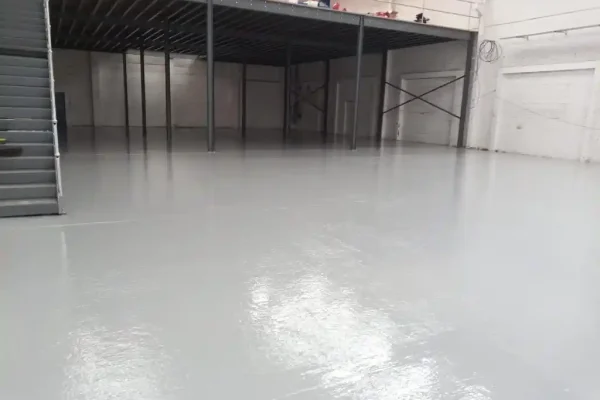
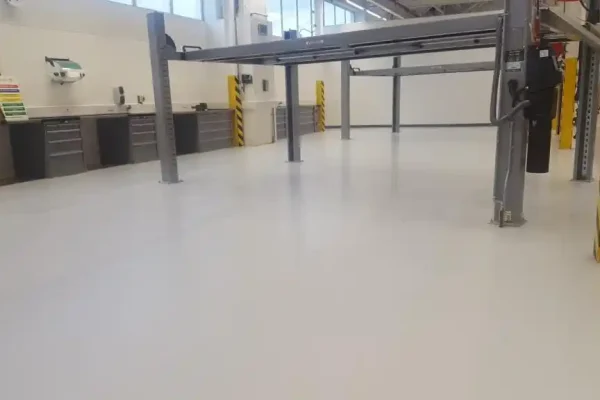
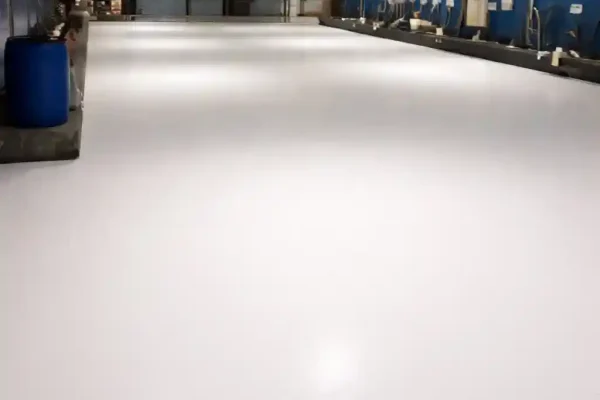
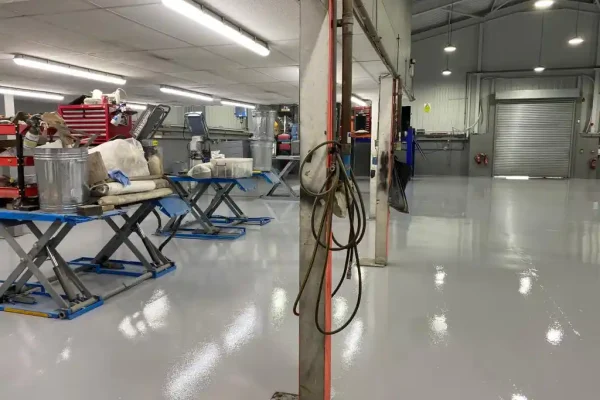
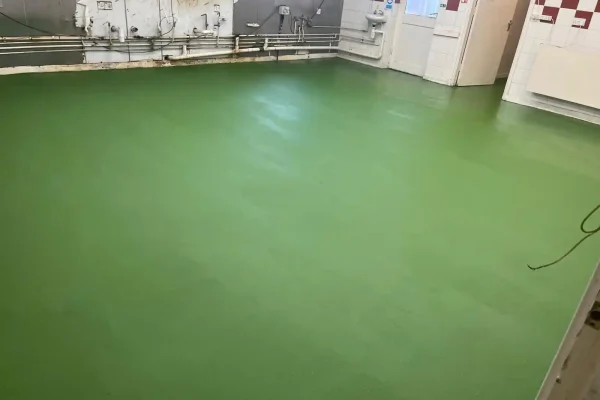
Resin flooring contractors Solihull assembly supply chain, technical and interchange operators rely on for floors specified around chemistry and finish. Supporting facilities from the Damson Parkway and Lode Lane employment area to Blythe Valley Park, Cranmore and the units around Birmingham International.
Working for national manufacturers, logistics operators and public sector estates since 1999.
As resin flooring contractors Solihull operators call on regularly, we work to standards a general warehouse never applies. The borough holds the airport, the rail interchange and the exhibition complex at Bickenhill, with the M42 running from Junction 4 at Shirley to Junction 6.
Assembly-related and supply chain buildings here work to appearance, cleanliness, static and chemical requirements rather than to raw load. Paint preparation, spray, sealing and inspection areas expose floors to solvents, isocyanates, thinners and cleaning chemistry, and have to decontaminate easily afterwards.
Interchange facilities then add a second constraint entirely. Continuous operation, public-facing space and access windows measured in hours rather than days.
Large-scale assembly and supply chain activity on the eastern side of the town.
Manufacturing and supply chain floorspace adjoining the main assembly corridor.
A modern business park at M42 Junction 4 with technical and light industrial occupiers.
Established light industrial and trade capacity around Cranmore Boulevard and Highlands Road.
Industrial and trade units close to the airport along Bickenhill Lane and the A45.
Freight, catering, maintenance and service back-of-house at the airport and rail interchange.
Solvent and isocyanate resistance with straightforward decontamination afterwards.
Colour-coded zoning under castor, tug and AGV traffic with rapid local repair.
Measurable electrical resistance to EN 1081 alongside genuine particle control.
Abrasion resistance and demarcation under continuous handling equipment.
Baggage, catering, maintenance and plant floors running twenty-four hours.
Fuel, oil and hydraulic exposure with pit edges and correct drainage detail.
Preparation, spray, sealing and inspection areas put solvents, isocyanates, thinners and aggressive cleaning chemistry onto the floor as routine. What matters is resisting all of it and then cleaning down to an inspection standard afterwards.
EH40 limits govern these areas, and ISOPA and ALIPA training applies directly to the polyurethane systems used.
EN 1081 gives the test basis for line-side static control, specified with earthing detail rather than described loosely.
Where AGVs, castors and inspection work run, surface regularity is a performance requirement, not a cosmetic one.
Continuous operation is the norm across this borough. Interchange buildings run around the clock, assembly runs to a plan, and event space at Bickenhill works to a fixed calendar, so access windows are frequently measured in hours.
The sequence is agreed before a system is chosen, and rapid-cure options are explained through their cure characteristics rather than as promised completion times. A slipped promise on a live interchange or line costs far more than the floor.
Where polyurethane systems are specified, and in finishing areas they usually are, ISOPA and ALIPA diisocyanate training records apply and every operative handling them holds current REACH certification.
EH40 exposure limits across paint and finishing areas, with ISOPA and ALIPA training as standard.
Conductive or dissipative systems specified with test values and earthing detail, never as a claim.
BS 7976 pendulum values with Equality Act contrast at thresholds in public-facing buildings.
BS 8204-6 and EN 13813 frame flatness where AGV, castor and inspection duties depend on it.
FeRFA classifies resin flooring into eight types by build-up and thickness, and BS 8204-6 governs which one a floor actually needs, with EN 13813 for the screed. Polyaspartic and MMA sit outside that classification because they describe the resin chemistry rather than the build-up, and in Solihull they are frequently chosen for the length of the access window.
FeRFA Type 1. Two or more coats up to 150 microns, binding a dusting substrate and giving a cleanable surface. From £8 per square metre.
FeRFA Type 2. Dual component to 300 microns, solvent free, in gloss, matt or silk. Chemical resistance with a decorative finish.
FeRFA Type 3. Up to 1000 microns over prepared concrete and the system specified on most industrial jobs. Takes colour well for demarcation.
FeRFA Type 4. Multi-coat build at 1 to 3mm with aggregate broadcast between coats, for impact and constant wear.
FeRFA Type 5. Flow-applied at 2 to 3mm for a seamless finish where hygiene and cleaning matter more than impact resistance.
FeRFA Type 7. Three part filled system at 4 to 6mm thickness, giving a self-smoothing finish for heavy and very heavy duty areas.
FeRFA Types 7 and 8. Trowel-applied at 6 to 9mm to take thermal shock, steam cleaning and constant heavy forklift traffic.
Cures at temperatures down to −5°C and is ready in around two hours. Installed overnight or at a weekend it can remove the need to shutdown entirely.
Cures in hours, but the odour can taint food, fabrics and stock and the area must be cleared and ventilated. Better suited to new build and refurbishment projects.
Rates run from £8 per square metre for a floor seal to £45 for MMA, inclusive of preparation, labour and materials. Where the window is a single shift, the faster system is often the cheaper project once lost operation is counted.
| System | FeRFA | Thickness | Per m² |
|---|---|---|---|
| Floor Seal | Type 1 | Up to 150µm | From £8 |
| Epoxy and PU Coating | Type 2 | 150 – 300µm | £8 – £12 |
| High Build Coating | Type 3 | 300 – 1000µm | £8 – £12 |
| Multi-Layer Flooring | Type 4 | 1 – 3mm | £12 – £16 |
| Self-Smoothing | Type 5 | 2 – 4mm | £20 – £30 |
| Heavy Duty Flowable | Type 7 | 4 – 6mm | £25 – £35 |
| Heavy Duty PU Screed | Type 8 | 6 – 9mm | £30 – £40 |
| Polyaspartic | Chemistry | 300 – 500µm | £38 |
| MMA | Chemistry | 2 – 6mm | £45 |
Inclusive of preparation, labour and materials. Rates assume a sound, accessible substrate and are indicative until the floor has been surveyed. Polyaspartic and MMA sit outside the FeRFA type classification because they describe the resin chemistry rather than the build-up.
A three day shutdown at a plant turning over £2,000 an hour is £120,000 of lost output. On most sites that is several times the price of the floor.
Five contractors quoted one timber processing plant. All five proposed the same system and a three to four day closure. None of them costed the closure.
We proposed a faster-curing system installed across a weekend. A higher rate per square metre, and no shutdown at all. On the client’s own figures the avoided losses exceeded the price of the floor.
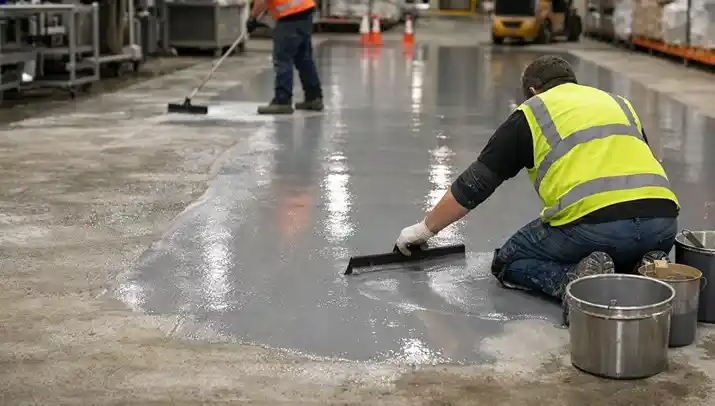
We install evenings, weekends and one bay at a time.
Whether a shutdown costs you thousands an hour or simply gets in the way, you do not always have to close your site for a resin flooring installation.
Localised repair and making good so line-side areas return to use without full replacement.
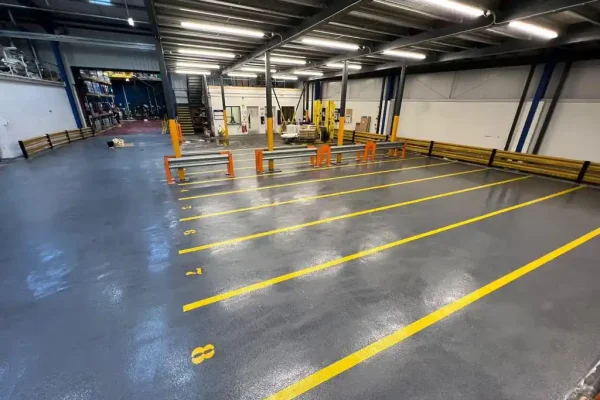
Line-side zones, walkways and AGV routes set out as a scheme and applied in resin.
Damp proof membrane where a substrate fails moisture testing, as a standalone package.
Chemically resistant systems that decontaminate cleanly to an inspection standard.
Zoned, static-controlled finishes installed inside changeover and shutdown windows.
Catering, plant and service floors laid overnight around continuous operation.
We work across the borough regularly, from the Damson Parkway and Lode Lane employment area through to Blythe Valley Park at Shirley, Cranmore, Elmdon and the units around Bickenhill and Birmingham International. We are Cheshire based, so a survey usually happens within days and there is no mobilisation charge for attending.

Resistance to what is used in it and a surface that decontaminates properly. Solvents, isocyanates, thinners and cleaning chemistry all attack an unsuitable system, and EH40 exposure limits apply to the area. The polyurethane systems specified there carry ISOPA and ALIPA diisocyanate training requirements.
No. EN 1081 provides the test method for electrical resistance, so a line-side floor should be specified with a resistance value, the test conditions and the earthing detail. Anti-static on its own is an adjective rather than a specification, and it is not comparable between quotations.
It is functional here. Where AGVs, castors and inspection work depend on the surface, regularity affects whether equipment tracks properly and whether work can be assessed reliably. BS 8204-6 and EN 13813 give the framework, and it is specified rather than assumed.
Frequently, yes. Rapid-cure systems return an area to service within hours, which is what makes short windows realistic. We set out the cure behaviour and the compromises rather than promising a completion time, because a slipped promise on a live interchange or line is expensive.
From £8 per square metre for a floor seal up to £45 for MMA, inclusive of preparation, labour and materials. Chemically resistant and static-controlled systems sit at the upper end. The full table by system is on the cost page.
Birmingham · Coventry · West Bromwich · Walsall · Dudley · Wolverhampton
Tell us what the area is exposed to, what it must do electrically and how long the window is. We attend, test the substrate, and put a written specification and a fixed price in front of you at no cost.