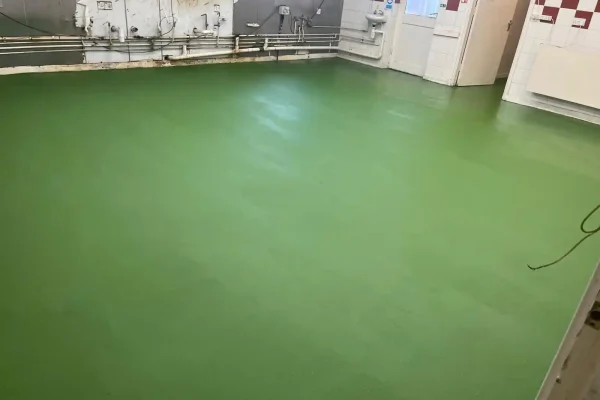
Resin flooring contractors Nottingham laboratories, clinical estates and manufacturers rely on for floors that stay cleanable under repeated sanitising. Supporting regulated, logistics and city-centre facilities from Thane Road at Beeston to Colwick, Lenton Lane, Daleside and Basford.
Working for national manufacturers, logistics operators and public sector estates since 1999.
As resin flooring contractors Nottingham operators call on regularly, we answer questions about porosity more often than about tonnage. This is the county’s technical centre: pharmaceutical and laboratory manufacturing around Beeston, two university research estates, major teaching hospital floorspace and food production, reached by M1 Junctions 24 to 26 and the A52, A46 and A6514.
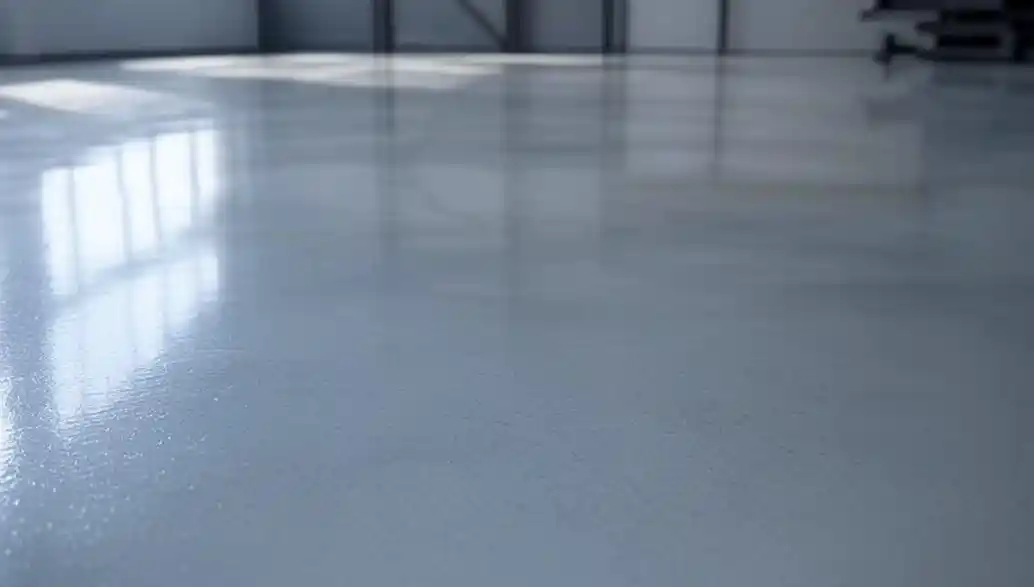
In regulated space the specification stops being about wear alone. What matters is whether the surface is non-porous, seamless and coved, and whether it survives being sanitised again and again without degrading.
So the failure appears at the details long before the open floor looks tired. Coving, drain surrounds, door thresholds and the narrow castor-worn lines along fixed routes go first, and by then the cleanability the floor was specified for has already gone.
The enterprise zone holding pharmaceutical, laboratory and technical manufacturing floorspace.
Warehousing, logistics and trade units with heavy vehicle movement on the Trent-side edge.
Manufacturing, storage and distribution facilities inside the ring road to the south west.
Logistics, warehousing and industrial support operations along the Daleside Road corridor.
Light industrial, manufacturing and storage units on the northern A6002 and A610 routes.
Research, laboratory, teaching and technical space across the city research estates.
Seamless, non-porous, chemically resistant finishes with hygienic coving throughout.
Particle control and finishes that will neither shed nor absorb under technical use.
Disinfectant resistance, castor durability and sealed junctions at walls and thresholds.
Washdown, thermal shock, drainage falls and HACCP-driven detailing across the area.
Abrasion resistance, joint protection, point-load tolerance and clear demarcation.
Stockrooms, kitchens and service routes that are industrial in all but the name.
In a laboratory, a clinical corridor or a production suite, the open floor is rarely the problem. Cleanability is lost at coving, drain surrounds and thresholds, and along the narrow wear lines that castors cut into the same route every day.
Sealed, coved junctions and detailed drain surrounds are where sanitising regimes succeed or quietly stop working.
Trolley traffic, not forklifts, drives wear in clinical and laboratory areas, cutting narrow lines along fixed routes.
EN 1081 gives the test basis for static control. A claim of anti-static without a measured value means nothing.
Very little of this work happens in an empty building. A ward, a laboratory suite and a city-centre kitchen all have to keep running, so sequencing and return to service are commercial arguments here as much as technical ones.
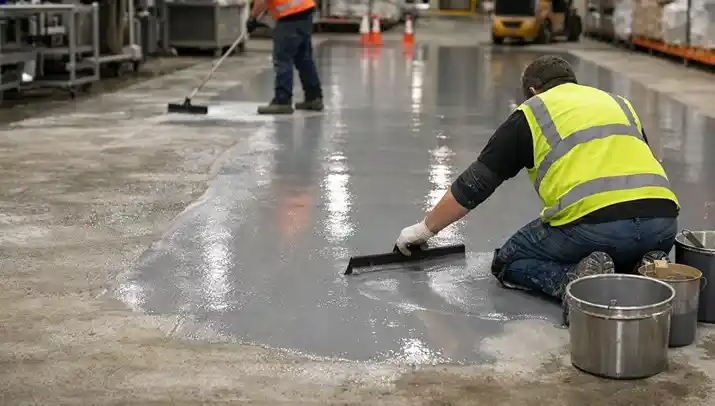
Areas are taken room by room or overnight, with rapid-cure systems where a space has to be handed back for the next session or the next service. We state their compromises plainly rather than presenting cure speed as free.
Preparation runs under H-class extraction with shared areas screened, because dust cannot be allowed to travel into clinical space, laboratory equipment or food areas while the rest of the building stays open.
Non-porous, sealed, non-dusting and coved finishes supporting repeated sanitisation regimes.
The test basis for electrical resistance in electronics, laboratory and technical manufacturing.
Seamless finishes, coved skirtings, sealed drain surrounds and correct falls across food areas.
BS 7976 pendulum values at entrances and washdown, with Equality Act contrast at thresholds.
FeRFA classifies resin flooring into eight types by build-up and thickness, and BS 8204-6 governs which one a floor actually needs, with EN 13813 for the screed and EN 1504-2 for concrete protection. Polyaspartic and MMA sit outside that classification because they describe the resin chemistry rather than the build-up. In Nottingham the seamless types lead, because cleanability decides the specification before strength does.
FeRFA Type 1. Two or more coats up to 150 microns, binding a dusting substrate and giving a cleanable surface. From £8 per square metre.
FeRFA Type 2. Dual component to 300 microns, solvent free, in gloss, matt or silk. Chemical resistance with a decorative finish.
FeRFA Type 3. Up to 1000 microns over prepared concrete and the system specified on most industrial jobs. Takes colour well for demarcation.
FeRFA Type 4. Multi-coat build at 1 to 3mm with aggregate broadcast between coats, for impact and constant wear.
FeRFA Type 5. Flow-applied at 2 to 3mm for a seamless finish where hygiene and cleaning matter more than impact resistance.
FeRFA Type 7. Three part filled system at 4 to 6mm thickness, giving a self-smoothing finish for heavy and very heavy duty areas.
FeRFA Types 7 and 8. Trowel-applied at 6 to 9mm to take thermal shock, steam cleaning and constant heavy forklift traffic.
Cures at temperatures down to −5°C and is ready in around two hours. Installed overnight or at a weekend it can remove the need to shutdown entirely.
Cures in hours, but the odour can taint food, fabrics and stock and the area must be cleared and ventilated. Better suited to new build and refurbishment projects.
Rates run from £8 per square metre for a floor seal to £45 for MMA, inclusive of preparation, labour and materials. Regulated and clinical areas sit at the upper end, because the detailing and the testing are where the value is.
| System | FeRFA | Thickness | Per m² |
|---|---|---|---|
| Floor Seal | Type 1 | Up to 150µm | From £8 |
| Epoxy and PU Coating | Type 2 | 150 – 300µm | £8 – £12 |
| High Build Coating | Type 3 | 300 – 1000µm | £8 – £12 |
| Multi-Layer Flooring | Type 4 | 1 – 3mm | £12 – £16 |
| Self-Smoothing | Type 5 | 2 – 4mm | £20 – £30 |
| Heavy Duty Flowable | Type 7 | 4 – 6mm | £25 – £35 |
| Heavy Duty PU Screed | Type 8 | 6 – 9mm | £30 – £40 |
| Polyaspartic | Chemistry | 300 – 500µm | £38 |
| MMA | Chemistry | 2 – 6mm | £45 |
Inclusive of preparation, labour and materials. Rates assume a sound, accessible substrate and are indicative until the floor has been surveyed. Polyaspartic and MMA sit outside the FeRFA type classification because they describe the resin chemistry rather than the build-up.
A three day shutdown at a plant turning over £2,000 an hour is £120,000 of lost output. On most sites that is several times the price of the floor.
Five contractors quoted one timber processing plant. All five proposed the same system and a three to four day closure. None of them costed the closure.
We proposed a faster-curing system installed across a weekend. A higher rate per square metre, and no shutdown at all. On the client’s own figures the avoided losses exceeded the price of the floor.
We install evenings, weekends and one bay at a time.
Whether a shutdown costs you thousands an hour or simply gets in the way, you do not always have to close your site for a resin flooring installation.
Forming coved junctions, drain surrounds and sealed thresholds where cleanability is lost.
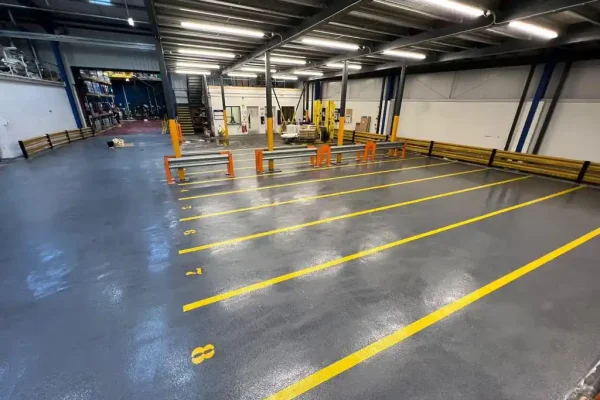
Vehicle routes, walkways and exclusion zones applied in resin rather than painted on top.
Damp proof membrane where a substrate fails moisture testing, as a standalone package.
Seamless coved systems handed back sanitisable and evidenced for audit and validation.
Disinfectant resistant finishes phased room by room around continuing clinical use.
Abrasion resistant floors, joint repairs and demarcation across the city industrial ring.
We work across the city regularly, from the Thane Road enterprise zone at Beeston and the research campuses through to Colwick, Lenton Lane, Daleside and Basford. We are Cheshire based rather than Nottingham based, so a survey usually happens within days and there is no mobilisation charge for attending.

On its own, nothing. EN 1081 provides the test basis for electrical resistance, so a static-controlled floor should come with a measured resistance value and the conditions it was tested under. If a quotation says anti-static without a number, ask what the number is before comparing prices.
Because cleanability goes at the details first. Coving, drain surrounds and door thresholds break down while the open field of the floor still looks acceptable, and once a junction opens there is a place residue can sit that cleaning cannot reach. Those areas are repaired and re-detailed rather than the whole floor replaced.
Castor traffic. Trolleys and beds follow the same route hundreds of times a day and cut deep, narrow wear lines, which is a different failure from the broad abrasion a forklift produces. It is specified for directly rather than treated as ordinary footfall wear.
Yes, and it is most of what we do here. Areas are taken room by room or overnight, preparation runs under H-class extraction with spaces screened so dust does not travel, and rapid-cure systems are used where a room has to be handed back for the next session.
From £8 per square metre for a floor seal up to £45 for MMA, inclusive of preparation, labour and materials. Regulated, clinical and laboratory areas sit at the upper end. The full table by system is on the cost page.
Tell us what the area is used for, what it is cleaned with and when it can be released. We attend, test the substrate, and put a written specification and a fixed price in front of you at no cost.