Commercial Flooring Contractor: Trusted by Big Brands
Appointing a commercial flooring contractor requires evaluating technical competence, preparation methods, and material performance rather than surface aesthetics alone. Facilities managers across warehousing, manufacturing, pharmaceuticals, and retail depend on seamless resin surfaces to protect operational safety and asset value. A failed installation causes expensive downtime, contamination risks, and safety breaches under British Standards. Experienced specialists match substrate testing, mechanical profiling, and chemical selection to your operational demands.
How can estates managers assess competing tenders to separate genuine engineering capability from superficial cosmetic finishes? Many facilities struggle with premature coating failure, unbudgeted delays, and poorly coordinated site handovers because quotes conceal critical preparation shortfalls. What specific verification steps, regulatory standards, and specification criteria must project teams review before choosing a commercial flooring contractor?
Key Takeaways
- Professional contractors rely on mechanical diamond grinding and vacuum extraction to achieve durable mechanical interlock rather than chemical etching or unverified primers.
- Tender evaluations must compare explicit build thickness and stated FeRFA types like for like to avoid premature wear under aggressive trafficking.
- Reputable resin flooring specialists hold documented diisocyanate training credentials to handle polyurethane chemistry safely within live, occupied commercial and industrial facilities.
- Measured slip resistance verified through BS 7976 pendulum testing delivers legally defensible safety controls across wet production environments and retail entrance zones.
- Phased sequencing and rapid-cure chemistries enable operational continuity, preventing costly disruption whilst existing concrete substrates undergo mechanical repair and technical resurfacing.
Key Criteria for Commercial Flooring Specification
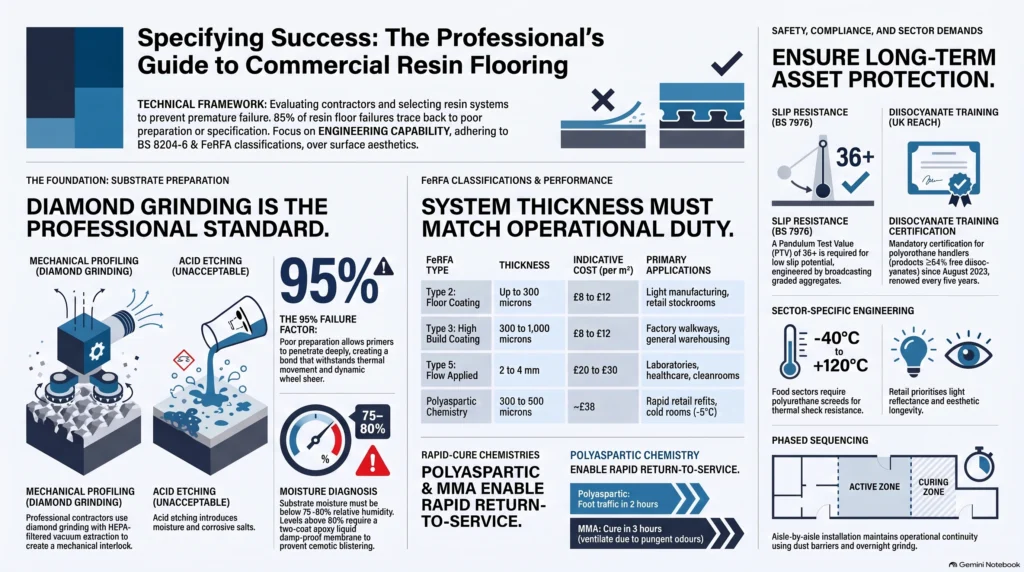
Specifying industrial and commercial resin systems demands a balance between mechanical duty, chemical exposure, and installation timescales. Facilities teams must understand how system build-up dictates performance across demanding operational environments. The following comparison outlines standard classifications defined by BS 8204-6 and FeRFA. It highlights typical thicknesses, duty ratings, and representative installed costs per square metre.
Price variations reflect essential substrate preparation, material chemistry, and application methods rather than contractor margins alone. These benchmark categories enable procurement teams to assess quotes transparently. Exact FeRFA classifications and minimum thicknesses prevent premature surface failure. They also protect long-term maintenance budgets across the whole asset life.
| FeRFA Classification | Typical Thickness | Indicative Cost Range | Primary Operational Applications |
|---|---|---|---|
| Type 2: Floor Coating | Up to 300 microns | £8 to £12 per m² | Light manufacturing, workshops, retail stockrooms |
| Type 3: High Build Coating | 300 to 1,000 microns | £12 to £20 per m² | Demarcated factory walkways, general warehousing |
| Type 5: Flow Applied | 2 to 4 mm | £20 to £30 per m² | Laboratories, healthcare suites, cleanrooms |
| Type 8: Heavy Duty Screed | 6 to 9 mm | £30 to £40 per m² | Food processing, washdown areas, commercial kitchens |
| Polyaspartic Chemistry | 300 to 500 microns | £30 to £45 per m² | Rapid turnaround retail refits, cold rooms to −5°C |
Commercial Flooring Contractor Duties in High-Duty Sectors
Sector Demands Across Regulated Industrial Facilities
A competent commercial flooring contractor designs installations around strict industrial regulations, audit mandates, and physical stressors. Food processing environments require seamless surfaces and coved skirting to satisfy HACCP hygiene inspections. Heavy engineering workshops need high compressive strength and impact tolerance. This resilience resists dropped tooling, machine vibrations, and corrosive cutting oils.
In pharmaceutical cleanrooms, floors must inhibit microbial harbourage whilst tolerating aggressive chemical washdowns. Specifiers cannot treat commercial flooring as a generic commodity. In practice, we find an engineering client in the North West needs high-build epoxy to resist forklift traffic and hydraulic spills. A food production facility instead demands thermal shock resistance for daily steam cleaning. Each operating environment sets non-negotiable chemical and mechanical thresholds.
Commercial Specification Factors in Public and Healthcare Estates
Public-facing facilities prioritise slip safety, light reflectance, and aesthetic longevity alongside regulatory compliance. Retail showrooms require hard-wearing decorative finishes that enhance illumination whilst handling intense footfall. Healthcare environments demand continuous, non-porous surfaces. These surfaces endure hospital-grade disinfectants and heavy castor wheels without scuffing or harbouring bacteria along perimeter junctions.
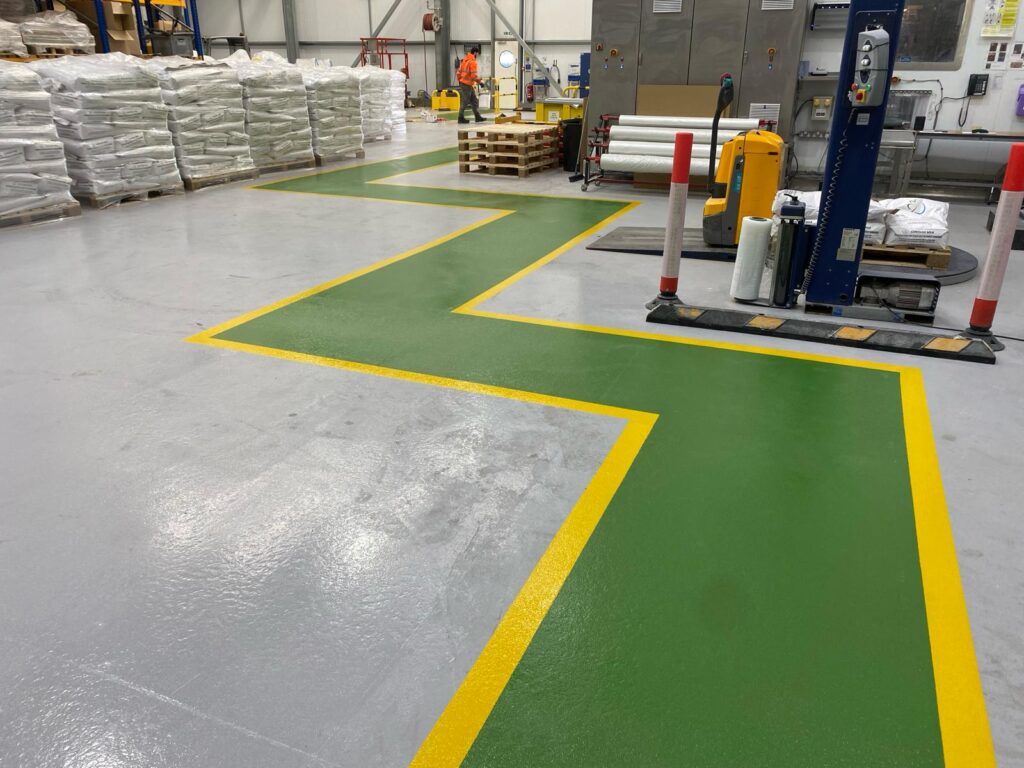
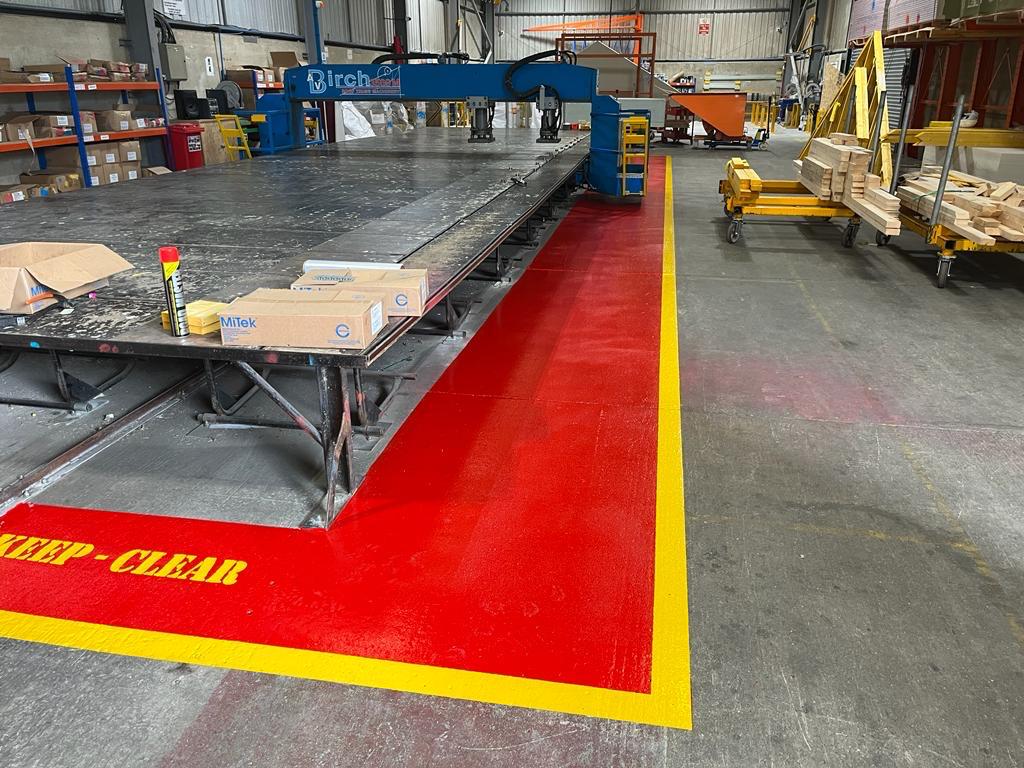
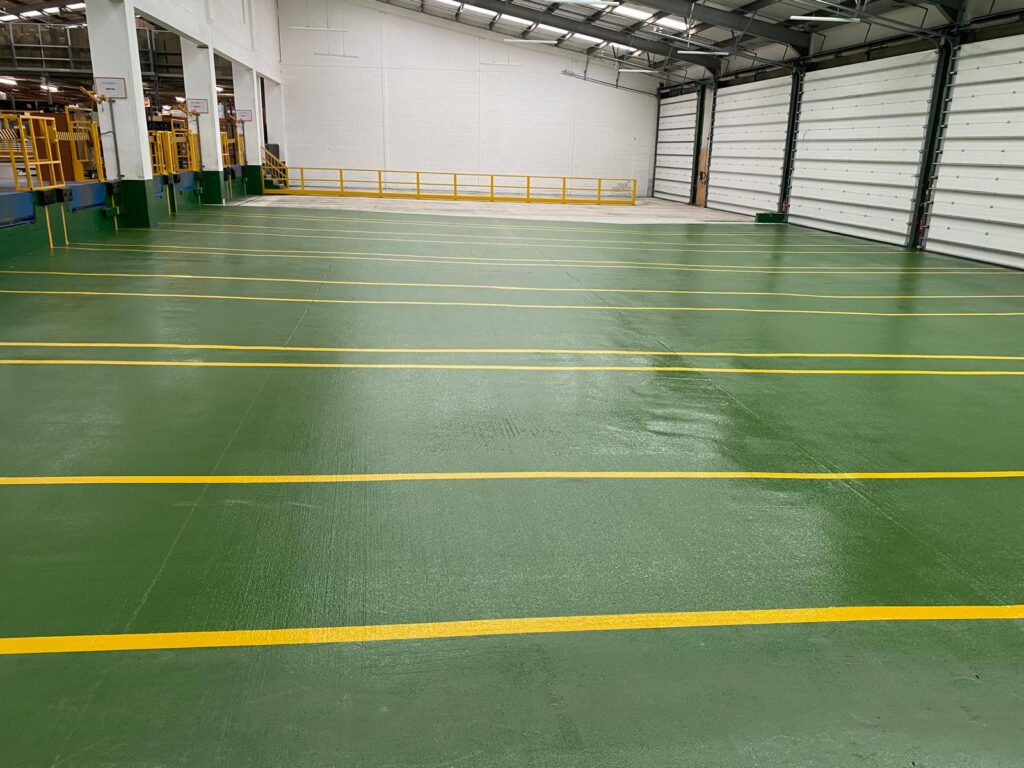
Light reflectance is a functional specification factor in retail and logistics settings. Lighter resin tones raise ambient illumination. This reduces artificial lighting energy loads whilst improving operational visibility. In public corridors, accessibility regulations require visual colour contrast at doorways, ramps, and stair thresholds. Contractors must integrate these contrasting demarcation lines into the cured resin surface. The result is a permanent safety control that withstands aggressive scrubber-dryer cleaning.
Technical Differences Between Commercial Resin Flooring Companies
Mechanical Profiling Versus Surface Coating Practices
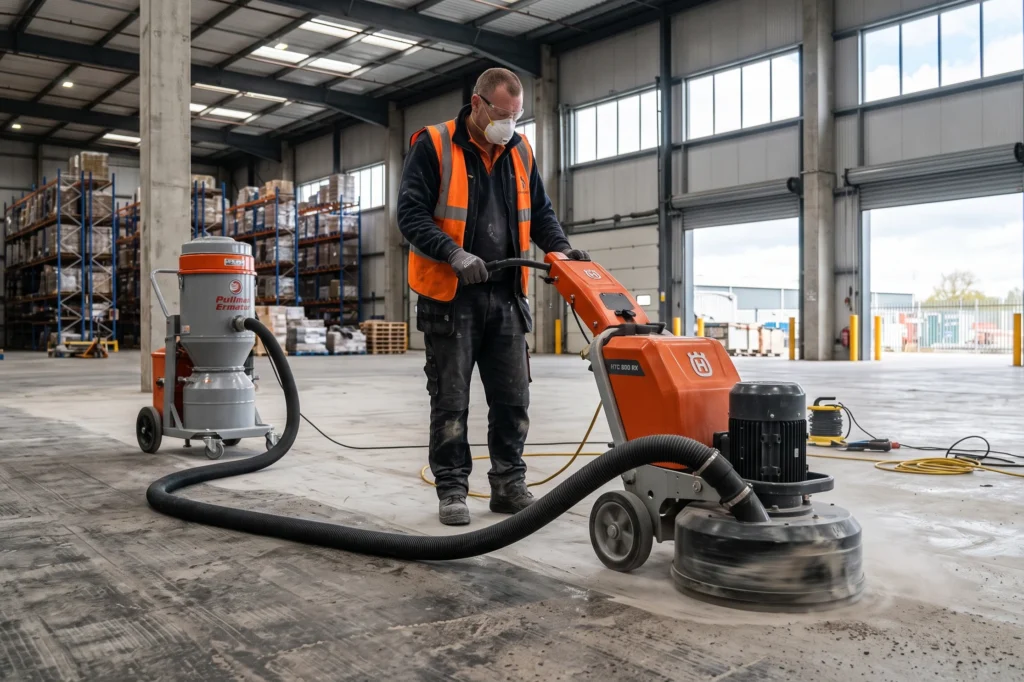
Professional commercial resin flooring companies distinguish themselves through rigorous mechanical substrate preparation rather than rapid cosmetic applications. Diamond grinding and captive shot blasting remove weak laitance, opening the concrete pore structure for mechanical adhesion. Unqualified operators frequently rely on acid etching or superficial sanding, leading to early delamination under traffic.
From experience across the sector, most resin floor failures trace back to inadequate preparation or incorrect specification rather than material defects. Properly prepared concrete allows resin primers to penetrate deeply, forming an enduring mechanical key. This bond withstands thermal movement and dynamic wheel shear. Trustworthy contractors deploy industrial diamond grinding machinery fitted with HEPA-filtered vacuum extraction. That approach captures hazardous respirable dust at source.
Verification and Quality Assurance Protocols
Reputable flooring contractors conduct comprehensive diagnostic testing before proposing or applying resin chemistries. Technicians measure relative humidity in the concrete substrate using calibrated hygrometers to identify moisture risks. Surface tensile strength testing confirms whether the substrate can support heavy-duty screeds under repeated dynamic braking loads.
Standard epoxies tolerate substrate moisture levels up to 75 to 80 per cent relative humidity. Where measured moisture exceeds these parameters, technicians install a two-coat epoxy liquid damp-proof membrane. This membrane suppresses vapour emissions up to 98 per cent relative humidity. Skipping moisture diagnosis causes osmotic blistering. Trapped vapour then pushes the cured resin off the concrete, causing catastrophic debonding within months.
Did You Know?
Under UK REACH rules in force since 24 August 2023, industrial and professional users of products containing 0.1 per cent or more free diisocyanates must complete certified training. That training must be refreshed at least every five years.
Substrate Preparation Standards Required by a Commercial Flooring Contractor
Mechanical Preparation Methods for Sound Concrete
A professional commercial flooring contractor selects mechanical preparation plant based on the existing concrete condition and specified resin thickness. Enclosed diamond grinding provides a clean, open-pored profile suitable for thin coatings and self-smoothing systems. Captive shot blasting delivers the aggressive mechanical key required for heavy-duty screeds.
Acid etching is unacceptable in modern professional practice. It introduces excessive water into the substrate and leaves corrosive salts that undermine adhesion. Mechanical diamond grinding removes surface laitance, curing agents, and historic paint cleanly. For thicker screeds or heavily contaminated industrial floors, captive shot blasting exposes sound aggregate. That process creates a coarse profile which anchors heavy-duty polyurethane or flowable resin screeds.
Substrate Crack and Joint Remediation Procedures
Structural cracks and movement joints require specialised engineering rather than simple resin infill before topcoat installation. Rigidly filling an active expansion joint transfers horizontal stresses into the newly laid resin, causing spontaneous cracking. Experienced installers reform joint arrises with structural resin mortars before installing elastomeric movement sealants.
Joint arris spalling is the most frequent defect in high-traffic logistics facilities. Hard forklift wheels strike unreinforced saw-cut joints, fracturing the concrete edges. Qualified contractors rebuild broken arrises using high-strength epoxy repair mortars. They reinstate expansion joints directly above original movement lines. Technicians then install flexible polysulphide sealants that accommodate building movement whilst keeping floors trafficable.
Need a Resin Flooring Site Visit and Quote?
System Specification and Performance Requirements Across Commercial Buildings
Resin Chemistries and Temperature Profiles
System performance depends directly on matching the polymer chemistry to operational temperatures and working exposures. Epoxy resins deliver exceptional compressive strength and chemical resistance across dry warehousing and laboratories. Heavy-duty polyurethane screeds provide the flexibility required to survive intense thermal shock and regular steam cleaning regimes.
Epoxy systems become brittle below 5°C and can fail under thermal shock above 60°C. Heavy-duty polyurethane screeds installed at 6 to 9 millimetres tolerate temperatures from −40°C to +120°C. That capability makes polyurethane screeds essential for food production, commercial bakeries, and dairies. Installers must also check the product safety data sheet before use. Where free diisocyanate content reaches 0.1 per cent, current certified training is mandatory.
Slip Safety and British Standard Pendulum Testing
Anti-slip properties must be engineered against specific workplace contaminants rather than general assumptions. Reputable contractors verify wet slip performance using the BS 7976 pendulum test method. A Pendulum Test Value of 36 or higher confirms a low slip potential under wet or oily operating conditions.
Broadcast aggregate size and concentration determine final slip resistance. Coarser quartz aggregates deliver robust traction in wet washdown areas, but they demand greater cleaning effort. Finer grades suit dry commercial environments, retail entrances, and assembly lines. These lighter textures balance slip prevention with routine maintenance. Specifiers must weigh traction requirements against cleaning practicalities to maintain a compliant, hygienic surface.
Case Studies
Our case studies cover – Printing & Packaging, Warehousing & Logistics, Pharma & Healthcare, Automotive & Engineering, Aviation & Aerospace, Food & Drink, Printing & Packaging, Warehousing & Logistics, Pharma & Healthcare
Operational Continuity and Phased Installation in Occupied Sites
Rapid-Cure Chemistry for Tight Windows
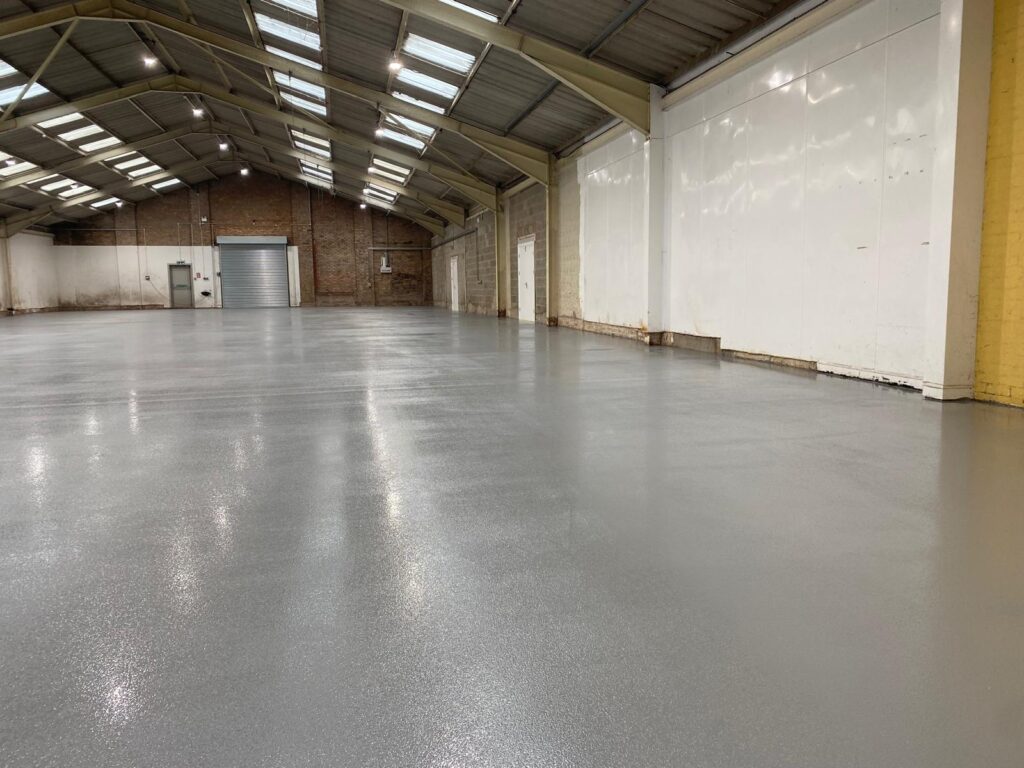
Operational downtime often costs commercial facilities far more than the flooring materials themselves. Fast-curing polyaspartic systems achieve foot traffic readiness within two hours and full cure within twenty-four hours. They cure reliably down to −5°C, allowing retail refits and cold store maintenance without prolonged operational shutdown.
Methyl methacrylate systems cure rapidly, achieving full chemical resistance within two to three hours. However, this chemistry releases a pungent acrylic odour during application. The vapour can taint open food, packaging, and fabrics. Contractors must evaluate site ventilation before specifying it. Polyaspartic chemistry provides a practical, low-odour alternative for active commercial sites. It prevents facility shutdowns whilst delivering strong UV stability and showroom durability.
Aisle-by-Aisle Phasing in Live Facilities
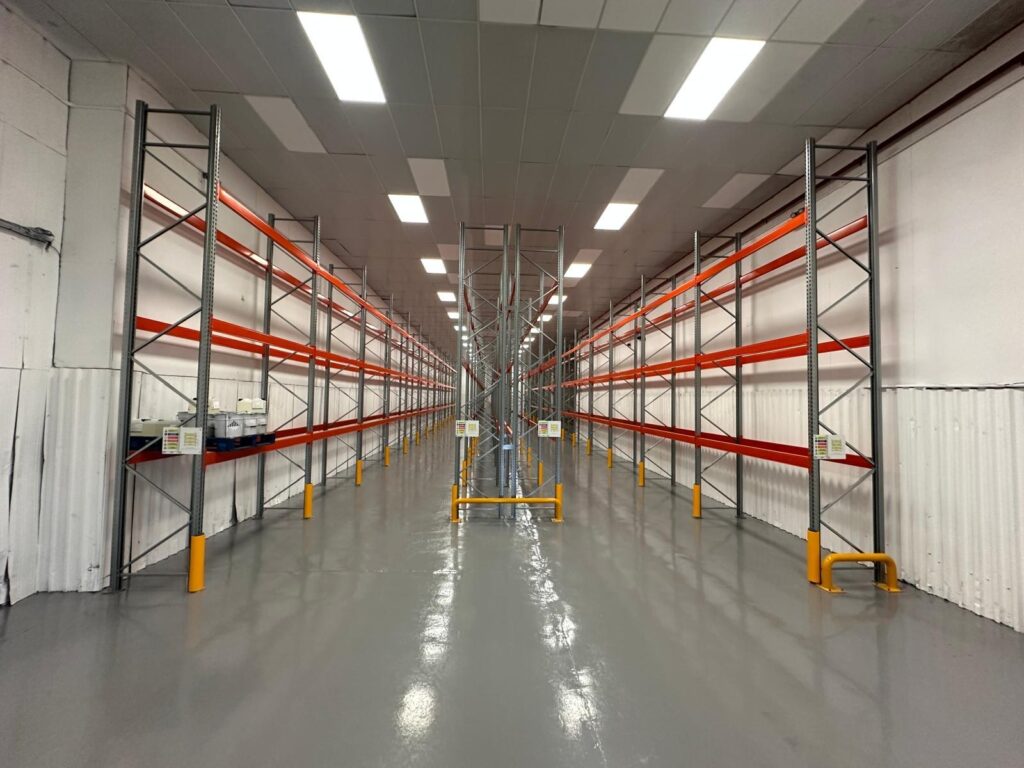
Work inside occupied warehouses and production plants requires disciplined logistical zoning and physical isolation. Contractors erect dust barriers, route extraction ducting, and establish temporary internal traffic management plans. Phased installation bay by bay or aisle by aisle keeps logistics operations active throughout surface preparation and curing.
Physical segregation prevents airborne dust and chemical vapours from reaching operational picking aisles or clean rooms. Experienced teams coordinate with facility managers to adjust working hours. Noisy grinding carried out overnight or during weekend closures minimises operational disruption. Clear line demarcation applied during phased handovers helps vehicles navigate safely around active installation zones.
“JD Flooring did an excellent job installing a resin floor in our food production facility. The floor is durable, hygienic, and meets all safety regulations. The team was knowledgeable and professional, and the project was completed within the agreed-upon timeframe. I highly recommend JD Flooring for food industry flooring needs.”
Alex Martinez
Tender Comparison When Choosing a Commercial Flooring Contractor
Stated System Thickness and FeRFA Classifications
Tenders for commercial resin flooring often appear similar on paper whilst offering drastically different functional performance. Quotes must explicitly state the FeRFA system classification, total dry film thickness, and resin product code. A proposal omitting thickness details frequently masks an under-specified thin coating intended for light domestic use.
When choosing a commercial flooring contractor, facilities managers must evaluate proposals like for like. A 300-micron floor coating cannot withstand continuous forklift traffic. A 4-millimetre heavy-duty flowable system handles severe mechanical loads for over a decade. Quotes lacking defined thicknesses usually indicate reduced material volume. Reputable contractors document exact resin build-ups, primer specifications, and material weights per square metre.
Preparation Methods and Programme Exclusions in Tenders
Low tender prices frequently conceal significant exclusions covering mechanical substrate preparation and crack repair. Unequal bids often hide omissions such as joint rebuilding, priming, or dust containment. Clients must confirm that proposals include mechanical diamond grinding, structural crack repairs, and disposal of hazardous preparation residues.
Review tender programmes to ensure realistic return-to-service schedules. Unrealistic timeframes suggest a contractor intends to rush cure cycles or eliminate primer coats. Check that tenders evidence public liability insurance of £5 million or £10 million for commercial work. Distinguish manufacturer material warranties from installer workmanship guarantees. That separation establishes unambiguous operational and legal accountability.
Statutory Health, Safety, and Environmental Compliance
Construction Design and Management Duties
Most commercial resin flooring projects qualify as construction work governed by the Construction (Design and Management) Regulations 2015. Clients, designers, and contractors must plan, manage, and monitor health and safety risks collaboratively. Professional contractors provide Risk Assessments and Method Statements alongside documented proof of workforce technical training.
Contractors must produce detailed COSHH assessments covering all liquid resins, primers, and cleaning solvents before starting work. Technicians must understand occupational exposure limits and safe handling protocols for hazardous materials. Work inside active commercial buildings requires strict air monitoring and personal protective equipment. Clear emergency spill response plans protect building occupants and installation technicians throughout the application process.
Silica Dust Control and Environmental Permitting
Grinding concrete substrates produces hazardous respirable crystalline silica dust, classified as a human carcinogen. Under COSHH regulations, contractors must prevent exposure or control it below the EH40 workplace exposure limit of 0.1 mg/m³. Industrial on-tool vacuum extraction fitted with verified HEPA filtration is therefore mandatory.
Environmental regulations also govern chemical containment areas, bunds, and process drainage networks. Secondary containment bunds must hold 110 per cent of the largest stored container’s capacity. Alternatively, they must hold 25 per cent of the total volume stored. Installers form seamless, chemical-resistant linings across bund floors and upstands. This impervious lining stops hazardous fluids permeating the concrete or entering local drainage.
Final Thoughts
Appointing an experienced commercial flooring contractor protects facilities from premature surface failures, safety breaches, and costly downtime. Selecting the right flooring partner requires thorough evaluation of mechanical preparation methods, FeRFA system classifications, and verifiable technician competencies. Headline cost alone is a poor guide to installed performance.
Reliable flooring performance is an engineered outcome delivered through meticulous substrate testing, compliant chemical specification, and disciplined site management. Facilities teams that audit tenders transparently ensure their flooring assets withstand rigorous operational demands for decades.
Arrange a Free Site Survey
If you are thinking about upgrading the flooring in your commercial or industrial space then we would love to hear from you. Our team of experts will conduct a free onsite survey and then guide you through the process of product selection and project planning, whilst remaining mindful of your budgetary restraints.
Frequently Asked Questions
A:
Calibrated surface hygrometers measure the relative humidity within the concrete substrate. Flooring specialists isolate a section of the floor to record equilibrium moisture vapour emissions over several hours. Standard commercial epoxy coatings require relative humidity levels below 75 to 80 per cent. Where readings exceed that threshold, the contractor must mechanically profile the concrete. A dedicated two-coat epoxy liquid damp-proof membrane then prevents osmotic blistering and debonding.
A:
The fundamental difference lies in system thickness, composition, and load capacity. Resin coatings are thin-film systems applied by roller at 150 to 1,000 microns. They suit light foot traffic and general warehousing. Resin screeds are heavily aggregate-filled systems applied by trowel at 4 to 9 millimetres. Screeds withstand heavy point loads, steel-wheeled forklift traffic, dropped tooling, and severe thermal shock from steam cleaning in demanding industrial environments.
A:
Return-to-service time depends entirely on the resin chemistry and ambient site temperature. Standard epoxy and polyurethane systems generally need 24 to 48 hours for foot traffic. Full chemical resistance can take up to seven days. Fast-curing polyaspartic systems accept pedestrian traffic in roughly two hours and reach full cure within 24 hours. Methyl methacrylate cures completely within two to three hours, enabling overnight or weekend turnaround.
A:
Diamond grinding mechanically cuts away weak concrete laitance. It opens the pores of the substrate to create a reliable mechanical key for resin adhesion. Acid etching introduces substantial volumes of water into the concrete, raising moisture levels and risking osmotic failure. Acid washing also leaves chemical salts that inhibit bonding. Industrial diamond grinding uses integrated HEPA-filtered extraction, capturing hazardous silica dust without introducing moisture.
A:
Slip resistance is assessed primarily using the BS 7976 pendulum test method. The test measures the dynamic coefficient of friction across wet and dry surfaces. A Pendulum Test Value of 36 or higher indicates a low slip potential under prevailing operational conditions. Commercial contractors achieve this rating by broadcasting graded aggregates into the wet resin basecoat. The chosen profile must reflect actual workplace contamination and cleaning practicality.
