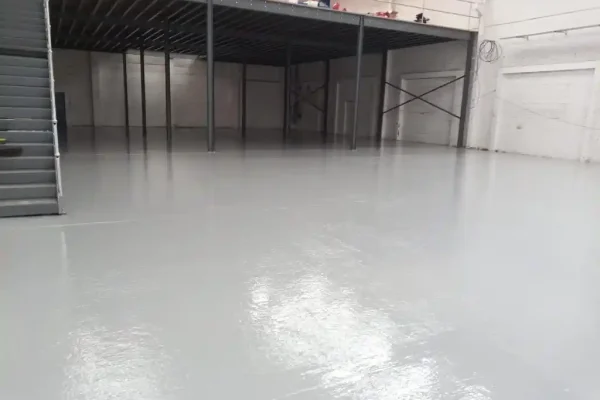
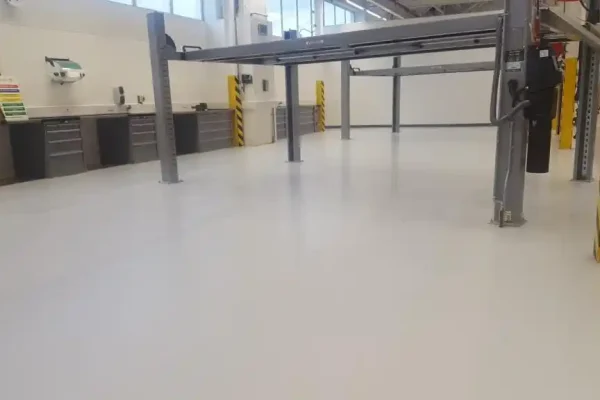
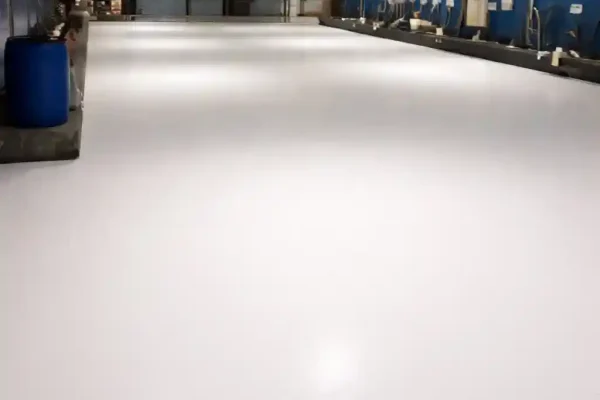
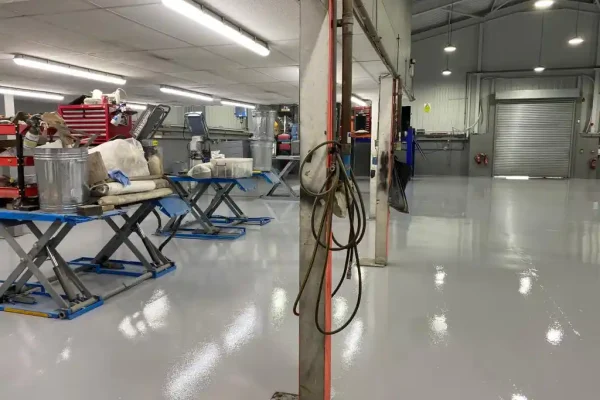
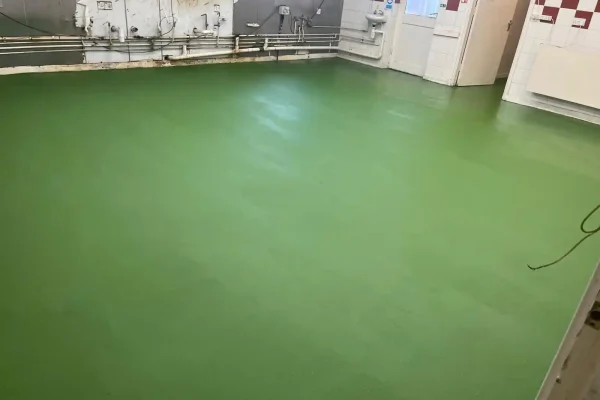
Resin flooring contractors Westhoughton distribution and manufacturing operators rely on for modern floors under punishing loads. Supporting facilities beside Logistics North, across Wingates Industrial Estate and along the Chequerbent and A6 corridor on the M61.
Working for national manufacturers, logistics operators and public sector estates since 1999.
As resin flooring contractors Westhoughton operators call on regularly, we deal with modern concrete rather than historic. The town sits on the M61 between Junctions 4 and 6, looking out over some of the largest logistics development in the North West, built to current standards on the doorstep of an older Lancashire town.
That concrete is purpose-built, power-floated and laid to tight flatness tolerances, then loaded far harder than a general-purpose floor ever was. High-bay racking concentrates load at baseplates, narrow-aisle trucks demand sustained flatness and dock levellers take repeated impact.
Failure is rarely dramatic. It is progressive arris breakdown along traffic lines, abrasion polishing on the main runs, and localised damage where pallets are dropped.
One of the largest logistics developments in the North West, north-east near Junction 4.
An established manufacturing, engineering and distribution estate with heavy movement.
Mixed industrial, trade and roadside premises on the historic route through the town.
Established industrial and storage premises to the north, between here and Bolton.
Trade, storage and service units linking the town westwards towards Hindley.
A large adjacent retail and leisure destination at Horwich with back-of-house space.
Long aisle runs, high-bay racking loads and continuous forklift and pallet traffic.
Surface regularity, joint condition and truck guidance requirements throughout.
Leveller edges, trailer impact and the highest concentration of damage on site.
Acid resistance, containment and clearly marked segregation from other traffic.
Temperature differentials, washdown and hygiene detailing within larger sheds.
Oils, coolants and localised plant loading across the established engineering stock.
Purpose-built concrete laid to tight tolerances is not automatically right for what ends up standing on it. High-bay baseplates concentrate load into small areas, and the general-purpose floor beneath them was rarely engineered for that specific point load.
EN 13813 and BS 8204-6 anchor the discussion against real baseplate and traffic loads rather than nominal duty.
In narrow-aisle and very narrow-aisle work, surface regularity and joint condition affect truck performance directly.
Failure is progressive breakdown along traffic lines rather than a single event, which is why early repair pays.
These buildings run close to continuously, so joint and bay repair is phased rather than delivered as a whole-floor shutdown. That is the operational promise here, and the sequence is agreed against your plan before a system is chosen.
Work is taken bay by bay, aisle by aisle or door by door with racking left loaded wherever possible, and rapid-cure options used where a run has to be back under traffic within a shift.
Preparation runs under H-class extraction with areas screened, because a live fulfilment operation cannot absorb dust drifting across stock or pick faces.
EN 13813 with BS 8204-6, matched to real point and rolling loads rather than nominal duty.
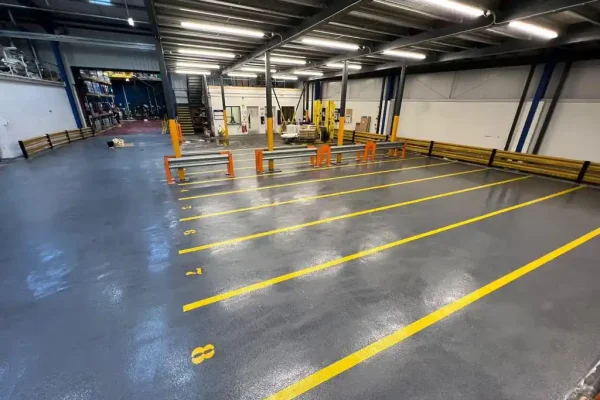
Demarcated forklift lanes, crossings and exclusion zones in high-throughput buildings.
BS 7976 pendulum values at goods-in, aprons and canopy transitions where water comes in.
Bunding at 110% of capacity around fuel and chemical storage in distribution buildings.
FeRFA classifies resin flooring into eight types by build-up and thickness, and BS 8204-6 governs which one a floor actually needs, with EN 13813 covering screed materials. Polyaspartic and MMA sit outside that classification because they describe the resin chemistry rather than the build-up. In Westhoughton the load engineering leads and the chemistry follows.
FeRFA Type 1. Two or more coats up to 150 microns, binding a dusting substrate and giving a cleanable surface. From £8 per square metre.
FeRFA Type 2. Dual component to 300 microns, solvent free, in gloss, matt or silk. Chemical resistance with a decorative finish.
FeRFA Type 3. Up to 1000 microns over prepared concrete and the system specified on most industrial jobs. Takes colour well for demarcation.
FeRFA Type 4. Multi-coat build at 1 to 3mm with aggregate broadcast between coats, for impact and constant wear.
FeRFA Type 5. Flow-applied at 2 to 3mm for a seamless finish where hygiene and cleaning matter more than impact resistance.
FeRFA Type 7. Three part filled system at 4 to 6mm thickness, giving a self-smoothing finish for heavy and very heavy duty areas.
FeRFA Types 7 and 8. Trowel-applied at 6 to 9mm to take thermal shock, steam cleaning and constant heavy forklift traffic.
Cures at temperatures down to −5°C and is ready in around two hours. Installed overnight or at a weekend it can remove the need to shutdown entirely.
Cures in hours, but the odour can taint food, fabrics and stock and the area must be cleared and ventilated. Better suited to new build and refurbishment projects.
Rates run from £8 per square metre for a floor seal to £45 for MMA, inclusive of preparation, labour and materials. Racking zones and dock aprons sit at the upper end and are priced separately from the open floor around them.
| System | FeRFA | Thickness | Per m² |
|---|---|---|---|
| Floor Seal | Type 1 | Up to 150µm | From £8 |
| Epoxy and PU Coating | Type 2 | 150 – 300µm | £8 – £12 |
| High Build Coating | Type 3 | 300 – 1000µm | £8 – £12 |
| Multi-Layer Flooring | Type 4 | 1 – 3mm | £12 – £16 |
| Self-Smoothing | Type 5 | 2 – 4mm | £20 – £30 |
| Heavy Duty Flowable | Type 7 | 4 – 6mm | £25 – £35 |
| Heavy Duty PU Screed | Type 8 | 6 – 9mm | £30 – £40 |
| Polyaspartic | Chemistry | 300 – 500µm | £38 |
| MMA | Chemistry | 2 – 6mm | £45 |
Inclusive of preparation, labour and materials. Rates assume a sound, accessible substrate and are indicative until the floor has been surveyed. Polyaspartic and MMA sit outside the FeRFA type classification because they describe the resin chemistry rather than the build-up.
A three day shutdown at a plant turning over £2,000 an hour is £120,000 of lost output. On most sites that is several times the price of the floor.
Five contractors quoted one timber processing plant. All five proposed the same system and a three to four day closure. None of them costed the closure.
We proposed a faster-curing system installed across a weekend. A higher rate per square metre, and no shutdown at all. On the client’s own figures the avoided losses exceeded the price of the floor.
We install evenings, weekends and one bay at a time.
Whether a shutdown costs you thousands an hour or simply gets in the way, you do not always have to close your site for a resin flooring installation.
Arris rebuilding and correct filler selection along traffic lines and at leveller edges.
Forklift lanes, crossings and exclusion zones set out to the operational plan in resin.
Damp proof membrane where a substrate fails moisture testing, as a standalone package.
Duty-rated systems and joint repairs installed bay by bay around continuous running.
Impact resistant build-ups at leveller edges, phased door by door around trailers.
Acid resistant floors with containment falls and clear segregation from traffic.
We work across the area regularly, from the Logistics North corridor and Wingates Industrial Estate through to Chequerbent, the A6, Lostock and the units along the A58 towards Hindley. We are Cheshire based, so a survey usually happens within days and there is no mobilisation charge for attending.

Because modern concrete is not automatically engineered for what ends up standing on it. High-bay racking baseplates concentrate load into very small areas, and a general-purpose floor rarely accounts for that. It is a point load problem rather than a build quality one.
It matters operationally. In narrow-aisle and very narrow-aisle work, surface regularity and joint condition affect how a truck tracks and how stable a mast is at height, so flatness is a performance requirement rather than a tolerance recorded once at handover.
No, and we plan on the basis that you cannot. Joint and bay repair is phased bay by bay, aisle by aisle or door by door with racking left loaded where possible, and the sequence is agreed against your operational plan rather than assuming a shutdown.
Acid resistance, containment and segregation. Bunding at 110 per cent of capacity applies where fuel and chemicals are stored, so the floor, upstands and falls are specified together, and the area is demarcated so it is clearly separated from general traffic.
From £8 per square metre for a floor seal up to £45 for MMA, inclusive of preparation, labour and materials. Racking zones and dock aprons sit at the upper end and are priced separately. The full table by system is on the cost page.
Tell us what the racking carries, where the arrises are going and which bays can be released. We attend, test the substrate, and put a written specification and a fixed price in front of you at no cost.