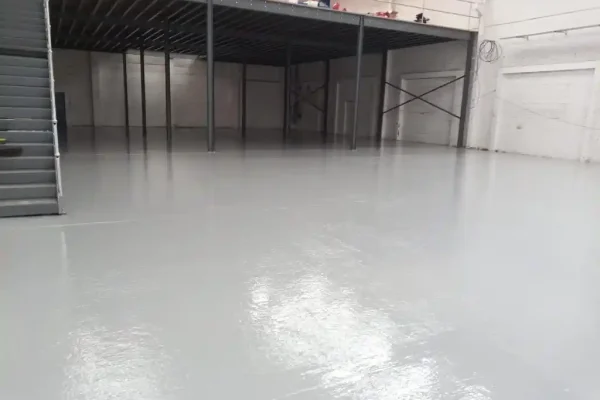
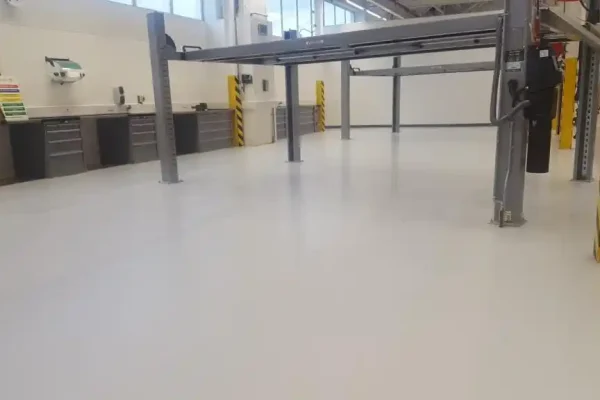
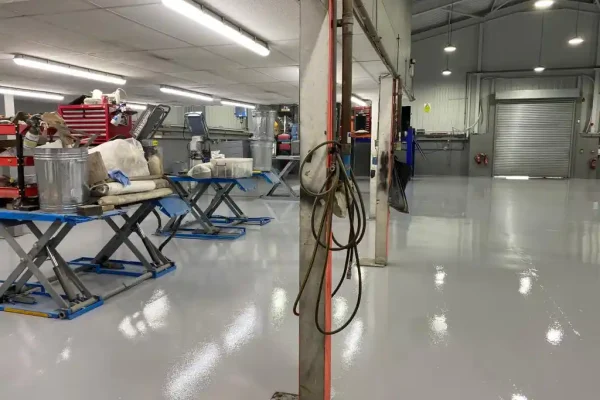
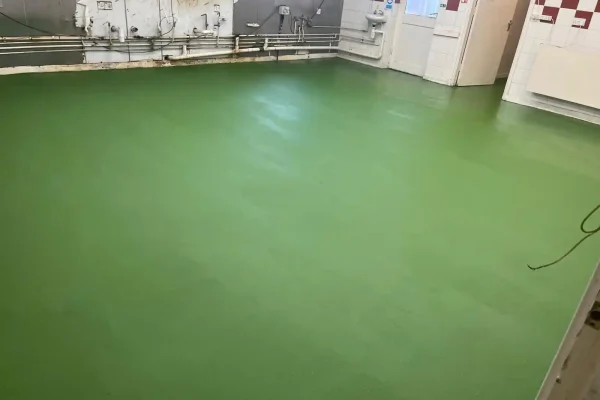
Resin flooring contractors Eccles industrial, engineering and trade occupiers rely on when the concrete is damp before anything else. Supporting premises across the Patricroft and Peel Green corridors, the Barton area beside the Ship Canal and the units along the A57 and M602.
Working for national manufacturers, logistics operators and public sector estates since 1999.
As resin flooring contractors Eccles occupiers call on regularly, we spend the survey on the concrete rather than the traffic. The town wraps around the M602 and Junction 12 of the M60, with the Manchester Ship Canal along its southern edge and the Bridgewater Canal running through Patricroft and Monton.
Premises around Patricroft, Barton and Peel Green sit on low-lying ground, frequently on made ground with a high water table, and on concrete laid before modern damp-proof membrane practice.
So substrate moisture is the decisive technical question far more often than load. Blistering, osmotic bubbling and delamination here are almost always moisture, and no coating specification gets round a wet substrate.
Historic engineering and works land on Liverpool Road, with the oldest substrates in Salford.
Multi-unit light industrial and storage accommodation to the west of the town centre.
Waterside industrial land beside the Ship Canal, facing Trafford Park across the water.
Small industrial units, yards and merchant premises sitting just off the A57 route.
Trade counters, service premises and vehicle businesses on the route into Salford.
Converted and part-converted works in mixed light industrial and commercial use.
Sealing floors where moisture ingress and historic contamination both need answering.
Oil, fuel, hydraulic and coolant resistance with tolerance of dropped components.
Large bays with washdown, measured grip and heavy axle loading through the day.
Severe abrasion from grit and stone tracked across the floor by every movement.
Forklift routes and racking loads serving the Trafford Park and Port Salford corridors.
Variable substrate quality with joint and crack treatment and phased occupation.
On low-lying canal-side ground the concrete frequently has no effective damp-proof membrane. Vapour pushes up through it, and whatever is bonded on top blisters, bubbles or lifts. Testing for that is the specification, not a contingency.
BS 8204-6 requires substrate moisture to be assessed first, so relative humidity is measured inside the concrete.
Where a moisture-suppressing layer sits beneath the wearing surface, the whole build-up is specified together.
EN 1504-2 frames protecting carbonated or contaminated concrete, the honest aim on much of this stock.
The M602 delivers traffic straight into the town, which keeps older, imperfect buildings in productive use long after their floors have given up. Occupiers stay because the location works, so the floor has to be fixed around them.
Work is taken zone by zone or into weekends, with phased occupation where a converted building is only partly in use. Preparation time on damp and contaminated concrete goes into the programme rather than being discovered during it.
Preparation runs under H-class extraction with areas screened, and where the concrete has absorbed decades of oil the grindings are contained rather than swept through the rest of the building.
BS 8204-6 requires condition assessment, so relative humidity testing precedes any system selection.
EN 13813 material properties with FeRFA Types 1 to 8 describing the full build rather than a product.
Arresting deterioration in old, carbonated or contaminated concrete rather than improving appearance.
Premises adjoining the canals carry surface water duties that interact with falls and containment.
FeRFA classifies resin flooring into eight types by build-up and thickness, and BS 8204-6 governs which one a floor actually needs, with EN 13813 for the screed and EN 1504-2 where the concrete is being protected. Polyaspartic and MMA sit outside that classification because they describe the resin chemistry rather than the build-up. In Eccles what sits beneath the wearing surface matters as much as the surface itself.
FeRFA Type 1. Two or more coats up to 150 microns, binding a dusting substrate and giving a cleanable surface. From £8 per square metre.
FeRFA Type 2. Dual component to 300 microns, solvent free, in gloss, matt or silk. Chemical resistance with a decorative finish.
FeRFA Type 3. Up to 1000 microns over prepared concrete and the system specified on most industrial jobs. Takes colour well for demarcation.
FeRFA Type 4. Multi-coat build at 1 to 3mm with aggregate broadcast between coats, for impact and constant wear.
FeRFA Type 5. Flow-applied at 2 to 3mm for a seamless finish where hygiene and cleaning matter more than impact resistance.
FeRFA Type 7. Three part filled system at 4 to 6mm thickness, giving a self-smoothing finish for heavy and very heavy duty areas.
FeRFA Types 7 and 8. Trowel-applied at 6 to 9mm to take thermal shock, steam cleaning and constant heavy forklift traffic.
Cures at temperatures down to −5°C and is ready in around two hours. Installed overnight or at a weekend it can remove the need to shutdown entirely.
Cures in hours, but the odour can taint food, fabrics and stock and the area must be cleared and ventilated. Better suited to new build and refurbishment projects.
Rates run from £8 per square metre for a floor seal to £45 for MMA, inclusive of preparation, labour and materials. Damp proof membrane packages are priced separately, because whether one is needed is a test result rather than an assumption.
| System | FeRFA | Thickness | Per m² |
|---|---|---|---|
| Floor Seal | Type 1 | Up to 150µm | From £8 |
| Epoxy and PU Coating | Type 2 | 150 – 300µm | £8 – £12 |
| High Build Coating | Type 3 | 300 – 1000µm | £8 – £12 |
| Multi-Layer Flooring | Type 4 | 1 – 3mm | £12 – £16 |
| Self-Smoothing | Type 5 | 2 – 4mm | £20 – £30 |
| Heavy Duty Flowable | Type 7 | 4 – 6mm | £25 – £35 |
| Heavy Duty PU Screed | Type 8 | 6 – 9mm | £30 – £40 |
| Polyaspartic | Chemistry | 300 – 500µm | £38 |
| MMA | Chemistry | 2 – 6mm | £45 |
Inclusive of preparation, labour and materials. Rates assume a sound, accessible substrate and are indicative until the floor has been surveyed. Polyaspartic and MMA sit outside the FeRFA type classification because they describe the resin chemistry rather than the build-up.
A three day shutdown at a plant turning over £2,000 an hour is £120,000 of lost output. On most sites that is several times the price of the floor.
Five contractors quoted one timber processing plant. All five proposed the same system and a three to four day closure. None of them costed the closure.
We proposed a faster-curing system installed across a weekend. A higher rate per square metre, and no shutdown at all. On the client’s own figures the avoided losses exceeded the price of the floor.
We install evenings, weekends and one bay at a time.
Whether a shutdown costs you thousands an hour or simply gets in the way, you do not always have to close your site for a resin flooring installation.
Surface damp proof membrane where a substrate fails moisture testing, as its own package.
Crack and joint treatment and making good on ageing canal-side and converted floors.
Forklift routes, walkways and yard thresholds applied in resin rather than painted on.
Damp, contaminated concrete tested, treated and overlaid rather than broken out.
Oil resistant floors with washdown falls and measured grip across large bays.
Abrasion resistant systems where grit and stone are tracked in continuously.
We work across the area regularly, from the Patricroft corridor and Lyntown at Peel Green through to Barton, Winton, Monton and the units along Eccles New Road and the M602. We are Cheshire based, so a survey usually happens within days and there is no mobilisation charge for attending.

Moisture, in almost every case here. Much of this stock sits on low-lying ground with no effective damp-proof membrane, so vapour pushes up through the concrete and lifts whatever is bonded to it. It is not a product fault, and a better coating will do exactly the same thing.
Relative humidity is measured inside the concrete rather than at the surface, because a surface reading tells you very little. BS 8204-6 requires substrate condition including moisture to be assessed before a system is chosen, so the testing comes first and the specification follows the result.
Yes, with the right build-up. A surface damp proof membrane can be installed beneath the wearing surface, and the whole thing is then specified as a system rather than a product. We price that separately so you can see exactly what the moisture is costing you.
Specifying that transition zone separately. Grit, rainwater and wet tyres coming off a waterside yard create a classic threshold slip risk, so pendulum values to BS 7976 in the wet state govern the finish there rather than the value used across the rest of the floor.
From £8 per square metre for a floor seal up to £45 for MMA, inclusive of preparation, labour and materials. Damp proof membrane packages and preparation on contaminated concrete are priced separately. The full table by system is on the cost page.
Tell us how old the building is, whether the floor has ever blistered and what crosses it. We attend, test the substrate, and put a written specification and a fixed price in front of you at no cost.