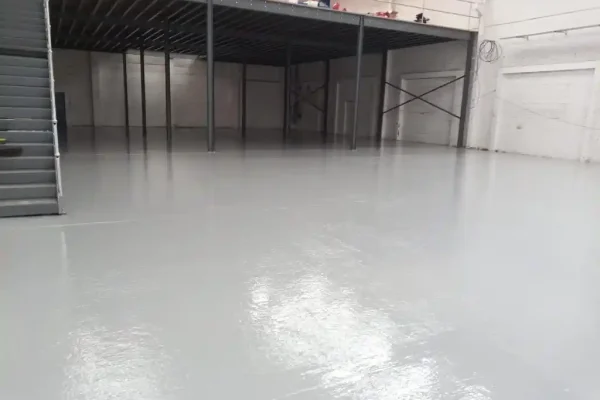
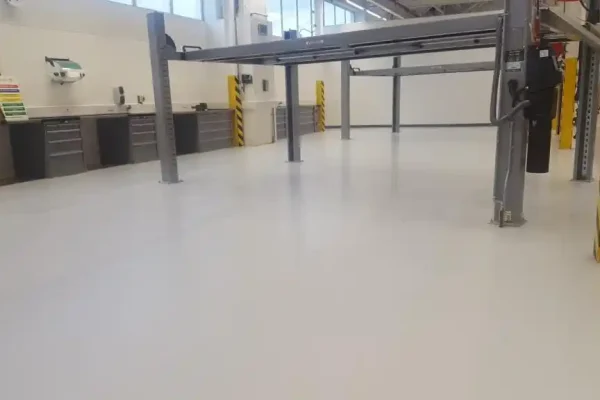
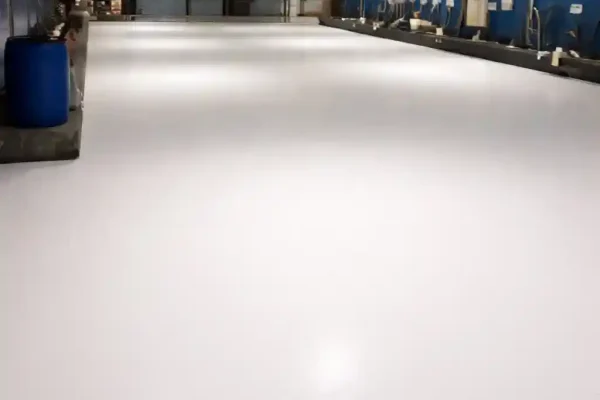
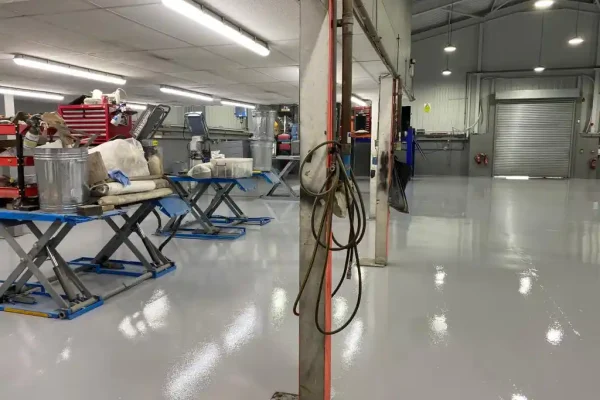
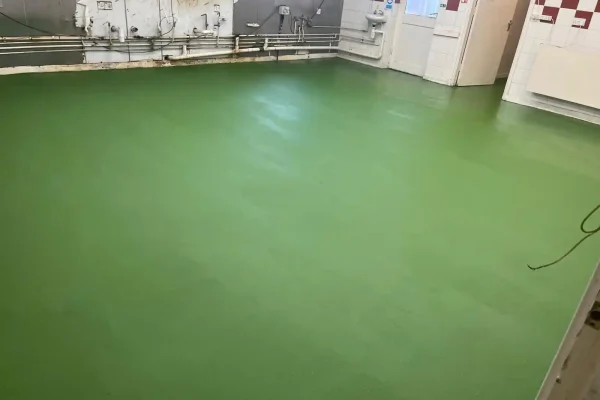
Resin flooring contractors Altrincham trade units, commercial premises and clinical practices rely on when a floor already has a history. Supporting the Broadheath industrial area around Atlantic Street and Linley Lane, the A56 corridor and the town centre retail and hospitality quarter.
Working for national manufacturers, logistics operators and public sector estates since 1999.
As resin flooring contractors Altrincham occupiers call on regularly, we are rarely asked what a new floor should be. We are asked what to do with the one already there. The town sits where the M56 meets the A56 in Trafford, with the Bridgewater Canal cutting through the industrial quarter at Broadheath.
That stock has been re-let and refitted many times, so the substrate is usually an old power-floated surface carrying adhesive, tile bed, thin coating or paint. Substrate history rather than traffic load is what causes failure here.
At the other end of the town the retail, hospitality and professional quarter generates work where finish quality, colour and slip performance are all in public view, which is a different brief again.
The core of the Broadheath industrial stock, with trade units, workshops and warehousing.
Multi-unit light industrial and storage accommodation typical of the Broadheath cluster.
A continuous run of industrial, trade and service units running towards Sale.
Older works and yards where substrate age and moisture history are recurring issues.
Trade counters and merchants with high trolley movement and a customer-facing element.
Retail, hospitality and clinical premises around the market and the interchange.
Wheel tracking and dropped stock on a surface customers can see as they queue.
Mixed foot, trolley and forklift traffic over layers of historic coatings.
Offices, studios and showrooms needing a controlled, appearance-critical finish.
Coving, correct falls and slip resistance behind food and drink premises.
Seamless surfaces tolerating repeated disinfection and castor-wheeled equipment.
Oil, fuel and solvent resistance with measured grip around wash and inspection.
A Broadheath unit that has been re-let several times usually carries adhesive, tile bed, paint and a failed coating on top of the original concrete. What comes off decides what goes on, and no product overcomes a bad bond.
BS 8204-6 requires a sound, clean, prepared base, so adhesives, tile beds and failed coatings come off mechanically first.
Older Broadheath and canal-side stock carries moisture history worth establishing before a system is put forward.
Much of this work is customer-facing, so colour, evenness and how the finish ages are part of the specification.
Short working windows planned around trading hours are usually the governing constraint here rather than the technical brief. A shop opens, a practice has a list, a kitchen has a service, and none of them move for a floor.
Retail, hospitality and clinical areas are taken overnight or during closed periods, with rapid-cure systems where a room has to be handed back for the next morning. Broadheath units are taken zone by zone or over a weekend.
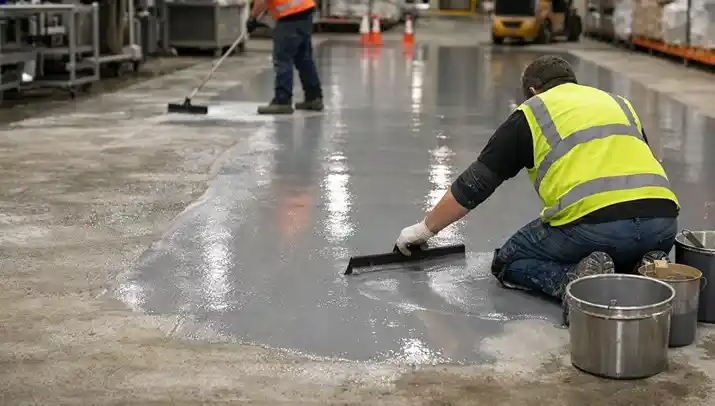
Preparation runs under H-class extraction with areas screened, because removing old adhesives and coatings in an occupied building generates far more dust than laying the new floor does.
BS 7976 pendulum values at entrances where rain is tracked in, and across wet kitchen zones.
Equality Act contrast at thresholds, ramps and steps, built into the resin rather than applied.
EN 13501-1 with the fl suffix stated for escape routes and service corridors rather than claimed.
BS 8204-6 requires a sound, clean, prepared base, which means removal and moisture assessment.
FeRFA classifies resin flooring into eight types by build-up and thickness, and BS 8204-6 governs which one a floor actually needs, with EN 13813 for the screed. Polyaspartic and MMA sit outside that classification because they describe the resin chemistry rather than the build-up, and in Altrincham they are frequently chosen for an overnight window.
FeRFA Type 1. Two or more coats up to 150 microns, binding a dusting substrate and giving a cleanable surface. From £8 per square metre.
FeRFA Type 2. Dual component to 300 microns, solvent free, in gloss, matt or silk. Chemical resistance with a decorative finish.
FeRFA Type 3. Up to 1000 microns over prepared concrete and the system specified on most industrial jobs. Takes colour well for demarcation.
FeRFA Type 4. Multi-coat build at 1 to 3mm with aggregate broadcast between coats, for impact and constant wear.
FeRFA Type 5. Flow-applied at 2 to 3mm for a seamless finish where hygiene and cleaning matter more than impact resistance.
FeRFA Type 7. Three part filled system at 4 to 6mm thickness, giving a self-smoothing finish for heavy and very heavy duty areas.
FeRFA Types 7 and 8. Trowel-applied at 6 to 9mm to take thermal shock, steam cleaning and constant heavy forklift traffic.
Cures at temperatures down to −5°C and is ready in around two hours. Installed overnight or at a weekend it can remove the need to shutdown entirely.
Cures in hours, but the odour can taint food, fabrics and stock and the area must be cleared and ventilated. Better suited to new build and refurbishment projects.
Rates run from £8 per square metre for a floor seal to £45 for MMA, inclusive of preparation, labour and materials. On a floor with a history the preparation is priced separately, because removing what is there is the real variable.
| System | FeRFA | Thickness | Per m² |
|---|---|---|---|
| Floor Seal | Type 1 | Up to 150µm | From £8 |
| Epoxy and PU Coating | Type 2 | 150 – 300µm | £8 – £12 |
| High Build Coating | Type 3 | 300 – 1000µm | £8 – £12 |
| Multi-Layer Flooring | Type 4 | 1 – 3mm | £12 – £16 |
| Self-Smoothing | Type 5 | 2 – 4mm | £20 – £30 |
| Heavy Duty Flowable | Type 7 | 4 – 6mm | £25 – £35 |
| Heavy Duty PU Screed | Type 8 | 6 – 9mm | £30 – £40 |
| Polyaspartic | Chemistry | 300 – 500µm | £38 |
| MMA | Chemistry | 2 – 6mm | £45 |
Inclusive of preparation, labour and materials. Rates assume a sound, accessible substrate and are indicative until the floor has been surveyed. Polyaspartic and MMA sit outside the FeRFA type classification because they describe the resin chemistry rather than the build-up.
A three day shutdown at a plant turning over £2,000 an hour is £120,000 of lost output. On most sites that is several times the price of the floor.
Five contractors quoted one timber processing plant. All five proposed the same system and a three to four day closure. None of them costed the closure.
We proposed a faster-curing system installed across a weekend. A higher rate per square metre, and no shutdown at all. On the client’s own figures the avoided losses exceeded the price of the floor.
We install evenings, weekends and one bay at a time.
Whether a shutdown costs you thousands an hour or simply gets in the way, you do not always have to close your site for a resin flooring installation.
Mechanical removal of adhesives, tile beds, paint and failed coatings back to sound concrete.
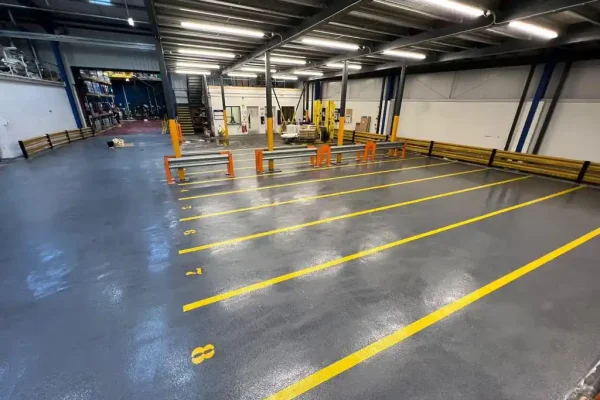
Walkways, trolley routes and customer separation applied in resin rather than in tape.
Damp proof membrane where a substrate fails moisture testing, as a standalone package.
Historic coatings removed, concrete tested and a system matched to what is beneath.
Appearance-critical finishes installed overnight so trading resumes the next morning.
Seamless coved systems with falls to drain, handed back cleanable and inspection ready.
We work across the town regularly, from Atlantic Street and Linley Lane at Broadheath through to the A56 corridor, Navigation Road and the town centre retail and hospitality quarter. We are Cheshire based, so a survey usually happens within days and there is no mobilisation charge for attending.
Everything unsound comes off before anything goes on. Adhesives, tile beds, paint and failed coatings are removed mechanically back to sound concrete, and adhesion is tested before a system is selected. BS 8204-6 requires a sound, clean, prepared base, and there is no product that gets around that.

Yes. Colour, evenness and how the finish ages become part of the brief alongside durability, and level changes and thresholds bring Equality Act contrast into scope. A resin system can build that contrast in integrally rather than having strips applied over it later.
Aggregate graded to a measured requirement, specified from BS 7976 pendulum values in the wet condition. Rain tracked in from the A56 and the canal-side yards keeps these entrances wet for much of the day, so the specification is written for that zone rather than applied at one level throughout.
Frequently, yes. Rapid-cure systems return a floor to use in a few hours, which makes an overnight or closed-period window realistic. We set out the return-to-service window rather than promising a completion time that a trading business cannot afford to have slip.
From £8 per square metre for a floor seal up to £45 for MMA, inclusive of preparation, labour and materials. Removal of existing floor coverings and coatings is priced separately. The full table by system is on the cost page.
Stretford · Urmston · Manchester · Irlam · Stockport · Knutsford · Warrington
Tell us what is on the floor now, who sees it and how long the area can be closed. We attend, test the substrate, and put a written specification and a fixed price in front of you at no cost.