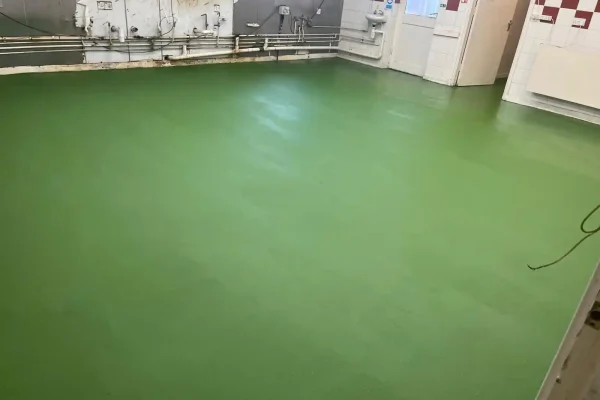
Resin flooring contractors St Helens materials processors and distribution operators rely on for floors that survive abrasive fines and heat. Serving manufacturing and warehousing across Haydock Industrial Estate, Florida Farm, Lea Green, Bold and the Ravenhead and Cowley Hill areas.
Working for national manufacturers, logistics operators and public sector estates since 1999.
As resin flooring contractors St Helens operators call on regularly, we answer two quite different questions in one borough. The town made its name in glass and heavy materials, and that legacy still sits at Ravenhead and Cowley Hill. Layered over it is a modern distribution economy anchored on Junction 23 of the M6 at Haydock and the M62 to the south.
In the manufacturing half, the failure is abrasive erosion. Hard fines, cullet and aggregate ground underfoot and under wheels behave like a lapping compound, cutting through thin-film systems far faster than pallet traffic ever would, with localised heat and thermal cycling attacking the bond line alongside it.
In the distribution half the pattern is the familiar one: joint arris breakdown, racking point loads and dock-edge damage. Both are solvable. They are not solvable with the same specification, and saying so is the whole point.
The principal distribution and manufacturing cluster at Junction 23 of the M6, on the Penny Lane corridor.
Large-format employment and distribution land fronting the motorway on the borough eastern side.
Modern industrial, trade and distribution units on the southern side of the town off the Linkway.
Mixed manufacturing, storage and trade premises along the A570 St Helens Linkway corridor.
Former glassworks land now in mixed industrial, storage and regeneration use near the centre.
Established manufacturing and engineering units in the south east, with Sherdley Road alongside.
Abrasive fines, dropped material and localised heat needing screeds rather than coatings.
Thermal cycling and radiant heat that stress the bond line far beyond a coating.
Abrasion, joint protection and racking baseplate loads at Haydock and Lea Green.
Very high abrasion under shovel and loader traffic with constant dropped material.
Oil, coolant and solvent exposure combined with dropped tool impact at benches.
Leveller impact, hard-wheeled trailer traffic and weather ingress at the threshold.
Cullet, aggregate and hard process fines get ground between wheel and floor all day. That is not traffic wear, it is lapping, and it takes the surface off a thin-film system in a fraction of the life the datasheet suggests.
Hard fines cut rather than polish, so abrasion class is specified against the material on the floor, not the tonnage over it.
BS 8204-6 and the FeRFA range give the honest answer in a processing hall, and it is usually a polyurethane screed.
Furnace-adjacent and annealing areas cycle the floor thermally, and that breaks the bond rather than the peak figure.
Neither half of the borough stops easily. A process line runs continuously and a Haydock shed runs multiple shifts, so phasing is agreed before anything is specified rather than after.
Where polyurethane systems are used, and in these environments they usually are, ISOPA and ALIPA diisocyanate training records matter directly. Every operative handling them holds current REACH certification, and we present that as competence assurance rather than paperwork.
Preparation runs under H-class extraction with shared areas screened. That matters more here than in most towns, because materials handling and worn concrete together put respirable crystalline silica into the air, limited under EH40 to 0.1 mg per cubic metre over eight hours.
The FeRFA range is the spine here, because a processing hall needs a screed rather than a high-build coating.
ISOPA and ALIPA training for the polyurethane systems that these process environments genuinely require.
The EH40 limit of 0.1 mg per cubic metre over eight hours where materials handling meets worn concrete.
Built into the floor across the high-throughput distribution buildings at Haydock and at Lea Green.
FeRFA classifies resin flooring into eight types by build-up and thickness, and BS 8204-6 governs which one a floor actually needs, with EN 13813 covering the screed material itself. Polyaspartic and MMA sit outside that classification because they describe the resin chemistry rather than the build-up. In St Helens the answer differs by building, which is why we specify the process halls and the sheds separately.
FeRFA Type 1. Two or more coats up to 150 microns, binding a dusting substrate and giving a cleanable surface. From £8 per square metre.
FeRFA Type 2. Dual component to 300 microns, solvent free, in gloss, matt or silk. Chemical resistance with a decorative finish.
FeRFA Type 3. Up to 1000 microns over prepared concrete and the system specified on most industrial jobs. Takes colour well for demarcation.
FeRFA Type 4. Multi-coat build at 1 to 3mm with aggregate broadcast between coats, for impact and constant wear.
FeRFA Type 5. Flow-applied at 2 to 3mm for a seamless finish where hygiene and cleaning matter more than impact resistance.
FeRFA Type 7. Three part filled system at 4 to 6mm thickness, giving a self-smoothing finish for heavy and very heavy duty areas.
FeRFA Types 7 and 8. Trowel-applied at 6 to 9mm to take thermal shock, steam cleaning and constant heavy forklift traffic.
Cures at temperatures down to −5°C and is ready in around two hours. Installed overnight or at a weekend it can remove the need to shutdown entirely.
Cures in hours, but the odour can taint food, fabrics and stock and the area must be cleared and ventilated. Better suited to new build and refurbishment projects.
Rates run from £8 per square metre for a floor seal to £45 for MMA, inclusive of preparation, labour and materials. Process and materials handling areas sit at the upper end, distribution floors usually lower, so the two are priced separately.
| System | FeRFA | Thickness | Per m² |
|---|---|---|---|
| Floor Seal | Type 1 | Up to 150µm | From £8 |
| Epoxy and PU Coating | Type 2 | 150 – 300µm | £8 – £12 |
| High Build Coating | Type 3 | 300 – 1000µm | £8 – £12 |
| Multi-Layer Flooring | Type 4 | 1 – 3mm | £12 – £16 |
| Self-Smoothing | Type 5 | 2 – 4mm | £20 – £30 |
| Heavy Duty Flowable | Type 7 | 4 – 6mm | £25 – £35 |
| Heavy Duty PU Screed | Type 8 | 6 – 9mm | £30 – £40 |
| Polyaspartic | Chemistry | 300 – 500µm | £38 |
| MMA | Chemistry | 2 – 6mm | £45 |
Inclusive of preparation, labour and materials. Rates assume a sound, accessible substrate and are indicative until the floor has been surveyed. Polyaspartic and MMA sit outside the FeRFA type classification because they describe the resin chemistry rather than the build-up.
A three day shutdown at a plant turning over £2,000 an hour is £120,000 of lost output. On most sites that is several times the price of the floor.
Five contractors quoted one timber processing plant. All five proposed the same system and a three to four day closure. None of them costed the closure.
We proposed a faster-curing system installed across a weekend. A higher rate per square metre, and no shutdown at all. On the client’s own figures the avoided losses exceeded the price of the floor.
We install evenings, weekends and one bay at a time.
Whether a shutdown costs you thousands an hour or simply gets in the way, you do not always have to close your site for a resin flooring installation.
Arris rebuilding, crack stitching and flexible sealing across trafficked joints and aprons.
Walkways, vehicle routes and exclusion zones applied in resin rather than painted on top.
Damp proof membrane where a substrate fails moisture testing, as a standalone package.
Heavy-duty screeds laid where abrasive fines and heat would take a coating apart quickly.
Abrasion resistant floors and joint repairs installed aisle by aisle across multiple shifts.
Former works floors assessed, repaired and refinished for new employment occupiers.
We work across the borough regularly, from Haydock Industrial Estate and Florida Farm at Junction 23 through to Lea Green, Bold, Reginald Road at Sutton and the Ravenhead and Cowley Hill areas. We are Cheshire based, so a survey usually happens within days and there is no mobilisation charge for attending.

Because hard fines and cullet act as a lapping compound between the wheel and the floor. That cuts rather than polishes, so a system rated on tonnage alone wears through far sooner than its datasheet implies. Abrasion class has to be specified against the material actually on the floor.
In a materials processing or hot process hall the honest answer is usually a screed. BS 8204-6 and the FeRFA range exist to make that judgement properly, and a high-build coating in that environment simply moves the cost into repairs. In a distribution shed the answer is often different, which is why we specify them separately.
Yes, and it changes the build-up rather than just the product. Radiant heat and thermal cycling stress the bond line, and it is the repeated movement rather than the peak temperature that breaks it. Polyurethane screeds are specified for that, and the thickness is chosen against the cycle rather than a maximum figure.
Usually. Process areas are phased around the operation and warehousing is taken aisle by aisle or into shift changeovers. Preparation runs under H-class extraction with shared areas screened, which is what makes working in a live materials handling building practical.
From £8 per square metre for a floor seal up to £45 for MMA, inclusive of preparation, labour and materials. Process and materials handling floors sit at the upper end and distribution floors usually lower. The full table by system is on the cost page.
Liverpool · Kirkby · Bootle · Warrington · Wigan · Widnes · Skelmersdale
Tell us what is on the floor, how hot the area gets and when the line or the aisle can be released. We attend, test the substrate, and put a written specification and a fixed price in front of you at no cost.