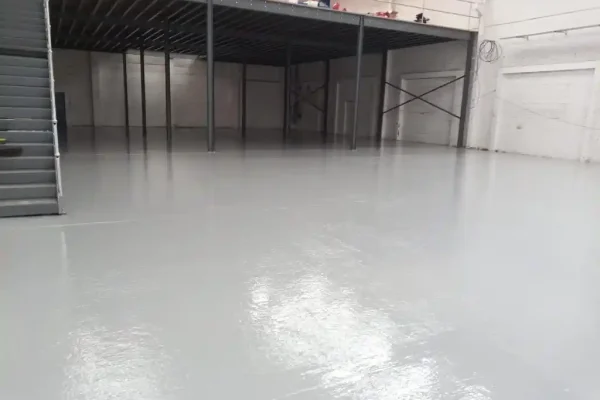
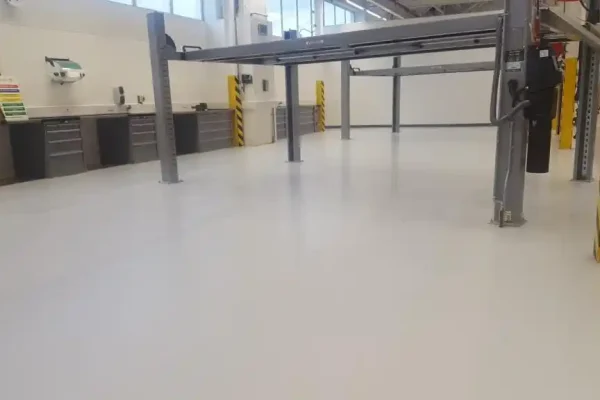
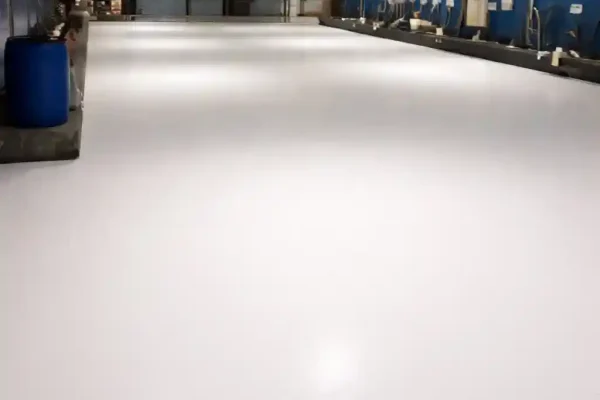
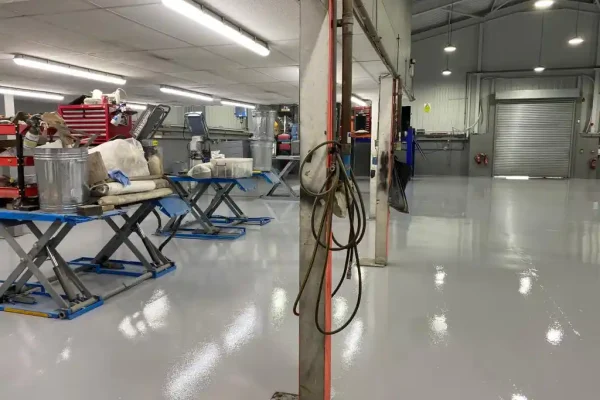
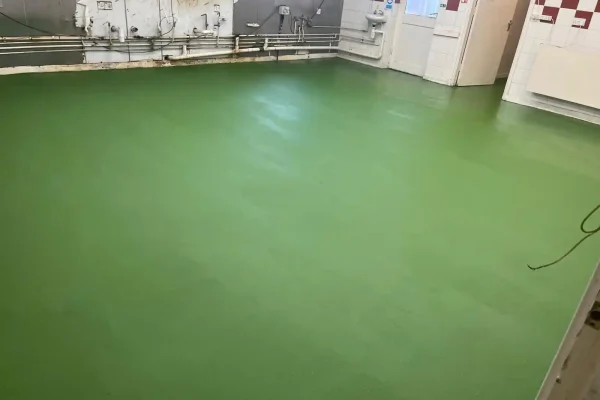
Resin flooring contractors Accrington engineering and fabrication businesses rely on when the concrete has been patched more than once. Supporting owner-managed production units across Altham Business Park, Huncoat, Clayton-le-Moors and the mill belt through Church and Oswaldtwistle.
Working for national manufacturers, logistics operators and public sector estates since 1999.
As resin flooring contractors Accrington businesses call on regularly, we spend the survey establishing what is already there. The town sits in the Hyndburn valley on the M65 at Junctions 6 and 7, and its industrial base is old in fabric and practical in use.
Engineering, fabrication, textiles and coating work operate out of brick mill and weaving-shed stock whose floors have been overlaid, patched and drilled repeatedly. Substrate condition rather than system choice is the leading question in almost every enquiry here.
It also runs on smaller owner-managed units of a few hundred to a couple of thousand square metres, not large campuses. That changes the floor areas involved and it changes how the work has to be phased.
Modern industrial and distribution units on the A678 with heavier vehicle movement.
Established industrial and storage units on former colliery and works land.
Manufacturing, trade and distribution units close to Junction 7 of the M65.
A ribbon of older works, yards and light industrial units through the town.
Weaving-shed and finishing-works stock in mixed engineering and storage use.
Trade counters and merchants with mixed trolley, forklift and customer traffic.
Coolant and cutting-oil resistance with impact tolerance under dropped bar stock.
Large plates with poor original falls, needing levelling before a performance layer.
Chemical and dye staining resistance with contained wet areas and falled detail.
Abrasion resistance on pallet routes with treatment of tightly jointed floors.
Fuel and oil resistance, pit surrounds and grip where wheels carry water in.
Small-area seamless finishes with defined access routes behind trading premises.
Most Accrington floors we survey have been coated before and the coating has come away. Oil contamination and previous layers decide whether anything will bond, so preparation and testing settle the outcome long before a product is chosen.
Cutting oils and coolant soak into mill-era concrete, and no system bonds to a contaminated surface.
BS 8204-6 governs in-situ resin flooring, so mechanical preparation and adhesion testing come first.
Older floors frequently lack an effective damp-proof membrane, so testing is normal rather than exceptional.
In a unit of a few hundred square metres there is no spare bay to work in, so phasing around one production line matters more here than programme management at scale.
Floors are taken sectionally or over a weekend, with rapid-cure options where a machine has to be back on the same floor quickly. Mill buildings also constrain the work through column spacing and roof-light layouts, which affect lighting levels and therefore colour and reflectance choices.
Preparation runs under H-class extraction with areas screened. Grinding a dusting mill floor releases respirable crystalline silica, limited under EH40 to 0.1 mg per cubic metre over eight hours, and in a small unit there is nowhere for it to go.
The EH40 limit of 0.1 mg per cubic metre over eight hours makes sealing a mill floor a control.
BS 8204-6, where oil contamination and previous coatings decide whether anything holds.
BS 7976 pendulum values give machine shops and workshop entrances an evidence base.
ISOPA and ALIPA obligations where polyurethane is proposed in occupied engineering units.
FeRFA classifies resin flooring into eight types by build-up and thickness, and BS 8204-6 governs which one a floor actually needs, with EN 13813 for the screed. Polyaspartic and MMA sit outside that classification because they describe the resin chemistry rather than the build-up. In Accrington the prepared substrate decides the type rather than the other way round.
FeRFA Type 1. Two or more coats up to 150 microns, binding a dusting substrate and giving a cleanable surface. From £8 per square metre.
FeRFA Type 2. Dual component to 300 microns, solvent free, in gloss, matt or silk. Chemical resistance with a decorative finish.
FeRFA Type 3. Up to 1000 microns over prepared concrete and the system specified on most industrial jobs. Takes colour well for demarcation.
FeRFA Type 4. Multi-coat build at 1 to 3mm with aggregate broadcast between coats, for impact and constant wear.
FeRFA Type 5. Flow-applied at 2 to 3mm for a seamless finish where hygiene and cleaning matter more than impact resistance.
FeRFA Type 7. Three part filled system at 4 to 6mm thickness, giving a self-smoothing finish for heavy and very heavy duty areas.
FeRFA Types 7 and 8. Trowel-applied at 6 to 9mm to take thermal shock, steam cleaning and constant heavy forklift traffic.
Cures at temperatures down to −5°C and is ready in around two hours. Installed overnight or at a weekend it can remove the need to shutdown entirely.
Cures in hours, but the odour can taint food, fabrics and stock and the area must be cleared and ventilated. Better suited to new build and refurbishment projects.
Rates run from £8 per square metre for a floor seal to £45 for MMA, inclusive of preparation, labour and materials. On mill-era concrete the preparation and repair are priced separately, because that is the part nobody can quote without looking.
| System | FeRFA | Thickness | Per m² |
|---|---|---|---|
| Floor Seal | Type 1 | Up to 150µm | From £8 |
| Epoxy and PU Coating | Type 2 | 150 – 300µm | £8 – £12 |
| High Build Coating | Type 3 | 300 – 1000µm | £8 – £12 |
| Multi-Layer Flooring | Type 4 | 1 – 3mm | £12 – £16 |
| Self-Smoothing | Type 5 | 2 – 4mm | £20 – £30 |
| Heavy Duty Flowable | Type 7 | 4 – 6mm | £25 – £35 |
| Heavy Duty PU Screed | Type 8 | 6 – 9mm | £30 – £40 |
| Polyaspartic | Chemistry | 300 – 500µm | £38 |
| MMA | Chemistry | 2 – 6mm | £45 |
Inclusive of preparation, labour and materials. Rates assume a sound, accessible substrate and are indicative until the floor has been surveyed. Polyaspartic and MMA sit outside the FeRFA type classification because they describe the resin chemistry rather than the build-up.
A three day shutdown at a plant turning over £2,000 an hour is £120,000 of lost output. On most sites that is several times the price of the floor.
Five contractors quoted one timber processing plant. All five proposed the same system and a three to four day closure. None of them costed the closure.
We proposed a faster-curing system installed across a weekend. A higher rate per square metre, and no shutdown at all. On the client’s own figures the avoided losses exceeded the price of the floor.
We install evenings, weekends and one bay at a time.
Whether a shutdown costs you thousands an hour or simply gets in the way, you do not always have to close your site for a resin flooring installation.
Grinding out oil-soaked concrete and removing previous coatings back to a sound base.
Correcting level and forming falls in weaving sheds that never had them originally.
Damp proof membrane where a substrate fails moisture testing, as a standalone package.
Oil-contaminated concrete decontaminated, tested and overlaid around fixed plant.
Large mill plates levelled and sealed into a serviceable working surface.
Durable finishes with measured grip where water and oil reach the entrance.
We work across Hyndburn regularly, from Altham Business Park and Huncoat through to Clayton Business Park at Junction 7, the Hyndburn Road corridor and the mill stock at Church and Oswaldtwistle. We are Cheshire based, so a survey usually happens within days and there is no mobilisation charge for attending.

Almost certainly preparation. Cutting oils and coolant soak deep into mill-era concrete, and a system applied over contamination or an old coating has nothing sound to bond to. We grind back mechanically and test adhesion before specifying, because that is what decides whether the next one stays down.
In this stock, yes, as a matter of routine rather than exception. Older floors here frequently have no effective damp-proof membrane, and vapour rising through the concrete lifts whatever is bonded to it. Testing before pricing is the difference between a specification and a gamble.
It is the normal condition here. Work is taken sectionally or over a weekend around a single production line, with rapid-cure options where a machine has to be back on that floor quickly. The programme is built around the line rather than the other way round.
It can. Roof-light layouts and column spacing in mill buildings hold lighting levels down, so colour and reflectance become practical decisions rather than cosmetic ones. A lighter finish can materially improve how the working area feels without changing the system performance.
From £8 per square metre for a floor seal up to £45 for MMA, inclusive of preparation, labour and materials. Most work here sits in the lower half, with preparation priced separately once the floor has been surveyed. The full table by system is on the cost page.
Tell us what has soaked into the floor, what failed last time and when the line can stop. We attend, test the substrate, and put a written specification and a fixed price in front of you at no cost.