Resin flooring contractors Macclesfield laboratory, precision manufacturing and industrial facilities rely on for seamless, cleanable floors. Supporting sites across the South Macclesfield Development Area, Lyme Green, Hurdsfield and Riverside Park, and throughout east Cheshire.
Working for national manufacturers, logistics operators and public sector estates since 1999.
As resin flooring contractors Macclesfield operators call on regularly, we work to a standard set by regulatory density rather than tonnage. Life-science, laboratory and precision engineering facilities here treat floor condition as a documented characteristic, not a background asset.
So the failure that matters is not spalling under forklifts. It is delamination and pinholing caused by inadequate preparation or substrate moisture, because a compromised seamless floor in a controlled area is a contamination risk before it is a maintenance one.
The town also carries converted mill and heritage industrial buildings where substrate variability is the defining challenge. Testing comes before specification here, every time.
A major employment zone supporting manufacturing, engineering, distribution and commercial operations across the town.
An established industrial and logistics park with high vehicle movement and sustained warehousing activity throughout.
Light industrial, engineering and trade units, much of it established stock sitting on older and tired concrete.
Industrial and commercial premises with mixed operational demands across a wide range of unit sizes and ages.
Trade, servicing and storage premises linking the town toward Poynton and Stockport and south to Congleton.
Heritage industrial stock here and at Bollington, where substrate variability is the defining challenge.
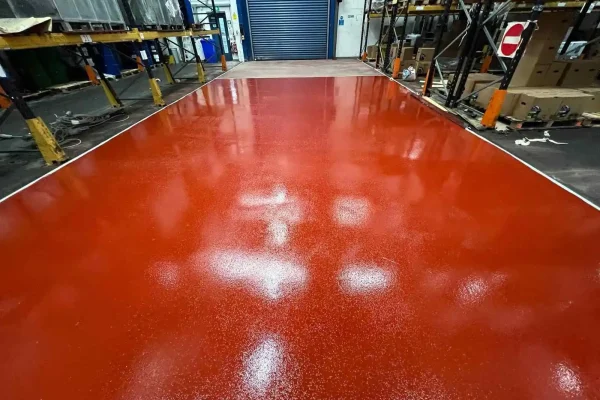
Seamless self-smoothing systems with coved junctions and documented disinfectant resistance.
Particle-free, easily decontaminated surfaces for cleanroom-adjacent corridors and change areas.
Non-dusting, dimensionally stable floors protecting tolerance-critical processes from contamination.
Controlled electrical resistance for static-sensitive assembly, instrumentation and test work.
Abrasion resistance and demarcation at Lyme Green and the South Macclesfield Development Area.
Substrate assessment, moisture control and repair before any system is chosen or is priced.
In a controlled area a lifting or pinholed floor is not a maintenance issue, it is a contamination route. Almost every case traces back to preparation or substrate moisture rather than to the resin that was specified.
Hygrometer readings taken inside the concrete rather than at the surface. Standard epoxies tolerate roughly 75 to 80 per cent RH.
Grinding or blasting back to sound concrete under extraction, because a seamless system is only as sound as what it bonds into.
Moisture-tolerant primers where the readings demand them, with those readings recorded so the specification is evidenced.
Most Macclesfield work happens with regulated production continuing next door, which changes how the job is controlled rather than what is installed. Vapour, dust and access are managed as part of the method statement, not dealt with when someone complains.
ISOPA and ALIPA diisocyanate training records matter directly where polyurethane systems are used, and every operative handling them holds current REACH certification. COSHH assessment and vapour control are issued before mobilisation.
Work is then phased room by room or into planned shutdowns, with rapid-cure systems where a controlled area has to be handed back and returned to service quickly.
Testing, mechanical preparation and priming determine survival, particularly in converted mill buildings.
Where static-sensitive assembly or test work is present, ESD performance is tested rather than claimed.
Sealed, non-porous, seamless finishes with coved skirtings and sealed penetrations in controlled areas.
BS 7976 pendulum values for production and washdown, with HSE L24 separating people from plant.
FeRFA classifies resin flooring into eight types by build-up and thickness, and BS 8204-6 governs which one a floor actually needs. Polyaspartic and MMA sit outside that classification because they describe the resin chemistry rather than the build-up. In Macclesfield the seamless types usually lead, because cleanability decides the specification before strength does.
FeRFA Type 1. Two or more coats up to 150 microns, binding a dusting substrate and giving a cleanable surface. From £8 per square metre.
FeRFA Type 2. Dual component to 300 microns, solvent free, in gloss, matt or silk. Chemical resistance with a decorative finish.
FeRFA Type 3. Up to 1000 microns over prepared concrete and the system specified on most industrial jobs. Takes colour well for demarcation.
FeRFA Type 4. Multi-coat build at 1 to 3mm with aggregate broadcast between coats, for impact and constant wear.
FeRFA Type 5. Flow-applied at 2 to 3mm for a seamless finish where hygiene and cleaning matter more than impact resistance.
FeRFA Type 7. Three part filled system at 4 to 6mm thickness, giving a self-smoothing finish for heavy and very heavy duty areas.
FeRFA Types 7 and 8. Trowel-applied at 6 to 9mm to take thermal shock, steam cleaning and constant heavy forklift traffic.
Cures at temperatures down to −5°C and is ready in around two hours. Installed overnight or at a weekend it can remove the need to shutdown entirely.
Cures in hours, but the odour can taint food, fabrics and stock and the area must be cleared and ventilated. Better suited to new build and refurbishment projects.
Rates run from £8 per square metre for a floor seal to £45 for MMA, inclusive of preparation, labour and materials. Controlled-area work sits at the upper end because the detailing and the testing are where the value is.
| System | FeRFA | Thickness | Per m² |
|---|---|---|---|
| Floor Seal | Type 1 | Up to 150µm | From £8 |
| Epoxy and PU Coating | Type 2 | 150 – 300µm | £8 – £12 |
| High Build Coating | Type 3 | 300 – 1000µm | £8 – £12 |
| Multi-Layer Flooring | Type 4 | 1 – 3mm | £12 – £16 |
| Self-Smoothing | Type 5 | 2 – 4mm | £20 – £30 |
| Heavy Duty Flowable | Type 7 | 4 – 6mm | £25 – £35 |
| Heavy Duty PU Screed | Type 8 | 6 – 9mm | £30 – £40 |
| Polyaspartic | Chemistry | 300 – 500µm | £38 |
| MMA | Chemistry | 2 – 6mm | £45 |
Inclusive of preparation, labour and materials. Rates assume a sound, accessible substrate and are indicative until the floor has been surveyed. Polyaspartic and MMA sit outside the FeRFA type classification because they describe the resin chemistry rather than the build-up.
A three day shutdown at a plant turning over £2,000 an hour is £120,000 of lost output. On most sites that is several times the price of the floor.
Five contractors quoted one timber processing plant. All five proposed the same system and a three to four day closure. None of them costed the closure.
We proposed a faster-curing system installed across a weekend. A higher rate per square metre, and no shutdown at all. On the client’s own figures the avoided losses exceeded the price of the floor.
We install evenings, weekends and one bay at a time.
Whether a shutdown costs you thousands an hour or simply gets in the way, you do not always have to close your site for a resin flooring installation.
Crack filling, patch repair and joint sealing on the older Hurdsfield and Riverside Park units and Bollington Mills.
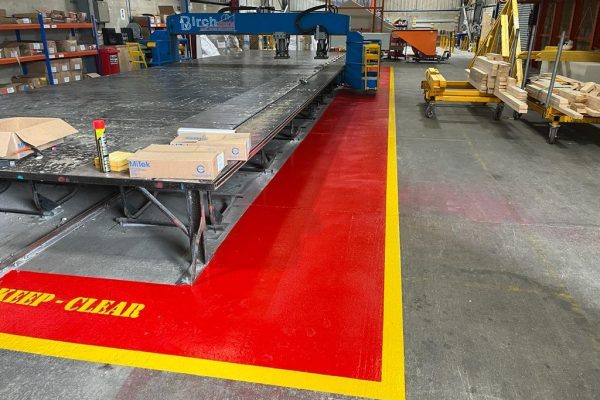
Traffic routes, walkways and process zone separation applied in resin rather than in tape.
Damp proof membrane where a substrate fails moisture testing, supplied as a standalone package.
Seamless finishes with coved junctions, handed back cleanable and reagent resistant for audit.
Non-dusting floors phased around live production so tolerance-critical work continues throughout.
Variable heritage substrates assessed, repaired and overlaid rather than broken out and replaced.
Macclesfield is where we are based, and it is the origin point for our east Cheshire coverage. That means a survey usually happens within days across the town, and out to Wilmslow, Congleton, Alderley Edge, Bollington and Poynton, with no mobilisation charge for attending.
Almost always preparation or moisture rather than the resin. If the surface was not ground back to sound concrete, the coating bonded to laitance that was never properly attached. If the substrate was above roughly 75 to 80 per cent relative humidity, vapour pushed the coating off from beneath. Both are avoidable and both are testable.
Yes, and it is most of what we do here. Vapour, dust and access controls are set out in the method statement before mobilisation, work is phased room by room, and rapid-cure systems are used where a controlled area has to be returned to service quickly.
We install seamless self-smoothing systems with coved junctions and sealed penetrations, which is what a cleanable specification actually requires. We record moisture readings, products used and preparation method so the floor is evidenced in your documentation rather than described.
It is a reason to test rather than a reason to avoid. Heritage substrates vary enormously across a single floor, so we assess soundness, moisture and any existing coatings before specifying, and price the repair work separately rather than discovering it mid-installation.
From £8 per square metre for a floor seal up to £45 for MMA, inclusive of preparation, labour and materials. Controlled and laboratory areas sit at the upper end. The full table by system is on the cost page.
Tell us what happens in the area, what it is cleaned with and when it can be released. We attend, test the substrate, and put a written specification and a fixed price in front of you at no cost.