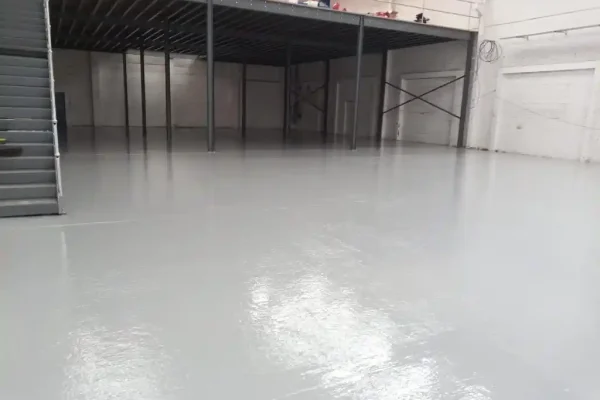
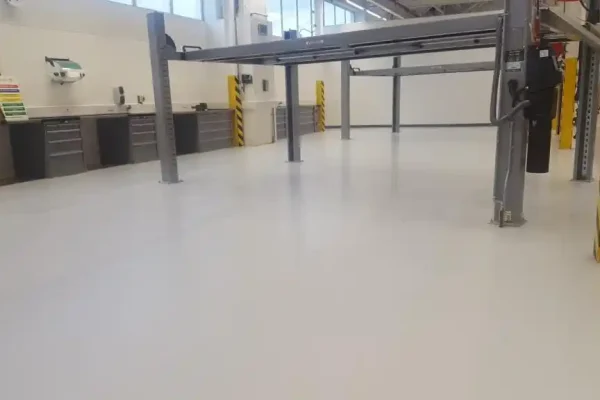
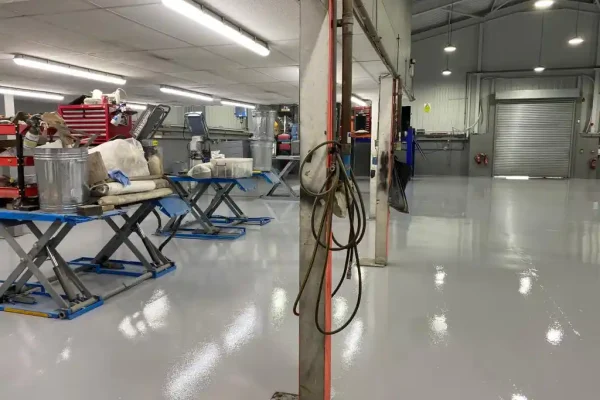
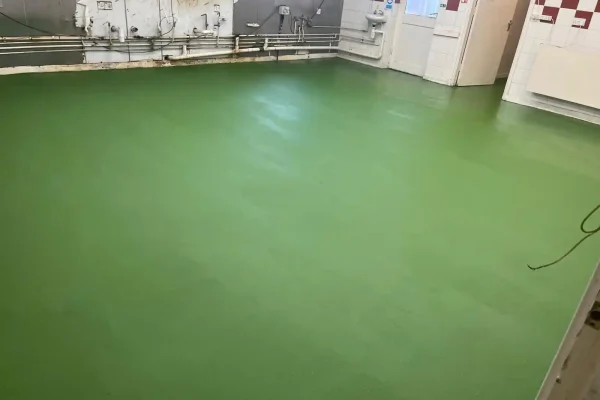
Resin flooring contractors Blackpool catering, hospitality and facilities teams rely on for floors that stay safe under grease and water. Supporting kitchens, cellars, cold stores and service areas behind the Promenade, and industrial units at Squires Gate and Whitehills.
Working for national manufacturers, logistics operators and public sector estates since 1999.
As resin flooring contractors Blackpool operators call on regularly, we answer questions about grease and access rather than about tonnage. Behind the Promenade the town runs a substantial operational economy of central kitchens, catering support, cold and dry stores, plant rooms and service corridors working long hours for much of the year.
Those floors fail for reasons the inland towns rarely see. Kitchens combine grease, water and constant foot traffic in confined spaces, entrances take wind-driven rain and sand off the coast, and venues trading every evening cannot release a floor for a week.
Industry sits alongside it at Squires Gate and Whitehills, reached by the M55 from Junction 32 of the M6. But for flooring purposes this is a back-of-house town first and an industrial one second.
Industrial and trade units near the airport, exposed to heavy wear and vehicle traffic.
Mixed commercial and industrial units with storage and distribution close to the M55.
Manufacturing and engineering operations with controlled-environment requirements.
Business, storage and light industrial units on the southern edge of the town.
Hotel and catering kitchens, cellars and wash-up areas with restricted access.
Goods-in, service corridors and plant areas behind the retail frontages.
Grease and water together, with coved skirtings and correct falls to gullies.
Continuous water, detergent and hot discharge with standing water to manage.
Sugar solutions, spillage and hosing with drainage that stops water ponding.
Threshold condensation, ice at door lines and abrasion from cage movement.
Oil and water resistance in small areas with seamless coved detailing.
Fuel and oil resistance with clearly demarcated pedestrian routes throughout.
A finish chosen for water alone will not hold in a commercial kitchen. Grease changes the contamination entirely, and the pendulum value that matters is the one measured against what is actually on the floor rather than a general wet reading.
BS 7976 pendulum testing gives evidence, and a kitchen is specified for grease and water together.
Pot-wash and steam cleaning make epoxy craze and debond, so polyurethane leads in those areas.
EN 13501-1 with the fl suffix matters where back-of-house sits on a protected escape route.
A venue trading every evening cannot release a floor for a week, so installation timing is part of the specification rather than a scheduling detail. The programme is built from the trading calendar backwards.
Kitchens go in overnight between services, back-of-house areas zone by zone, and larger areas into the closed season where one exists. Rapid-cure systems make a service-to-service window realistic, and we set out cure behaviour rather than promising a completion time a live venue cannot afford to have slip.
Where polyurethane systems are specified, and in wash-up and washdown areas they usually are, ISOPA and ALIPA diisocyanate training records apply and every operative holds current REACH certification.
BS 7976 pendulum testing against the actual contaminant rather than a generic anti-slip claim.
Seamless coved finishes with falls, resisting the caustic and acidic products catering uses.
EN 13501-1 with the fl suffix where finishes sit on protected routes in venues and hotels.
Equality Act contrast where back-of-house routes meet public areas, ramps and level changes.
FeRFA classifies resin flooring into eight types by build-up and thickness, and BS 8204-6 governs which one a floor actually needs, with EN 13813 for the screed. Polyaspartic and MMA sit outside that classification because they describe the resin chemistry rather than the build-up, and in Blackpool they are frequently chosen for the length of the closure window.
FeRFA Type 1. Two or more coats up to 150 microns, binding a dusting substrate and giving a cleanable surface. From £8 per square metre.
FeRFA Type 2. Dual component to 300 microns, solvent free, in gloss, matt or silk. Chemical resistance with a decorative finish.
FeRFA Type 3. Up to 1000 microns over prepared concrete and the system specified on most industrial jobs. Takes colour well for demarcation.
FeRFA Type 4. Multi-coat build at 1 to 3mm with aggregate broadcast between coats, for impact and constant wear.
FeRFA Type 5. Flow-applied at 2 to 3mm for a seamless finish where hygiene and cleaning matter more than impact resistance.
FeRFA Type 7. Three part filled system at 4 to 6mm thickness, giving a self-smoothing finish for heavy and very heavy duty areas.
FeRFA Types 7 and 8. Trowel-applied at 6 to 9mm to take thermal shock, steam cleaning and constant heavy forklift traffic.
Cures at temperatures down to −5°C and is ready in around two hours. Installed overnight or at a weekend it can remove the need to shutdown entirely.
Cures in hours, but the odour can taint food, fabrics and stock and the area must be cleared and ventilated. Better suited to new build and refurbishment projects.
Rates run from £8 per square metre for a floor seal to £45 for MMA, inclusive of preparation, labour and materials. Where a kitchen can only close overnight, the faster system is usually the cheaper project once lost service is counted.
| System | FeRFA | Thickness | Per m² |
|---|---|---|---|
| Floor Seal | Type 1 | Up to 150µm | From £8 |
| Epoxy and PU Coating | Type 2 | 150 – 300µm | £8 – £12 |
| High Build Coating | Type 3 | 300 – 1000µm | £8 – £12 |
| Multi-Layer Flooring | Type 4 | 1 – 3mm | £12 – £16 |
| Self-Smoothing | Type 5 | 2 – 4mm | £20 – £30 |
| Heavy Duty Flowable | Type 7 | 4 – 6mm | £25 – £35 |
| Heavy Duty PU Screed | Type 8 | 6 – 9mm | £30 – £40 |
| Polyaspartic | Chemistry | 300 – 500µm | £38 |
| MMA | Chemistry | 2 – 6mm | £45 |
Inclusive of preparation, labour and materials. Rates assume a sound, accessible substrate and are indicative until the floor has been surveyed. Polyaspartic and MMA sit outside the FeRFA type classification because they describe the resin chemistry rather than the build-up.
A three day shutdown at a plant turning over £2,000 an hour is £120,000 of lost output. On most sites that is several times the price of the floor.
Five contractors quoted one timber processing plant. All five proposed the same system and a three to four day closure. None of them costed the closure.
We proposed a faster-curing system installed across a weekend. A higher rate per square metre, and no shutdown at all. On the client’s own figures the avoided losses exceeded the price of the floor.
We install evenings, weekends and one bay at a time.
Whether a shutdown costs you thousands an hour or simply gets in the way, you do not always have to close your site for a resin flooring installation.
Forming coved skirtings and falls to gullies so kitchens and wash-up areas drain properly.
Service routes, cage lanes and pedestrian separation applied in resin rather than tape.
Damp proof membrane where a substrate fails moisture testing, as a standalone package.
Polyurethane systems with coving and falls, installed overnight between services.
Cleanable finishes with drainage detail that stops water standing under stillage.
Durable floors with fuel resistance and demarcation at Squires Gate and Whitehills.
We work across the Fylde coast regularly, from Squires Gate and Whitehills Business Park through to Blackpool Technology Park, Amy Johnson Way and the back-of-house areas behind the Promenade and town centre. We are Cheshire based, so a survey usually happens within days and there is no mobilisation charge for attending.
Because it was almost certainly specified for water rather than grease. The two behave very differently, and a finish tested wet but not against grease will not perform in a working kitchen. BS 7976 pendulum values measured against the actual contaminant are what should anchor the specification.
Thermal shock. Hot discharge and steam cleaning cycle the floor repeatedly, and an epoxy coating crazes and debonds under that movement. Polyurethane systems are formulated to absorb the cycling, which is why they lead in wash-up and washdown areas.
Overnight, between services, or in the closed season where you have one. Rapid-cure systems make a service-to-service window realistic, and the programme is built from your trading calendar backwards. We give cure behaviour rather than a promised completion time, because a slipped handback in season is expensive.

It does, and it is specific to the coast. Wind-driven rain and sand at goods-in and entrance doors create a grinding, slippery threshold that wears differently from the rest of the floor, so that zone is specified separately rather than carrying the same finish throughout.
From £8 per square metre for a floor seal up to £45 for MMA, inclusive of preparation, labour and materials. Kitchen and wash-up screeds sit at the upper end, and rapid-cure systems carry a premium that overnight working usually justifies. The full table by system is on the cost page.
Tell us what reaches the floor, how it is cleaned down and when the area can close. We attend, test the substrate, and put a written specification and a fixed price in front of you at no cost.