
Concrete floor grinding, shot blasting and moisture testing across the North West, Yorkshire, the Midlands and North East Wales. Carried out under dust extraction as the first stage of a resin installation, or supplied as a standalone preparation package for another trade to finish.
The top layer of a power-floated concrete substrate is laitance: a weak, closed skin of fines and cement paste. Resin bonded to laitance is bonded to something that is already only loosely attached to the concrete underneath it, and it will come away carrying that skin with it.
Concrete floor grinding removes it. It opens the surface, gives the resin a mechanical key, and takes off curing compounds, old coatings, adhesive residue and whatever twenty years of production has soaked into the top few millimetres.
Around 95 per cent of resin floor failures trace back to preparation or specification rather than to the material. Preparation is not the line to compare on price, because it is the line that decides whether anything above it survives.
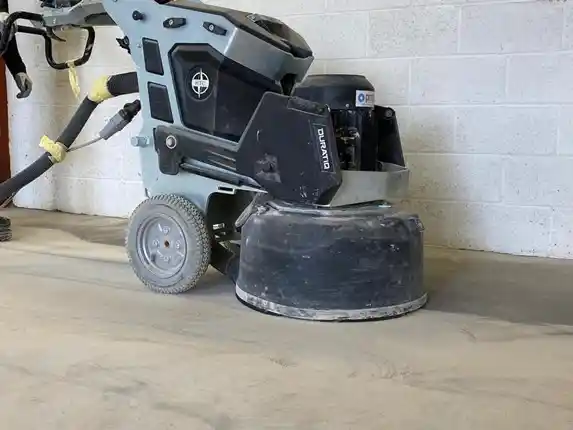

The default for most floors. Removes laitance and coatings, flattens minor undulation and leaves a controlled profile. Works right up to walls and around plant.
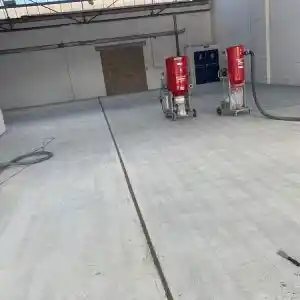
Faster over large open areas and leaves a deeper key for thicker build-ups. Captive blasting recovers the shot and the dust in one pass.
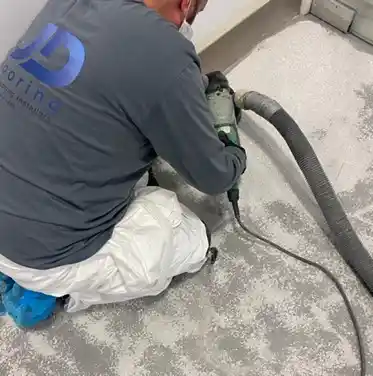
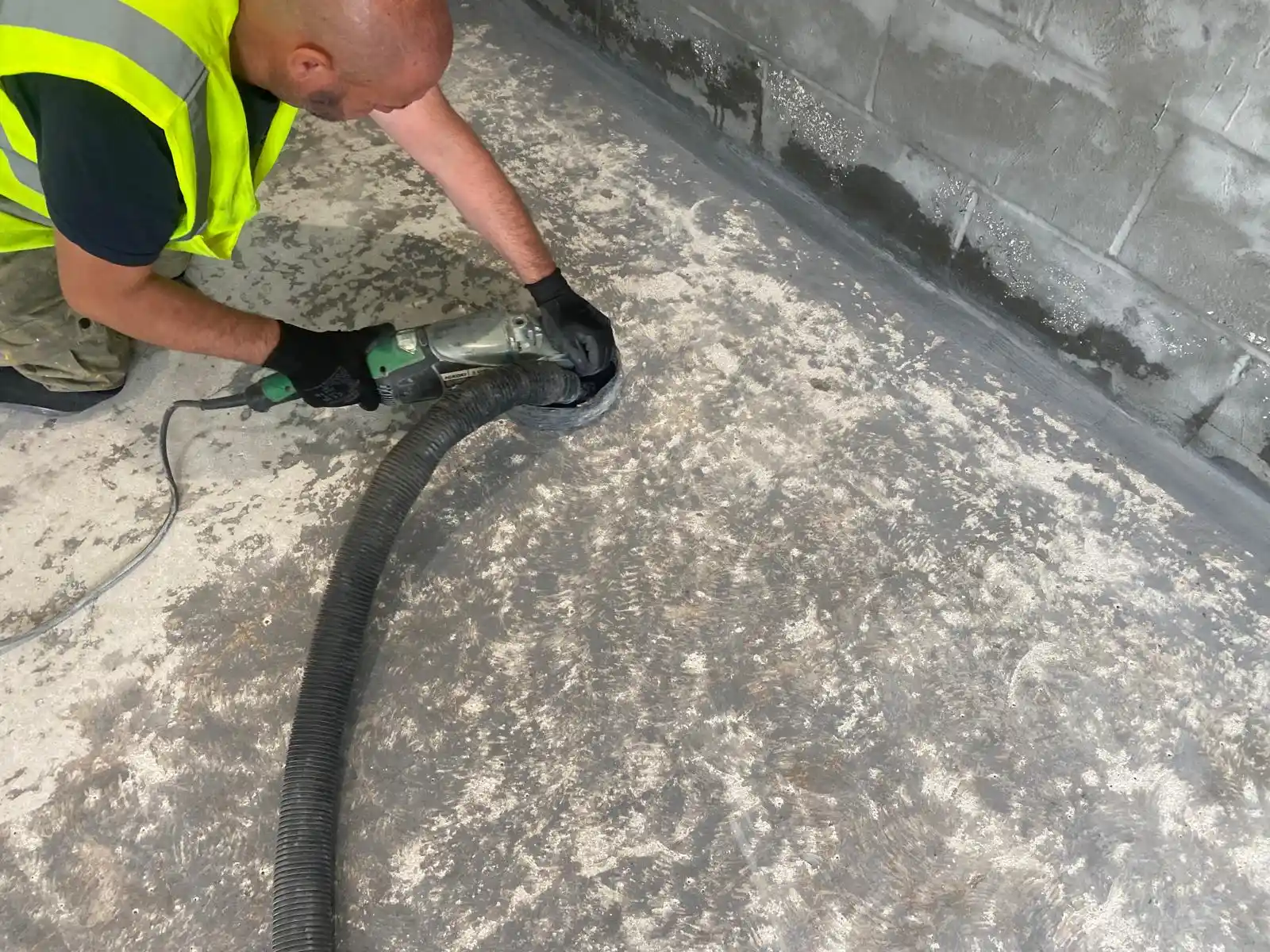
Handheld grinders take the perimeter, plinths, thresholds and anywhere a ride-on machine cannot reach. Slow, and the part cheap quotes leave out.
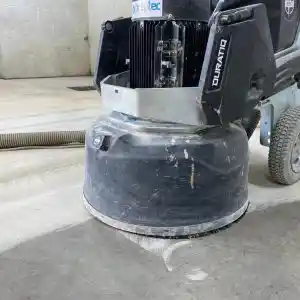
For heavily contaminated or badly damaged substrates where material has to come off in depth rather than be abraded from the surface.
Grinding concrete releases respirable crystalline silica. The workplace exposure limit is 0.1 mg per cubic metre as an eight-hour time-weighted average, and controlling it is a COSHH duty, not a courtesy to whoever works next door.
Every machine runs coupled to an H-class vacuum, so the dust is captured as it is made rather than swept up afterwards.
Screens and negative pressure where the space is shared, so stock, equipment and machinery are not coated by the time we finish.
COSHH assessment and method statement issued before we arrive, which is what your own health and safety file needs anyway.
Relative humidity measured inside the substrate, not at the surface. Standard epoxies tolerate roughly 75 to 80 per cent RH; above that the floor needs a liquid DPM before anything else goes down.
Cracks cut out and filled, spalled areas rebuilt, and movement joints treated as joints rather than filled rigid so they do not simply reopen through the new floor.
Laitance is the weak layer of fines and cement paste left on the surface of a power-floated substrate. It looks like sound concrete but it is only loosely attached to what is underneath. Bond resin to it and the coating eventually lifts, bringing the laitance with it. Grinding removes it.
Grinding is the default: it works up to walls, around plant, removes coatings and flattens minor undulation. Shot blasting is quicker across large open areas and leaves a deeper key for thicker build-ups. On most jobs we use both, blasting the open floor and grinding the perimeter and details.
Far less than people expect when it is done properly. Machines run coupled to H-class vacuum extraction so dust is captured at source, and shared spaces are screened. Grinding concrete releases respirable crystalline silica with a workplace exposure limit of 0.1 mg per cubic metre, so controlling it is a COSHH requirement rather than a preference.
Yes. We supply preparation as a standalone package, including moisture readings and a record of what was done, and hand the deck over for your own contractor to finish. Main contractors on fit-out programmes buy it this way regularly.
Yes, and it is worth doing properly. Preparing around racking, stock and plant is slower, gives a poorer result at the edges and costs more than moving things does. We agree the extent of clearance at survey rather than after the invoice.
It depends on area, what is already on the floor and how much of it is edge work. Removing a failed coating takes considerably longer than opening a clean slab. We give an indicative programme at survey once we know what is actually down.
Tell us the area, what is currently on the floor and what is going down afterwards. We survey, test the substrate and quote the preparation as its own line rather than burying it.